
Nisan 2, 5785; from sunset March 30, 2025, to sunset March 31, 2025
(The second day of the first month)
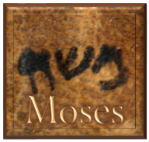
This is the name “Mosheh” (מֺשֶׁה – Moses) as seen in the Dead Sea Scrolls, written over two thousand years ago.
Nisan 2 is the traditional date for when Moses first prepared the ashes of the red heifer. This coincides with tomorrow being the traditional date for the cleansing of the Levites. In order for them to be cleansed, the ashes of the red heifer had to have been prepared beforehand. According to tradition, the red heifer sacrifice was to atone for the sin of the golden calf – though the Torah itself does not make this distinction. Drawing upon the thought of preparation, the sages instituted the Sabbath of the Red Heifer. The focus of this Sabbath is to study Numbers chapter 19 – the instructions revolving around the ashes of the red heifer. This special Sabbath occurs annually on the Sabbath after Purim. The intention is to bring to our minds that Passover is coming soon and we must start preparing. When the Temple was still standing, the need for purification before attending the Passover festivities in Jerusalem was paramount. Purification involved more than just a mikveh (a ritual immersion). In the reading below, we see that it was a week-long affair.
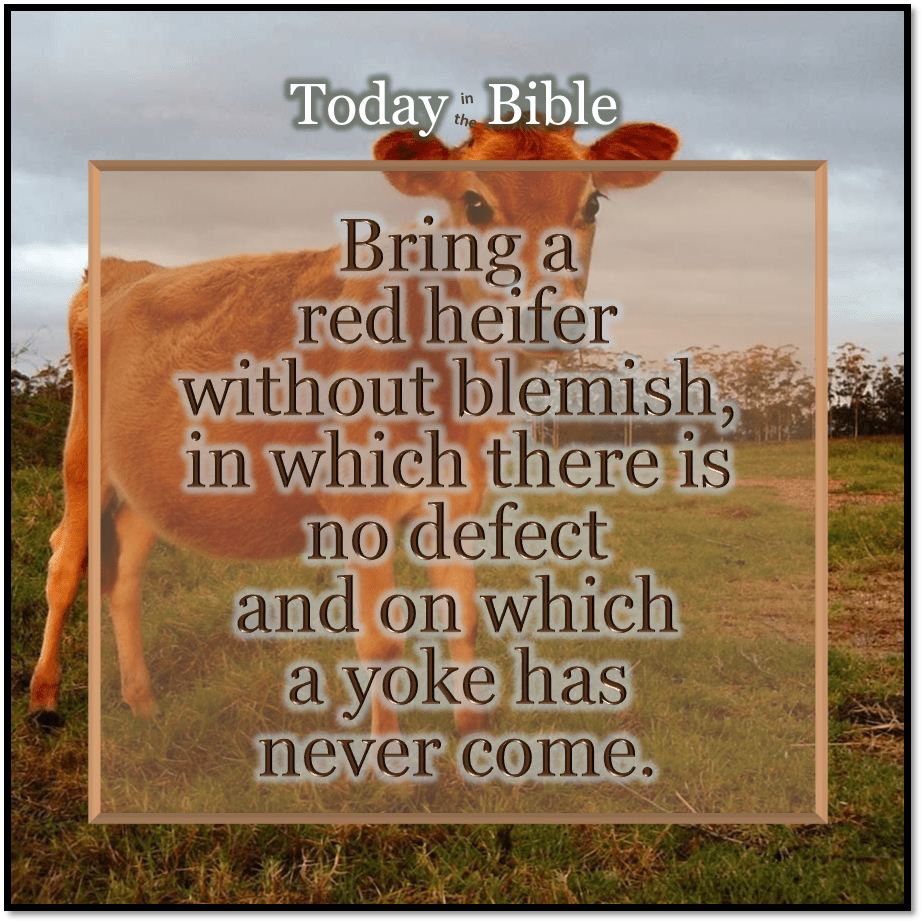
Now the LORD spoke to Moses and Aaron, saying, “This is the ordinance of the law which the LORD has commanded, saying: `Speak to the children of Israel, that they bring you a red heifer without blemish, in which there is no defect and on which a yoke has never come. You shall give it to Eleazar the priest, that he may take it outside the camp, and it shall be slaughtered before him; and Eleazar the priest shall take some of its blood with his finger, and sprinkle some of its blood seven times directly in front of the tabernacle of meeting. ˊ
`Then the heifer shall be burned in his sight: its hide, its flesh, its blood, and its dung shall be burned. And the priest shall take cedar wood and hyssop and scarlet, and cast them into the midst of the fire burning the heifer. Then the priest shall wash his clothes, he shall bathe in water, and afterward he shall come into the camp; the priest shall be unclean until evening. And the one who burns it shall wash his clothes in water, bathe in water, and shall be unclean until evening. ˊ
`Then a man who is clean shall gather up the ashes of the heifer, and store them outside the camp in a clean place; and they shall be kept for the congregation of the children of Israel for the water of purification; it is for purifying from sin. And the one who gathers the ashes of the heifer shall wash his clothes, and be unclean until evening. It shall be a statute forever to the children of Israel and to the stranger who dwells among them. ˊ
`He who touches the dead body of anyone shall be unclean seven days. He shall purify himself with the water on the third day and on the seventh day; then he will be clean. But if he does not purify himself on the third day and on the seventh day, he will not be clean. Whoever touches the body of anyone who has died, and does not purify himself, defiles the tabernacle of the LORD. That person shall be cut off from Israel. He shall be unclean, because the water of purification was not sprinkled on him; his uncleanness is still on him. ˊ
`This is the law when a man dies in a tent: All who come into the tent and all who are in the tent shall be unclean seven days; and every open vessel, which has no cover fastened on it, is unclean. Whoever in the open field touches one who is slain by a sword or who has died, or a bone of a man, or a grave, shall be unclean seven days. ˊ
`And for an unclean person they shall take some of the ashes of the heifer burnt for purification from sin, and running water shall be put on them in a vessel. A clean person shall take hyssop and dip it in the water, sprinkle it on the tent, on all the vessels, on the persons who were there, or on the one who touched a bone, the slain, the dead, or a grave. The clean person shall sprinkle the unclean on the third day and on the seventh day; and on the seventh day he shall purify himself, wash his clothes, and bathe in water; and at evening he shall be clean. But the man who is unclean and does not purify himself, that person shall be cut off from among the assembly, because he has defiled the sanctuary of the LORD. The water of purification has not been sprinkled on him; he is unclean. ˊ`It shall be a perpetual statute for them. He who sprinkles the water of purification shall wash his clothes; and he who touches the water of purification shall be unclean until evening. Whatever the unclean person touches shall be unclean; and the person who touches it shall be unclean until evening.’” – Numbers 19:1-22
The book of John tells us that many people came to Jerusalem early for Passover, so that they were able to purify themselves in the prescribed manner.
And the Passover of the Jews was near, and many went from the country up to Jerusalem before the Passover, to purify themselves. – John 11:55 (NKJ)
We know this was occurring earlier than the Passover week itself because, in subsequent verses, Jesus came to Bethany to dine with Mary, Martha, and Lazarus – “six days before the Passover” (John 12:1). The people were getting ready ahead of time. The sages also connected Ezekiel’s prophecy, recorded in chapter 36, with the red heifer ordinance. The following verses are read every year on the Sabbath of the Red Heifer.
Moreover the word of the LORD came to me, saying: “Son of man, when the house of Israel dwelt in their own land, they defiled it by their own ways and deeds; to Me their way was like the uncleanness of a woman in her customary impurity. Therefore I poured out My fury on them for the blood they had shed on the land, and for their idols with which they had defiled it.
“So I scattered them among the nations, and they were dispersed throughout the countries; I judged them according to their ways and their deeds. When they came to the nations, wherever they went, they profaned My holy name– when they said of them, `These are the people of the LORD, and yet they have gone out of His land.’
“But I had concern for My holy name, which the house of Israel had profaned among the nations wherever they went. Therefore say to the house of Israel, `Thus says the Lord GOD: “I do not do this for your sake, O house of Israel, but for My holy name’s sake, which you have profaned among the nations wherever you went. And I will sanctify My great name, which has been profaned among the nations, which you have profaned in their midst; and the nations shall know that I am the LORD,” says the Lord GOD, “when I am hallowed in you before their eyes.
“For I will take you from among the nations, gather you out of all countries, and bring you into your own land. Then I will sprinkle clean water on you, and you shall be clean; I will cleanse you from all your filthiness and from all your idols. I will give you a new heart and put a new spirit within you; I will take the heart of stone out of your flesh and give you a heart of flesh. I will put My Spirit within you and cause you to walk in My statutes, and you will keep My judgments and do them. Then you shall dwell in the land that I gave to your fathers; you shall be My people, and I will be your God.
“I will deliver you from all your uncleannesses. I will call for the grain and multiply it, and bring no famine upon you. And I will multiply the fruit of your trees and the increase of your fields, so that you need never again bear the reproach of famine among the nations. Then you will remember your evil ways and your deeds that were not good; and you will loathe yourselves in your own sight, for your iniquities and your abominations. Not for your sake do I do this,” says the Lord GOD, “let it be known to you. Be ashamed and confounded for your own ways, O house of Israel!”
`Thus says the Lord GOD: “On the day that I cleanse you from all your iniquities, I will also enable you to dwell in the cities, and the ruins shall be rebuilt. The desolate land shall be tilled instead of lying desolate in the sight of all who pass by. So they will say, `This land that was desolate has become like the garden of Eden; and the wasted, desolate, and ruined cities are now fortified and inhabited.’
“Then the nations which are left all around you shall know that I, the LORD, have rebuilt the ruined places and planted what was desolate. I, the LORD, have spoken it, and I will do it.”`Thus says the Lord GOD: “I will also let the house of Israel inquire of Me to do this for them: I will increase their men like a flock. Like a flock offered as holy sacrifices, like the flock at Jerusalem on its feast days, so shall the ruined cities be filled with flocks of men. Then they shall know that I am the LORD.”‘” – Ezekiel 36:16-38 (NKJ)
According to Jewish tradition, only nine red heifers were actually slaughtered in the period extending from Moses to the destruction of the Second Temple. Mishnah Parah recounts them, stating that Moses prepared the first, Ezra the second, Simon the Just and Yochanan the High Priest prepared two each, and Elioenai ben HaQayaph, Hanameel the Egyptian, and Yishmael ben Pi’avi prepared one each (Mishna Parah 3:5).
So why haven’t there been more red heifers sacrificed since the destruction of the Second Temple? Exactly that. The temple is not standing. There is no need to be ritually purified to enter it and to offer sacrifices. When there is a temple again – then the ashes of the red heifer become important once more.
When Maimonides (Moses ben Maimon, aka Rambam, 1138-1204 CE) reiterated the Mishna’s account of the nine red heifers (mentioned above), he then went on to say: “… and the tenth red heifer will be accomplished by the king, the Messiah; may he be revealed speedily, Amen, May it be G-d’s will.” He was recounting an ancient tradition – that the tenth red heifer is associated with the Messianic era.
Going back to Numbers 19 we see that the heifer has to be free from blemish. This has been interpreted as, “not one black hair.” Since the return of the nation of Israel excitement has been growing around the rebuilding of the temple. People have been searching for a perfect red heifer. There are even some who are trying to breed it themselves. If one is found, does this perhaps mean that it is a forerunner of the appearance of the Messiah Himself, who will officiate at its preparation?
If there has been no red heifer for the past 2,000 years, perhaps it is because the time was not right. Those trying to breed a perfect red heifer may have good intentions, but we cannot force the hand of God. In story after story, mankind has tried to put God on their own timeline; but He is not obligated to meet our expectations. It’s His timing. It’s His way. Will there be a physical temple built? Or are we talking about a spiritual temple instead? Perhaps it’s a true unification of the two? The book of Hebrews makes the final connection to the ultimate fulfillment of the red heifer and our Messiah, Yeshua. He was free from all defects. He was sacrificed “outside of the camp.” And He made us pure.
For if the blood of bulls and goats and the ashes of a heifer, sprinkling the unclean, sanctifies for the purifying of the flesh, how much more shall the blood of Christ, who through the eternal Spirit offered Himself without spot to God, cleanse your conscience from dead works to serve the living God? – Hebrews 9:13-14 (NKJ)
Did you know that our posts are categorized and tagged by content?
When you visit our home page at https://todayinthebible.com and select any post,
you can find the associated categories and tags just to the right of the title.
Simply click on any tag and you will be taken to all related posts.

© 2026 Today in the Bible

 Today in the Bible
You must be logged in to post a comment.