
Nisan 8, 5785; from sunset April 5, 2025, to sunset April 6, 2025
(The eighth day of the first month)
This is the name “Ezra” (עֶזְרָא) the Scribe as seen in the Dead Sea Scrolls; written by a scribe over two thousand years ago.
On the first day of this month, the Bible tells us that Ezra began his journey from Babylon to Jerusalem. He had sent out word of the return among the people and those who were willing to journey with him met by the river that flows to Ahava. From the book of 1 Esdras (an ancient Greek version of Ezra), we learn that this river is called Theras.
We don’t have a date for when they gathered – but we do have a date for when they departed. The text says that they spent three days there – by doing the math, we can place the following events as occurring today. Those three days were busy ones. They got organized by taking headcounts, divvying out the silver and gold vessels for the Temple, and fasting and praying for a safe journey. It was a good thing that Ezra took stock before leaving because, surprisingly, he could find no Levites in the group. He gathered the leaders and men of understanding together and they sent a command to Iddo, one of the Nethinim, to bring them servants for the Temple.
The word “Nethinim” comes from the Hebrew verb “natan” meaning “to give.” Nethinim is plural and means “Given Ones.” The Nethinim are believed to have originated in the inhabitants of Gibeon with whom Israel made a covenant, way back in the time of Joshua. These are the people who tricked the Israelites into believing they were wanderers and not residents of the Land – for God had warned Israel not to make a covenant with any peoples of the Land. When Israel found out they had been tricked, they spared the lives of the Gibeonites since they had sworn before God to let them live. They were put to work as woodcutters and water carriers for the House of the LORD (Joshua 9). Another train of thought regarding the Nethinim is that they became synonymous with men who wanted to serve in the Temple but were unable to provide a lineage proving they were descendants of Aaron or Levi.
Earlier today we learned that Jewish tradition states that King Ahasuerus ended his 180-day long banquet on this very day. The tradition holds that, during the banquet, he showed off the gold and silver vessels that had been confiscated by Nebuchadnezzar from the Temple in Jerusalem. Today in the Bible, under the reign of King Artaxerxes, is the day that those vessels are beginning their journey back to their rightful owner.
These are the heads of their fathers’ houses, and this is the genealogy of those who went up with me from Babylon, in the reign of King Artaxerxes:
of the sons of Phinehas, Gershom;
of the sons of Ithamar, Daniel;
of the sons of David, Hattush;
of the sons of Shecaniah,
of the sons of Parosh, Zechariah; and registered with him were one hundred and fifty males;
of the sons of Pahath-Moab, Eliehoenai the son of Zerahiah, and with him two hundred males;
of the sons of Shechaniah, Ben-Jahaziel, and with him three hundred males;
of the sons of Adin, Ebed the son of Jonathan, and with him fifty males;
of the sons of Elam, Jeshaiah the son of Athaliah, and with him seventy males;
of the sons of Shephatiah, Zebadiah the son of Michael, and with him eighty males;
of the sons of Joab, Obadiah the son of Jehiel, and with him two hundred and eighteen males;
of the sons of Shelomith, Ben-Josiphiah, and with him one hundred and sixty males;
of the sons of Bebai, Zechariah the son of Bebai, and with him twenty-eight males;
of the sons of Azgad, Johanan the son of Hakkatan, and with him one hundred and ten males;
of the last sons of Adonikam, whose names are these– Eliphelet, Jeiel, and Shemaiah— and with them sixty males;
also of the sons of Bigvai, Uthai and Zabbud, and with them seventy males.
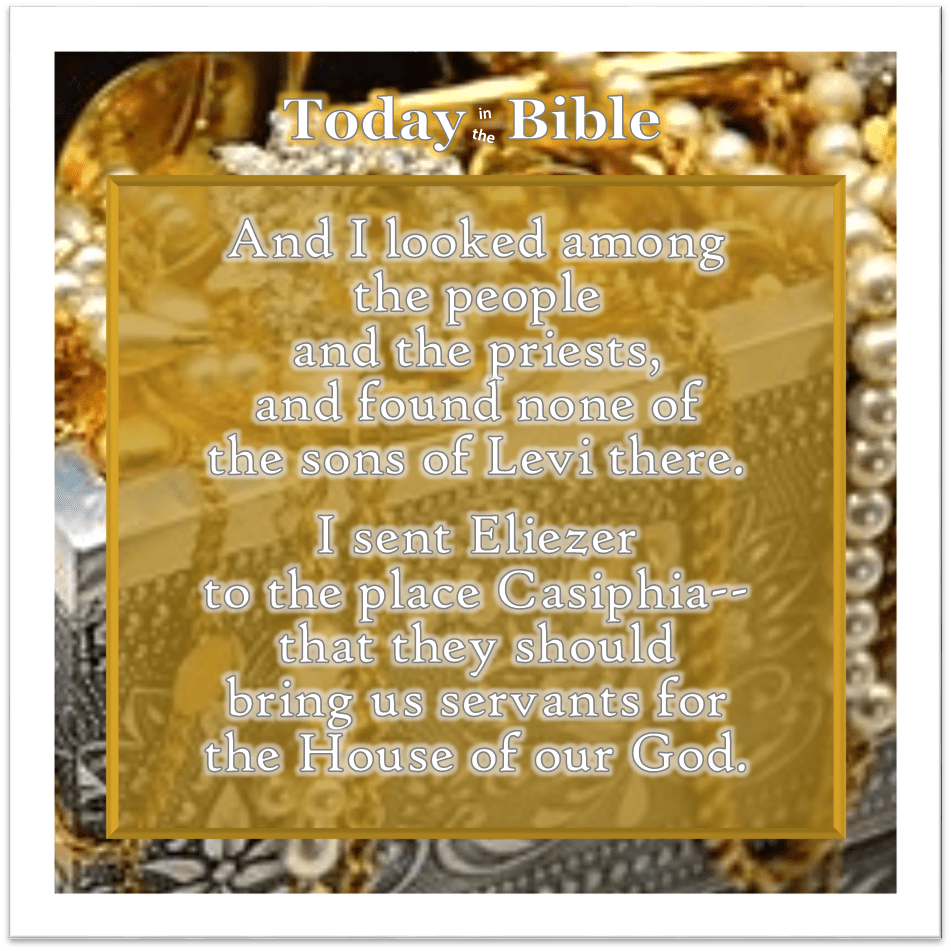
Now I gathered them by the river that flows to Ahava, and we camped there three days. And I looked among the people and the priests, and found none of the sons of Levi there. Then I sent for Eliezer, Ariel, Shemaiah, Elnathan, Jarib, Elnathan, Nathan, Zechariah, and Meshullam, leaders; also for Joiarib and Elnathan, men of understanding. And I gave them a command for Iddo the chief man at the place Casiphia, and I told them what they should say to Iddo and his brethren the Nethinim at the place Casiphia– that they should bring us servants for the house of our God. – Ezra 8:1-17
What is the “place Casiphia?” I did some digging and found that Casiphia is spelled using the same letters as the root for the Hebrew word “kesef” – silver. If you say Casiphia and kesef out loud – you can hear the similarities of the consonants in each word. The Revised Standard Version of the Bible contains the book of 1 Esdras and it translates the corresponding verses from above, as follows.
I assembled them at the river called Theras, and we encamped there three days, and I inspected them. When I found there none of the sons of the priests or of the Levites, I sent word to Eliezar, Iduel, Maasmas, Elnathan, Shemaiah, Jarib, Nathan, Elnathan, Zechariah, and Meshullam, who were leaders and men of understanding; and I told them to go to Iddo, who was the leading man at the place of the treasury, and ordered them to tell Iddo and his brethren and the treasurers at that place to send us men to serve as priests in the house of our Lord. – 1 Esdras 8:41-46 (RSV)
…perhaps we can see that it was not only the silver and gold that was of value at Casiphia – but also the men who had understanding of the proper service of the LORD – the priests and the Levites…
In this text, the word Casiphia is translated as treasury. Casiphia was likely the place of the treasury (kesef-silver). One of the big responsibilities of Ezra’s group was to bring back the silver and gold vessels to be used in the Temple. This version says that, not only the Levites were missing from the group, but also the priests. By reading between the lines, perhaps we can see that it was not only the silver and gold that was of value at Casiphia – but also the men who had understanding of the proper service of the LORD – the priests and the Levites.
In Exodus 19, the LORD, our God, had also gathered the people together; only this time it was at Sinai. There are some subtle similarities here that deserve to be called out. In the story of the exodus from Egypt, after the LORD delivered the people out from under the bondage of the Egyptians, He brought them out into the wilderness – to the foot of Mount Sinai. He intended to make a covenant with them and to make them as a special treasure to Himself…a kingdom of priests, a holy nation.
…then you shall be a special treasure to Me above all people…you shall be to Me a kingdom of priests and a holy nation…
In the third month after the children of Israel had gone out of the land of Egypt, on the same day, they came to the Wilderness of Sinai. For they had departed from Rephidim, had come to the Wilderness of Sinai, and camped in the wilderness. So Israel camped there before the mountain. And Moses went up to God, and the LORD called to him from the mountain, saying, “Thus you shall say to the house of Jacob, and tell the children of Israel: `You have seen what I did to the Egyptians, and how I bore you on eagles’ wings and brought you to Myself. Now therefore, if you will indeed obey My voice and keep My covenant, then you shall be a special treasure to Me above all people; for all the earth is Mine. And you shall be to Me a kingdom of priests and a holy nation.’ These are the words which you shall speak to the children of Israel.” – Exodus 19:1-6 (NKJ)
If we look at these two stories from a high level, we have a tale of two deliverances – one from Egypt, the other from Babylon. In both stories the people are pulled out from where they were held in bondage and gathered into a wilderness area. In the Exodus, God was looking for a people unto Himself – a special treasure, a kingdom of priests. In Ezra’s story, they went looking to a place called the treasury for the priests and Levites. In the Exodus, the people started on a journey to the Promised Land that took forty years. In Ezra, the people started on a journey to the Promised Land that took four months.
God’s heart has not changed. Ever since Adam and Eve, He’s continually been looking for people who will separate themselves unto Him, those who will obey His command – a special treasure (a “segulah”), better than silver. Better than gold. Ezra was one of those people.
For Ezra had prepared his heart to seek the Law of the LORD, and to do it, and to teach statutes and ordinances in Israel. – Ezra 7:10 (NKJ)
This is the central theme of the Bible. Whether from those who can identify their lineage through the sons of Israel or those want to serve but are unable to provide one (i.e. the Nethinim). God’s quintessential segulah is our Messiah, Yeshua (Jesus). The One who gave Himself completely and perfectly to the service of His Father. As His disciples, we strive to be like Him. We’ll end with a reminder from 1 Peter…
Coming to Him as to a living stone, rejected indeed by men, but chosen by God and precious, you also, as living stones, are being built up a spiritual house, a holy priesthood, to offer up spiritual sacrifices acceptable to God through Jesus Christ. – 1 Peter 2:4-5 (NKJ)
But you are a chosen generation, a royal priesthood, a holy nation, His own special people, that you may proclaim the praises of Him who called you out of darkness into His marvelous light; who once were not a people but are now the people of God, who had not obtained mercy but now have obtained mercy. – 1 Peter 2:9-10 (NKJ)
Anyone from the nations, who comes to Christ, follows the pattern of Israel. We were once in bondage. We were once in the wilderness. We came to the foot of Mount Sinai. We agreed to follow His commandments. We became His special people. A precious treasure. His segulah.
To read all of our posts about Ezra, please click on the image above.

© 2026 Today in the Bible

 Today in the Bible
You must be logged in to post a comment.