Nisan 10, 5785; from sunset April 7, 2025, to sunset April 8, 2025
(The tenth day of the first month)
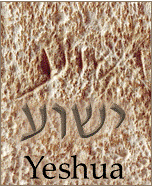
This is the name “Yeshua” (יֵשׁוּעַ – Jesus) as seen on the James Ossuary. Yeshua comes from the verb “yasha” meaning “to save or deliver.” Yeshua means “Salvation.”
All throughout today we’ve been connecting the dots between the events associated with this date in the Bible and others where no date is specified, but they seem to fit the pattern. Today in the Bible, we’d like to suggest one more. A couple of days ago we studied how John the Baptist was compared to Isaiah’s prophesy as, “The voice of one crying in the wilderness: “Prepare the way of the LORD” (Isaiah 40:3). Let’s pick up where we left off the other day. We’ve pulled the story together from all four gospels in order to gather in all of the details from that day.
These things were done in Bethabara beyond the Jordan, where John was baptizing. – John 1:28
When all the people were baptized… – Luke 3:21a
It came to pass in those days that Jesus came from Nazareth of Galilee, and was baptized by John in the Jordan. – Mark 1:9
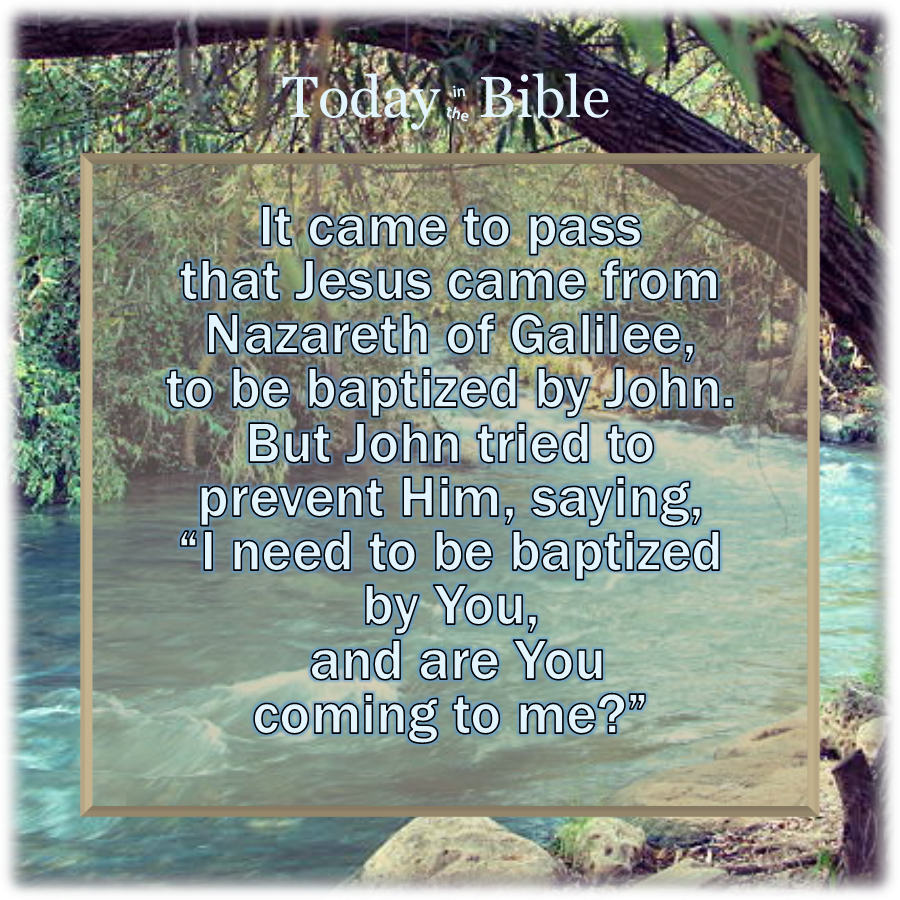
And John tried to prevent Him, saying, “I need to be baptized by You, and are You coming to me?”
But Jesus answered and said to him, “Permit it to be so now, for thus it is fitting for us to fulfill all righteousness.” Then he allowed Him. – Matthew 3:14-15
…and while He prayed, the heaven was opened. – Luke 3:21c
When He had been baptized, Jesus came up immediately from the water; and behold, the heavens were opened to Him, and He saw the Spirit of God descending like a dove and alighting upon Him. And suddenly a voice came from heaven, saying, “This is My beloved Son, in whom I am well pleased.” – Matthew 3:16-17
Some Bible translations say that John the Baptist performed his work at a place called Bethabara and some render Bethany beyond the Jordan. Bethabara means “House of the Ford” or “House of the Crossing.” The word “beth” means “house” and “abara” comes from the same root as the word “Hebrew” – “one who has crossed over.” The name Bethany may mean “House of Response” – perhaps indicating a response to John’s invitation to repent and be baptized. In our post earlier today on Naomi and Ruth, we supposed that Ruth may have made her declaration, “Your people shall be my people, and your God, my God” (Ruth 1:16) on the same day and at the same place where the Ark of the Covenant led the children of Israel across the Jordan River.
It seems that John the Baptist may have chosen this location because of its association with the Ark of the Covenant. The Ark carried “The Covenant.” The words, the commandments of God. He was performing a baptism of repentance to that very covenant. In our post on Naomi and Ruth for today, we also studied the connection between a baptism and a rebirth.
Now we’re suggesting that, perhaps, today was the day that John baptized Jesus and Jesus started His ministry. There’s no way to know for sure. But if we use the Ark of the Covenant as a picture of Jesus — “THE Word of God” — then it makes sense for both of them to cross the Jordan River on the same day. Which is, coincidentally, the same day as the Passover Lamb was to be chosen. And, coincidentally, our Father made His confirmation of Jesus by saying, “This is My beloved Son, in whom I am well pleased.”
There is one more comparison that we’d like to make — that is between the days of Joshua and the days of John the Baptist. Joshua 3:15 tells us that “the Jordan overflows all its banks during the whole time of harvest.” Luke 3:7 tells us that “multitudes” came out to John to be baptized by him in the Jordan. If we use our imagination, we can see that Luke could be bringing to mind a picture of the Jordan overflowing its banks during the “harvest” – the harvest of the “multitude” of souls seeking repentance. The Jordan was overflowing its banks during the whole time of the harvest…literally and figuratively.
There are others who place Jesus’ baptism on the last day of the month of Elul. They connect His subsequent forty days of fasting in the wilderness with the same time that Moses had his second forty-day fast upon Mount Sinai. This would have occurred in mid-late summer, after the sin of the golden calf. There are a lot of good analogies in that story too. The truth is, we don’t really know. This is just one supposition.
You can read the full version of Jesus’ baptism in Matthew 3:13-17, Mark 1:9-11, Luke 3:21-22, and John 1:28-34.
To see all of our posts regarding “Yeshua” (יֵשׁוּעַ – Jesus), click on the image below.

© 2026 Today in the Bible

 Today in the Bible
You must be logged in to post a comment.