Nisan 10, 5785; from sunset April 7, 2025, to sunset April 8, 2025
(The tenth day of the first month)
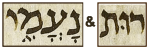
These are the names Naomi and Ruth as seen in the Aleppo Codex, written over 1,000 years ago.
Naomi & Ruth Continue – Orpah Turns Back
A couple of days ago, we deliberated on a date for when Naomi and her daughters-in-law left Moab in hopes of finding a promising grain harvest in Bethlehem. Today in the Bible, we’re meeting up with them again on “Decision Day.” This is the day when we believe Ruth may have made her decision to continue with Naomi and the day that Orpah may have made her decision to turn back. The Bible doesn’t give us a specific date but, given the other significant events occurring on this day, we believe this story fits in with the pattern of the day. Let’s read the text and then we’ll explain why we are dating this all-important moment to today.
And Naomi said to her two daughters-in-law, “Go, return each to her mother’s house. The LORD deal kindly with you, as you have dealt with the dead and with me. The LORD grant that you may find rest, each in the house of her husband.” Then she kissed them, and they lifted up their voices and wept.
And they said to her, “Surely we will return with you to your people.”
But Naomi said, “Turn back, my daughters; why will you go with me? Are there still sons in my womb, that they may be your husbands? Turn back, my daughters, go– for I am too old to have a husband. If I should say I have hope, if I should have a husband tonight and should also bear sons, would you wait for them till they were grown? Would you restrain yourselves from having husbands? No, my daughters; for it grieves me very much for your sakes that the hand of the LORD has gone out against me!”
Then they lifted up their voices and wept again; and Orpah kissed her mother-in-law, but Ruth clung to her.
And she said, “Look, your sister-in-law has gone back to her people and to her gods; return after your sister-in-law.”
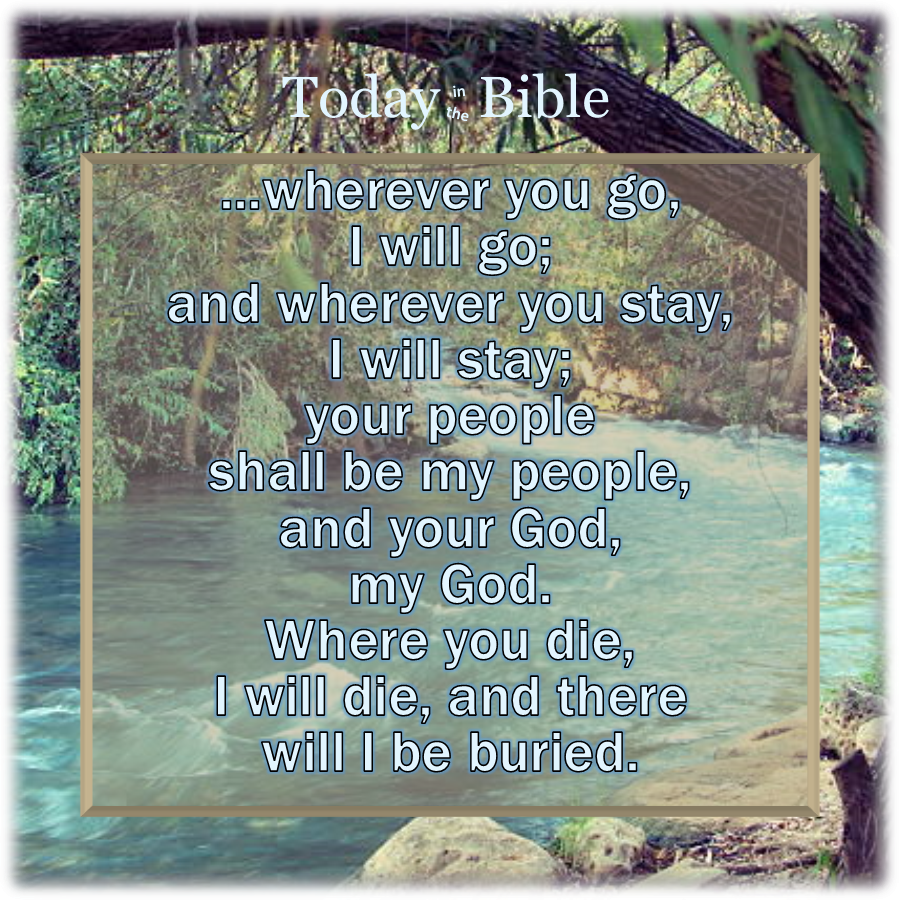
But Ruth said: “Entreat me not to leave you, or to turn back from following after you; for wherever you go, I will go; and wherever you lodge, I will lodge; your people shall be my people, and your God, my God. Where you die, I will die, and there will I be buried. The LORD do so to me, and more also, if anything but death parts you and me.” When she saw that she was determined to go with her, she stopped speaking to her. – Ruth 1:8-18 (NKJ)
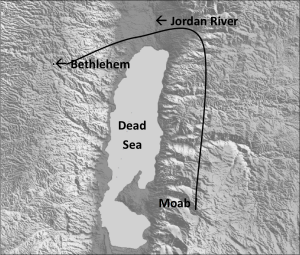
So Orpah returned to her family and Ruth chose to continue with Naomi. The women could have taken a southern route to circumnavigate the Dead Sea, but most scholars believe they would have taken the northern route.
Why This Date?
We, at Today in the Bible, believe that, if they did take the northern route, this moment of decision could have taken place before crossing the Jordan River. The book of Joshua tells us that the Jordan overflowed its banks during the harvest season (Joshua 3:15) and the book of Ruth tells us that the women arrived in Bethlehem at the beginning of the barley harvest (Ruth 1:22). The barley crop could not be harvested, eaten, bought, or sold until after the Firstfruits offering was made, the day after the Sabbath of the Feast of Unleavened Bread. The Feast of Unleavened Bread begins on the 15th day of this month, just five days from now. Dating the moment of decision to the 10th day of the first month seems plausible given this information.
Why This Place?
We imagine the women coming to the Jordan with the water overflowing its banks. It could have been a treacherous situation. Perhaps Naomi paused at this moment and said, “Go, return to your mother’s house” (i.e. “why make this treacherous crossing?”). The text tells us that Orpah made the decision to return to her family. The name Orpah is thought to mean “neck” or “mane” (as in the back of the neck) – others suggest that she was “stiff-necked.” Orpah showed Naomi “the back of her neck,” and returned to her family and her gods. Perhaps we could say, when the going got tough, Orpah got going — home! Maybe we could look at Orpah as representative of someone who turns their back on the God of Israel.
There are a couple of opinions as to the meaning of the name Ruth. Some see her name as stemming from a verb meaning “to be a friend or a companion;” others see it coming from a verb meaning “to look, see, or have a vision.” We like to think that Ruth was a friend or a companion to Naomi, as well as the children of Israel, and their God. When the going got tough, Ruth pledged herself to the people of Israel and their God and chose to cross over the Jordan River into the Promised Land. She did not turn her back on them.
Historically, this date is a significant one in the Bible.
- Lamb Selection Day for Passover
- Israel Crosses the Jordan & Enters the Promised Land
The book of Exodus relates the story of how God instructed Israel to choose a perfect lamb – they were to choose it on this very day (Exodus 12:3). They were instructed to slaughter that lamb in four days’ time, on the 14th day of the month (Exodus 12:6). They were to place the blood of the lamb on their lintel and doorposts; this would save them from the angel of death.
Though Ruth did not choose a “lamb” today, she did choose the LORD, the God of Israel as her personal God, turning her back on the gods of her nation. She chose the people of Israel as her people. Her words remind us of a vow, perhaps a wedding vow or some sort of covenantal ceremony.
In a way, Ruth was choosing life by going to Bethlehem. Naomi had heard that the LORD had visited His people by giving them “bread.” Ruth left the famine-infested land of Moab. She left the land of death on the other side of the Dead Sea. The land where her father-in-law, brother-in-law, and husband all died. She left, what seemed to be a land of certain death, for the promise of life in the form of an impending harvest – the “bread” found in Bethlehem. God gave the prophet Micah a prophesy for Bethlehem. He said that the One who was to be Ruler in Israel shall be born there and, “He will feed His flock” (Micah 5:2-4). The name Bethlehem means, “House of Bread.” Ruth was going to Bethlehem to be fed the Bread of Life.
If we flash forward to the days of Jesus, we can see that the instructions God gave to the people of Israel in Egypt, paint us a picture of what it means to choose Jesus as our Passover Lamb. He is our perfect Lamb. Salvation from certain death. We believe the children of Israel “chose their Passover Lamb” on the day that Jesus made his triumphal entry into Jerusalem. Four days later, He died on the day prescribed by His Father to kill the Lamb. If we place His blood on the lintel and doorposts of our heart, we are saved from the destroyer of life. We are granted the right to eternal life. In a sense, we have gone to Bethlehem to be fed the Bread of Life.
We believe it’s no coincidence that today is also the day that Israel crossed the Jordan River and entered into the Promised Land. It seems as if choosing the Lamb and crossing into the Promised Land are meant to go hand-in-hand. Ruth’s decision is a parallel in both space and time. She has chosen the God of Israel, and she is about to cross over the Jordan River into the Promised Land. If we plug Jesus into this pattern, when we choose Him as our Passover Lamb, we can enter into the “Promised Land” – “The Kingdom of God” – eternal life.
“Most assuredly, I say to you, unless one is born again, he cannot see the kingdom of God.” – John 3:3
Judaism views the story of Ruth as that of a quintessential Gentile convert. She left her old life behind and chose the God and the people of Israel as her new home. New Testament lingo calls it being “grafted in” (Romans 11) But there is a tie-in here to baptism. The picture given to us by a baptism is that of dying to your old life (going under the water) and being born anew (breaking the water, as in a birth). Jesus spoke of this when He and Nicodemus met as recorded in John chapter three (above).
John the Baptist chose the Jordan River to immerse those coming to him. His choice of that river may have been a very calculated one. John was performing a baptism of repentance (Matthew 3:1-2). Repentance to what? The commandments, the covenant of God. As we learned in an earlier post, Joshua led the people of Israel across the Jordan River on this very day. The priests went ahead of the people and carried the Ark of the Covenant. When their feet hit the water, the water “broke.” What was in the Ark of the Covenant? The commandments, the covenant of God. This made John’s baptism very symbolic. The people were choosing to return to the covenant that God made with them at the place where the Ark of the Covenant “broke the water” and brought the people into a “new life” in the Promised Land.
In those days John the Baptist came preaching in the wilderness of Judea, and saying, “Repent, for the kingdom of heaven is at hand!” – Matthew 3:1-2
Jesus said, “Whosoever believes and is baptized will be saved” (Mark 16:16). Baptism is a crucial part of conversion. John chose to perform his baptisms in the Jordan River. Jesus, too, was baptized in the Jordan River. Perhaps we can compare Him to the Ark of the Covenant. Maybe that’s why He insisted to John that He should be baptized there as well. He is the Word of God. He is our Covenant Representative. He taught us the importance of keeping the commandments. He fits the pattern for a new life in the Promised Land.
Ruth, too, seems to have chosen to align herself with the Word of God. Throughout her story, we see her living out God’s Word in her actions. Boaz, himself, declares that she is a “virtuous woman” (Ruth 3:11). She is symbolic of Gentiles who have chosen the God of Israel and have been baptized into repentance. No longer are we living our old life, but a new life that aligns with God’s commandments.
Conclusion
This is why we believe that Ruth made her decision on this day, and this is why we believe Ruth made her decision at that place.
We hope you’ll read all of our related posts dated Nisan 10 to see how beautifully it all ties in together. Also, we’ll continue our comparison of Ruth as a Gentile Christian and introduce our comparison of Naomi as the nation of Israel in the days and weeks ahead.
To read all of our posts about Naomi and Ruth, please click on the image above.

© 2026 Today in the Bible

 Today in the Bible
You must be logged in to post a comment.