
Nisan 11, 5785; from sunset April 8, 2025, to sunset April 9, 2025
(The eleventh day of the first month)
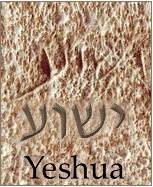
This is the name “Yeshua” (יֵשׁוּעַ – Jesus) as seen on the James Ossuary. Yeshua comes from the verb “yasha” meaning “to save or deliver.” Yeshua means “Salvation.”
Anyone who has ever endeavored to create a timeline for the week leading up to Jesus’ crucifixion and resurrection has struggled. It’s no different here! So, please forgive us if we place an event differently than what you had envisioned. The important thing is to remember and tell the story. During this week we will publish several posts per day and use the US Central time zone as our guide.
Yesterday, we placed His triumphal entry into Jerusalem and His subsequent trip to the Temple to remove the money changers. According to Matthew’s timeline, He then returned to Bethany for the night. Today in the Bible, we’re catching up with Jesus as He leaves Bethany and returns to the Temple. Both Matthew and Mark recount what happens next.
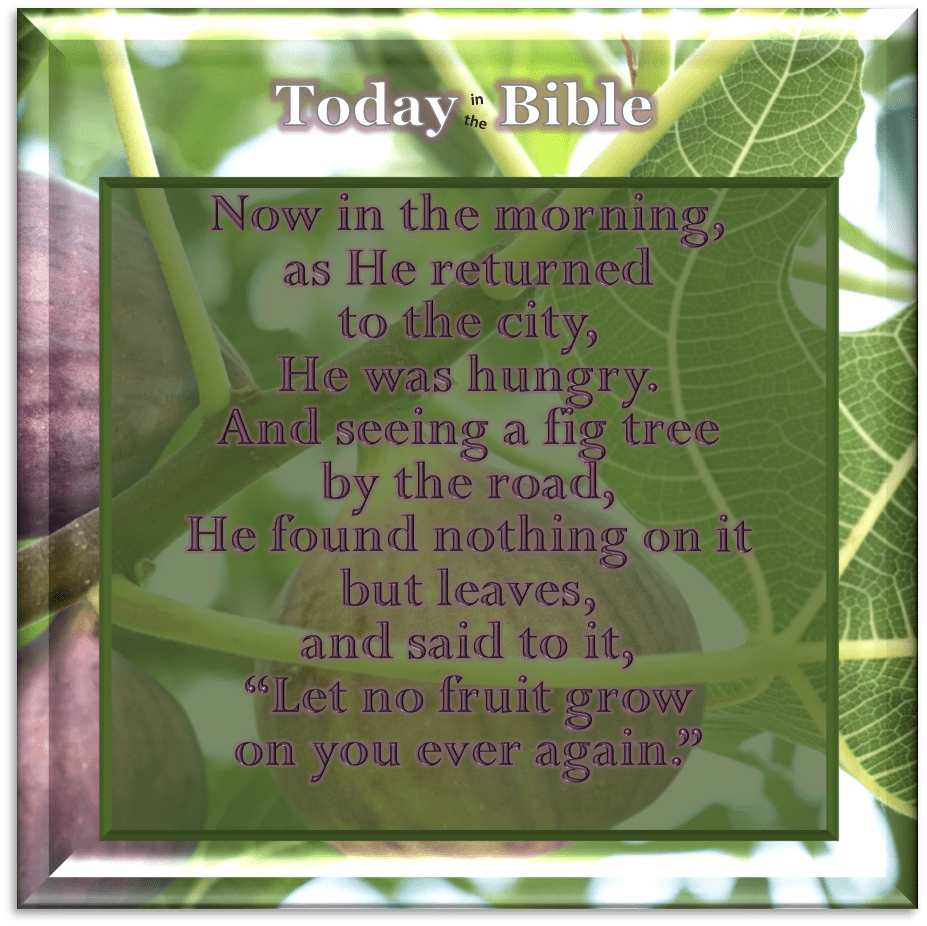
Now in the morning, as He returned to the city, He was hungry. And seeing a fig tree by the road, He came to it and found nothing on it but leaves, and said to it, “Let no fruit grow on you ever again.” Immediately the fig tree withered away.
And when the disciples saw it, they marveled, saying, “How did the fig tree wither away so soon?”
So Jesus answered and said to them, “Assuredly, I say to you, if you have faith and do not doubt, you will not only do what was done to the fig tree, but also if you say to this mountain, `Be removed and be cast into the sea,’ it will be done. And whatever things you ask in prayer, believing, you will receive.” – Matthew 21:18-22 (NKJ)
Mark splits the incident into two pieces. He recounts the curse as happening on one morning, inserts the incident with the money changers and a return to Bethany, and then returns to Peter seeing the withered tree and remembering the curse the next morning.
Now the next day, when they had come out from Bethany, He was hungry. And seeing from afar a fig tree having leaves, He went to see if perhaps He would find something on it. When He came to it, He found nothing but leaves, for it was not the season for figs. In response Jesus said to it, “Let no one eat fruit from you ever again.” And His disciples heard it. – Mark 11:12-14 (NKJ)
Now in the morning, as they passed by, they saw the fig tree dried up from the roots. And Peter, remembering, said to Him, “Rabbi, look! The fig tree which You cursed has withered away.
“So Jesus answered and said to them, “Have faith in God. For assuredly, I say to you, whoever says to this mountain, `Be removed and be cast into the sea,’ and does not doubt in his heart, but believes that those things he says will be done, he will have whatever he says. Therefore I say to you, whatever things you ask when you pray, believe that you receive them, and you will have them. And whenever you stand praying, if you have anything against anyone, forgive him, that your Father in heaven may also forgive you your trespasses. But if you do not forgive, neither will your Father in heaven forgive your trespasses.” – Mark 11:20-26 (NKJ)
John does not recount the incident and neither does Luke. However, Luke recalls another time, earlier in Jesus’ ministry, when He spoke a parable about a fig tree.
He also spoke this parable: “A certain man had a fig tree planted in his vineyard, and he came seeking fruit on it and found none. Then he said to the keeper of his vineyard, `Look, for three years I have come seeking fruit on this fig tree and find none. Cut it down; why does it use up the ground?’
“But he answered and said to him, `Sir, let it alone this year also, until I dig around it and fertilize it. And if it bears fruit, well. But if not, after that you can cut it down.’” – Luke 13:6-9 (NKJ)
A couple of months ago, we remembered Tu B’Shevat – the 15th day of the month of Shevat. The sages chose this day as the “new year for trees.” This was in response to God’s commandment about eating the fruit of a tree. This time, it’s not about the “Tree of the Knowledge of Good and Evil.” (Though, it’s interesting that Adam and Eve chose to cover themselves with fig leaves!) But this commandment is found in Leviticus.
When you come into the land, and have planted all kinds of trees for food, then you shall count their fruit as uncircumcised. Three years it shall be as uncircumcised to you. It shall not be eaten. But in the fourth year all its fruit shall be holy, a praise to the LORD. And in the fifth year you may eat its fruit, that it may yield to you its increase: I am the LORD your God. – Leviticus 19:23-25 (NKJ)
Perhaps there’s a connection between Jesus’ parable and His Father’s commandment in Leviticus. Both scriptures reference a three-year period. And Jesus’ ministry occurred during a 3 ½ year period. But Leviticus goes on to say that, in the fourth year, the fruit is holy to the LORD. Maybe, in today’s story, Jesus is saying that He found no fruit that was “Holy to the LORD” – particularly among the chief priests, scribes, Pharisees, and Sadducees.
The prophet Jeremiah received a vision from the LORD regarding two baskets of figs which were set before the Temple. One basket contained good figs and the other bad figs, so bad they couldn’t be eaten. In the vision, God explains that the figs represent different types of Israelites. You can read the whole parable in Jeremiah 23. Haggai, too, received a word from the LORD…
As yet the vine, the fig tree, the pomegranate, and the olive tree have not yielded fruit… – Haggai 2:19 (NKJ)
Figs were among the seven species listed as being prominent in the Promised Land (Deuteronomy 8:8). They are symbolic of prosperity. In Solomon’s day, every man dwelled securely under his own vine and fig tree (1 Kings 4:25). Solomon’s reign is representative of the Messianic era, where, once again, everyone every man will dwell securely under his own vine and fig tree. The Bible contains quite a few references to the fig tree. These are just a few. We’ll end with a mention from Proverbs.
Whoever keeps the fig tree will eat its fruit; so he who waits on his master will be honored. – Proverbs 27:18 (NKJ)
To see all of our posts regarding “Yeshua” (יֵשׁוּעַ – Jesus), click on the image below.

© 2026 Today in the Bible

 Today in the Bible
You must be logged in to post a comment.