

Nisan 14, 5785; from sunset April 11, 2025, to sunset April 12, 2025
(The fourteenth day of the first month)
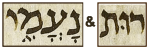
These are the names Naomi and Ruth as seen in the Aleppo Codex, written over 1,000 years ago.
Naomi & Ruth Arrive in Bethlehem
Today in the Bible, we’re remembering Naomi and Ruth. Just a few days ago we imagined that Ruth may have professed her allegiance to the God of Israel and to the children of Israel as she crossed over the Jordan River into the Promised Land. Today, we’re continuing with their story and seeing how the next few verses may fit into the pattern of the Passover Seder
Now the two of them went until they came to Bethlehem. And it happened, when they had come to Bethlehem, that all the city was excited because of them; and the women said, “Is this Naomi?”
But she said to them, “Do not call me Naomi; call me Mara, for the Almighty has dealt very bitterly with me. I went out full, and the LORD has brought me home again empty. Why do you call me Naomi, since the LORD has testified against me, and the Almighty has afflicted me?”
So Naomi returned, and Ruth the Moabitess her daughter-in-law with her, who returned from the country of Moab. Now they came to Bethlehem at the beginning of barley harvest. – Ruth 1:19-2:1 (NKJ)
We’ve already explored what the “beginning of the barley harvest” means. We understand that the barley crop could not be harvested, eaten, bought, or sold until the Firstfruits had been presented as a wave offering before the LORD. This offering occurred on the day after the Sabbath of the Feast of Unleavened Bread. The Feast of Unleavened Bread begins tonight at sunset. It’s the night of the Passover Seder. The text tells us that Naomi and Ruth returned to Bethlehem at this point. But we see something else in the text that may offer us a hint that today was the day of their arrival in Bethlehem.
During the Passover Seder, we are commanded to eat bitter herbs to remind us of the bitter enslavement experienced in Egypt. It’s also a tradition to mix up a sweet paste of apples, dates, cinnamon, nuts, honey, and wine. This sweet paste is known as charoset and is meant to resemble the mortar or mud used to make bricks, a back-breaking task that was thrust upon the children of Israel while in Egypt.
If we go back and carefully read our text for this post, we see that Naomi says, “Do not call me Naomi; call me Mara.” The name Naomi comes from a verb root that means “to be pleasant, sweet, delightful, or beautiful.” The name Mara comes from a verb that means “to be bitter.” Now we can see the word-play that our sweet Naomi used by pulling in the meaning of her name and juxtaposing it against the meaning of the bitter name, Mara. When viewed in light of the Passover Seder, suddenly we see the bitter herbs and the sweet charoset paste showing up in Naomi’s statement. Could she have said these words at a Passover Seder in Bethlehem? Perhaps she said them at the point of the Seder when these two foods are eaten together.
One other note of interest. Just days after Ruth chose the God and the people of Israel, we find her coming to Bethlehem, the birthplace of our Savior; possibly on the same date that He would make His sacrifice ~1,000 years in the future. A sacrifice which made it possible to bring Gentiles, like Ruth, into the people of God. Yet another pattern woven into the fabric of space and time by our Father. We worship a beautiful and amazing God.
To read all of our posts about Naomi and Ruth, please click on the image above.

© 2026 Today in the Bible

 Today in the Bible
You must be logged in to post a comment.