Nisan 14, 5785; from sunset April 11, 2025, to sunset April 12, 2025
(The fourteenth day of the first month)
Today in the Bible, we remember those throughout the millennia who have kept the Passover. We hope that you will consider adding your name to the list.
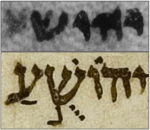
This is the name Yehoshua (Joshua); Joshua means “The LORD Saves.” The top image was written ~2,000 years ago and was found among the Dead Sea Scrolls. The bottom image was written ~1,000 years ago and is from the Aleppo Codex (the Crown of Aleppo). The top image was written on a scroll, possibly in Qumran, near the Dead Sea. The bottom is in a bound manuscript, written in Tiberias, near the Sea of Galilee, which later made its way to Aleppo (Syria). The Aleppo Codex is now housed in the Shrine of the Book alongside the Dead Sea Scrolls.
Israel Kept the Passover for the First Time in the Promised Land!
On the evening of the fourteenth day of the month, while camped at Gilgal on the plains of Jericho, the Israelites celebrated the Passover. – Joshua 5:10 (NIB)
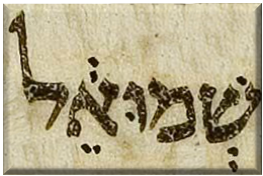
This is the name “Shemu’el” (שְׁמוּאֵל – Samuel) as seen in the Aleppo Codex, written over one thousand years ago.
Elkanah, Hannah, Samuel, & Eli Keep the Passover
Even though the word “Passover” is not mentioned by name in the story of Elkanah, Hannah, Samuel, and Eli…most scholars agree that the annual sacrifice mentioned throughout the book is referring to the annual Passover sacrifice. Similar to what we read in the book of Ruth, linguistic hints may be found in the text as well. The fact that Samuel observed the Passover is confirmed in 2 Chronicles where Josiah’s Passover observance is mentioned as being the greatest since the days of Samuel the prophet (2 Chronicles 35:18).
Now there was a certain man of Ramathaim Zophim, of the mountains of Ephraim, and his name was Elkanah the son of Jeroham, the son of Elihu, the son of Tohu, the son of Zuph, an Ephraimite. And he had two wives: the name of one was Hannah, and the name of the other Peninnah. Peninnah had children, but Hannah had no children.
This man went up from his city yearly to worship and sacrifice to the LORD of hosts in Shiloh. Also the two sons of Eli, Hophni and Phinehas, the priests of the LORD, were there. And whenever the time came for Elkanah to make an offering, he would give portions to Peninnah his wife and to all her sons and daughters. But to Hannah he would give a double portion, for he loved Hannah, although the LORD had closed her womb. And her rival also provoked her severely, to make her miserable, because the LORD had closed her womb.
So it was, year by year, when she went up to the house of the LORD, that she provoked her; therefore she wept and did not eat. – 1 Samuel 1:1-7 (NKJ)
This is a 2,600-year-old clay seal believed to have belonged to Nathan-Melech, who is mentioned in 2 Kings and was a servant to King Josiah. The seal reads, “(belonging) to Nathan-Melech, Servant of the King.”
Josiah Keeps the Passover
Then the king commanded all the people, saying, “Keep the Passover to the LORD your God, as it is written in this Book of the Covenant.” Such a Passover surely had never been held since the days of the judges who judged Israel, nor in all the days of the kings of Israel and the kings of Judah. But in the eighteenth year of King Josiah this Passover was held before the LORD in Jerusalem. – 2 Kings 23:21-23 (NKJ)
Now Josiah kept a Passover to the LORD in Jerusalem, and they slaughtered the Passover lambs on the fourteenth day of the first month. And he set the priests in their duties and encouraged them for the service of the house of the LORD.
Then he said to the Levites who taught all Israel, who were holy to the LORD: “Put the holy ark in the house which Solomon the son of David, king of Israel, built. It shall no longer be a burden on your shoulders. Now serve the LORD your God and His people Israel. Prepare yourselves according to your fathers’ houses, according to your divisions, following the written instruction of David king of Israel and the written instruction of Solomon his son. And stand in the holy place according to the divisions of the fathers’ houses of your brethren the lay people, and according to the division of the father’s house of the Levites. So slaughter the Passover offerings, consecrate yourselves, and prepare them for your brethren, that they may do according to the word of the LORD by the hand of Moses.”
Then Josiah gave the lay people lambs and young goats from the flock, all for Passover offerings for all who were present, to the number of thirty thousand, as well as three thousand cattle; these were from the king’s possessions. And his leaders gave willingly to the people, to the priests, and to the Levites. Hilkiah, Zechariah, and Jehiel, rulers of the house of God, gave to the priests for the Passover offerings two thousand six hundred from the flock, and three hundred cattle. Also Conaniah, his brothers Shemaiah and Nethanel, and Hashabiah and Jeiel and Jozabad, chief of the Levites, gave to the Levites for Passover offerings five thousand from the flock and five hundred cattle.
So the service was prepared, and the priests stood in their places, and the Levites in their divisions, according to the king’s command. And they slaughtered the Passover offerings; and the priests sprinkled the blood with their hands, while the Levites skinned the animals. Then they removed the burnt offerings that they might give them to the divisions of the fathers’ houses of the lay people, to offer to the LORD, as it is written in the Book of Moses. And so they did with the cattle.
Also they roasted the Passover offerings with fire according to the ordinance; but the other holy offerings they boiled in pots, in caldrons, and in pans, and divided them quickly among all the lay people. Then afterward they prepared portions for themselves and for the priests, because the priests, the sons of Aaron, were busy in offering burnt offerings and fat until night; therefore the Levites prepared portions for themselves and for the priests, the sons of Aaron.
And the singers, the sons of Asaph, were in their places, according to the command of David, Asaph, Heman, and Jeduthun the king’s seer. Also the gatekeepers were at each gate; they did not have to leave their position, because their brethren the Levites prepared portions for them. So all the service of the LORD was prepared the same day, to keep the Passover and to offer burnt offerings on the altar of the LORD, according to the command of King Josiah.
And the children of Israel who were present kept the Passover at that time, and the Feast of Unleavened Bread for seven days. There had been no Passover kept in Israel like that since the days of Samuel the prophet; and none of the kings of Israel had kept such a Passover as Josiah kept, with the priests and the Levites, all Judah and Israel who were present, and the inhabitants of Jerusalem. In the eighteenth year of the reign of Josiah this Passover was kept. – 2 Chronicles 35:1-19 (NKJ)
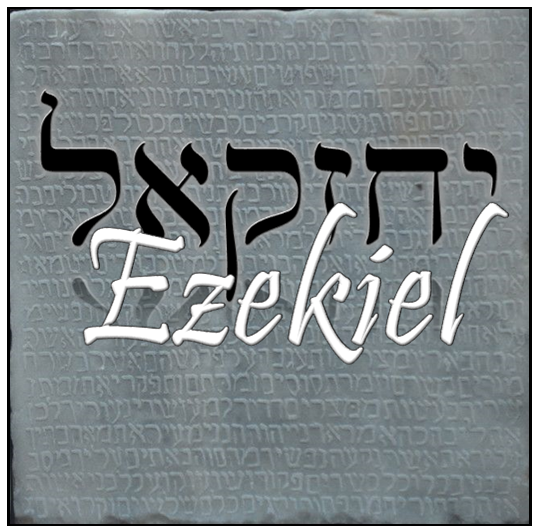
This is an image of one of the 66 stone tiles known as the “Ezekiel Plates” discovered in the 1800s at the traditional tomb site of the prophet Ezekiel. The tiles contain the entire book of Ezekiel and were placed inside the tomb with the letter-side facing toward the wall. There is an old Talmudic tradition that the original book of Ezekiel was buried with the prophet in his tomb and was left there to be revealed in the last days.
Ezekiel Envisions Passover Observance
In the first month, on the fourteenth day of the month, you shall observe the Passover, a feast of seven days; unleavened bread shall be eaten. And on that day the prince shall prepare for himself and for all the people of the land a bull for a sin offering.
On the seven days of the feast he shall prepare a burnt offering to the LORD, seven bulls and seven rams without blemish, daily for seven days, and a kid of the goats daily for a sin offering. And he shall prepare a grain offering of one ephah for each bull and one ephah for each ram, together with a hin of oil for each ephah. – Ezekiel 45:21-24 (NKJ)
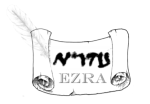
This is the name “Ezra” (עֶזְרָא) the Scribe as seen in the Dead Sea Scrolls; written by a scribe over two thousand years ago.
Ezra & the Descendants of the Captivity Keep the Passover
And the descendants of the captivity kept the Passover on the fourteenth day of the first month. For the priests and the Levites had purified themselves; all of them were ritually clean. And they slaughtered the Passover lambs for all the descendants of the captivity, for their brethren the priests, and for themselves. Then the children of Israel who had returned from the captivity ate together with all who had separated themselves from the filth of the nations of the land in order to seek the LORD God of Israel. – Ezra 6:19-21 (NKJ)
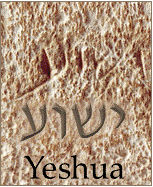
This is the name “Yeshua” (יֵשׁוּעַ – Jesus) as seen on the James Ossuary. Yeshua comes from the verb “yasha” meaning “to save or deliver.” Yeshua means “Salvation.”
Joseph, Mary, and Jesus Keep the Passover
Every year Jesus‘ parents went to Jerusalem for the Festival of the Passover. When he was twelve years old, they went up to the festival, according to the custom. – Luke 2:41-42 (NIV)

You and Me
Over the past 24 hours, we’ve seen how often “keeping the Passover” is mentioned in the Bible.
- The story of Joseph and his brothers bear a striking resemblance to Jesus and the Passover.
- Moses and the children of Israel kept the first Passover while still in bondage in Egypt.
- They kept it again their second year in the wilderness.
- It became one of the LORD’s appointed times as listed in Leviticus chapter 23.
- We are reminded to keep it at its appointed time and in its appointed place.
- After receiving the mark of the covenant – Joshua & the people of Israel kept the first Passover in the Promised Land.
- Ruth and Naomi likely kept the Passover when they returned from Moab to Bethlehem.
- The Passover was kept during the days of Samuel the prophet.
- After many years of being lost and forgotten, Josiah’s workmen discovered the Torah scroll. When it was read before the king, he kept the Passover in a tremendous fashion.
- Ezekiel was given a vision of the new Temple where the Passover is kept.
- After returning from the Babylonian exile, Ezra and the descendants of the captivity keep the Passover.
- A young family from Nazareth kept the Passover every year, according to the custom.
- At the age of twelve, Jesus and His family were in Jerusalem for the Passover.
- ~Twenty years later, Jesus and His disciples have their Passover Seder the night before Jesus fulfilled the Passover at its appointed time.
- ~Two thousand years later, we can add our names to the list. All over the world, small groups of believers keep the Passover in remembrance of Yeshua, HaMashiach, Jesus, the Messiah…
And he took bread, gave thanks and broke it, and gave it to them, saying, “This is my body given for you; do this in remembrance of me.” In the same way, after the supper he took the cup, saying, “This cup is the new covenant in my blood, which is poured out for you.” – Luke 22:19-20 (NIB)
Thank you, Jesus.

© 2026 Today in the Bible

 Today in the Bible
You must be logged in to post a comment.