Nisan 16, 5785; from sunset April 13, 2025, to sunset April 14, 2025
(The sixteenth day of the first month)
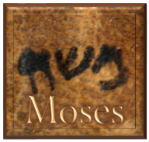
This is the name “Mosheh” (מֺשֶׁה – Moses) as seen in the Dead Sea Scrolls, written over two thousand years ago.
Today in the Bible, we are remembering the day of the Firstfruits offering. It’s one of the Appointed Times listed in Leviticus 23 and, as we’re learning, they are a shadow the Messiah. We’ll explore the connection between the Firstfruits and our Messiah further as we move through this momentous day.
The LORD said to Moses, “Speak to the Israelites and say to them: `When you enter the land I am going to give you and you reap its harvest, bring to the priest a sheaf of the first grain you harvest. He is to wave the sheaf before the LORD so it will be accepted on your behalf; the priest is to wave it on the day after the Sabbath. On the day you wave the sheaf, you must sacrifice as a burnt offering to the LORD a lamb a year old without defect, together with its grain offering of two-tenths of an ephah of fine flour mixed with oil–an offering made to the LORD by fire, a pleasing aroma–and its drink offering of a quarter of a hin of wine. You must not eat any bread, or roasted or new grain, until the very day you bring this offering to your God. This is to be a lasting ordinance for the generations to come, wherever you live. From the day after the Sabbath, the day you brought the sheaf of the wave offering, count off seven full weeks.” – Leviticus 23:9-15 (NIB)
There is some disagreement as to what the “day after the Sabbath” means in the verses above. Thus, the question, when do we start counting the seven full weeks? One line of thought is that it refers to the weekly Sabbath which falls during the seven-day long Feast of Unleavened Bread. A second line of thought is that it refers to the first day of the Feast of Unleavened Bread which is a special Sabbath day, no matter what day of the week it falls upon.
Karaite Jews and Israeli Samaritans begin counting the Omer (that is the seven full weeks) on the day after the weekly Sabbath which falls during the Feast of Unleavened Bread, rather than on the second day of the Feast of Unleavened Bread (the 16th of Nisan). The purpose of counting the seven full weeks is to celebrate the next appointed time on God’s calendar, Shavu’ot (aka the Feast of Weeks or Pentecost). Shavu’ot is the only one of God’s holidays for which the date is not expressly given in the Torah. Instead, the Torah tells us to determine the date of Shavu’ot by counting the days. For Karaite Jews and Israeli Samaritans, Shavu’ot always falls on a Sunday. This causes the holiday to fall on a different calendar date each year which complements the fact that the Torah does not give us an exact date.
Rabbinic Jews understand “the Sabbath” as the first day of the Feast of Unleavened Bread, Nisan 15 – thus, they start counting on Nisan 16. The counting of Karaite and Rabbinic Jews coincides when the first day of the Feast of Unleavened Bread is on the regular weekly Sabbath – but that doesn’t happen every year. So, what do we do?
There are many Christians who have taken hold of their Jewish roots. There are some Jews who are believers in Jesus as the Messiah. These groups are sometimes identified as Messianic Judaism. There are some in the Messianic movement who cast their lot in with Rabbinic Judaism’s system for counting the Omer. Why? Their argument comes from the verses below.
Then Jesus spoke to the multitudes and to His disciples, saying: “The scribes and the Pharisees sit in Moses’ seat. Therefore whatever they tell you to observe, that observe and do, but do not do according to their works; for they say, and do not do. For they bind heavy burdens, hard to bear, and lay them on men’s shoulders; but they themselves will not move them with one of their fingers. But all their works they do to be seen by men. They make their phylacteries broad and enlarge the borders of their garments. They love the best places at feasts, the best seats in the synagogues, greetings in the marketplaces, and to be called by men, `Rabbi, Rabbi.’
“But you, do not be called `Rabbi’; for One is your Teacher, the Christ, and you are all brethren. Do not call anyone on earth your father; for One is your Father, He who is in heaven. And do not be called teachers; for One is your Teacher, the Christ. – Matthew 23:1-10 (NKJ)
By counting the Omer in the manner of Rabbinic Judaism, they are following the command of Yeshua (Jesus) – our One Teacher. Yeshua respected the authority granted to the scribes and the Pharisees by the Torah.
So what should you do? This is an ancient controversy which goes back about two thousand years and is still in place today. Greater Judaism will begin “Counting the Omer” tonight. The others will wait until Saturday evening. Whichever way you choose to count, just be sure you understand the reasoning behind your choice.
Did you know that you can view any of our posts whenever you’d like?
Visit our home page at https://todayinthebible.com
where you can find them organized by month
in the “Archives” section on the right side of the page.

© 2026 Today in the Bible

 Today in the Bible
You must be logged in to post a comment.