
Nisan 22, 5785; from sunset April 19, 2025, to sunset April 20, 2025
(The twenty-second day of the first month)

Easter vs. Passover
If the Today in the Bible blog is all about placing biblical dates on today’s calendar, why hasn’t there been any posts this past week for holy week? No Palm Sunday. No Last Supper. No Good Friday. Why isn’t there a post today for Easter?
In 325 AD, the First Council of Nicaea was held. It was “was the first time that any attempt had been made to summon a general council of the whole ‘church.’”[1] One of the outcomes of the council was a dating system established for remembering the resurrection of Jesus (i.e. it’s important for everyone to be on the same page). This celebration later became known as “Easter.” The council determined that it should be held on the first Sunday after the first Full Moon occurring on or after the vernal equinox. If the Full Moon is on a Sunday, Easter is celebrated on the following Sunday. Therefore, the dating for Easter was defined by the Council of Nicaea and dependent upon the date of the spring equinox and the Full Moon.
| Easter | Passover |
| Timing defined by the Council of Nicaea | Timing defined by God |
| Vernal equinox | Lunar month |
| Full Moon | State of the barley crop in Israel |
The dating for Passover, however, is defined by God and is dependent upon the lunar month and the state of ripeness of the barley crop in Israel. Let’s work through it.
In Leviticus chapter 23, God gives us a listing of His self-proclaimed holy days. These are called “Appointed Times” and they are important days. Since we’re dealing with the question of the timing of Easter and Passover, let’s take a look at God’s instructions for observing His Appointed Time of Passover.
`On the fourteenth day of the first month at twilight is the LORD’s Passover.’ – Leviticus 23:5 (NKJ)
Ok. So, how is a biblical month defined, how do we determine the 14th day, and when is the first month of the year?
How is a Biblical Month Defined?
Now the LORD spoke to Moses and Aaron in the land of Egypt, saying, “This month shall be your beginning of months; it shall be the first month of the year to you.” – Exodus 12:1-2 (NKJ)
The Scripture above is recognized as a commandment to sanctify the crescent New Moon and establish a lunar calendar. This is considered to be the first commandment Israel was given as a nation (i.e. it’s important for everyone to get on the same page). The word “month” in these verses is the Hebrew word “chodesh.” Chodesh (“khoe-desh”) is a word used throughout the Hebrew Scriptures for the word “Moon” or “month.” It comes from a verb meaning “to renew or repair.” The Moon waxes and wanes throughout its cycle and is “renewed” again each month. It takes the Moon roughly 29 ½ days to cycle through all of its phases. Because of this, generally, if one month is 29 days, the next one will be 30 days.
How Do We Determine the 14th Day of the Month?
In astronomy, the New Moon is defined as the phase of the Moon when “the lunar disk is not visible to the naked eye, except when it is silhouetted against the Sun during a solar eclipse.”[2] The definition of the biblical New Moon is the first visible crescent of the Moon after it has completed its full cycle.
In the days of the Sanhedrin, the first day of each month was sanctified upon the word of two witnesses who testified to seeing the first sliver of the crescent New Moon. There are some who argue that the astronomical New Moon is the same as the biblical New Moon; however, the majority opinion is that the Moon must be seen in order to be sanctified. Therefore, if the astronomical New Moon cannot be seen on a monthly basis, it cannot be sanctified. So, that makes the first day of the biblical month the first time the crescent New Moon is seen. Each subsequent day of the month is then reckoned by the apparent waxing or waning of the Moon. This places the Full Moon on the 14th or 15th day of the biblical month and the astronomical New Moon on the last day of the biblical month.
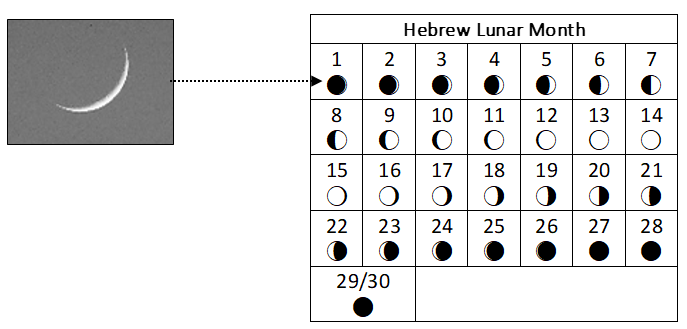
This year, Passover began at sunset on April 11th
and the Feast of Unleavened Bread began at sunset on April 12th.
When is the First Month of the Year?
God further defines the first month.
“Observe the month of Abib, and keep the Passover to the LORD your God, for in the month of Abib the LORD your God brought you out of Egypt by night. Therefore you shall sacrifice the Passover to the LORD your God, from the flock and the herd, in the place where the LORD chooses to put His name. You shall eat no leavened bread with it; seven days you shall eat unleavened bread with it, that is, the bread of affliction (for you came out of the land of Egypt in haste), that you may remember the day in which you came out of the land of Egypt all the days of your life.” – Deuteronomy 16:1-3 (NKJ)
These verses once again mention Passover, as well as the Feast of Unleavened Bread. Earlier we looked to Leviticus chapter 23 to give us the date for Passover. The subsequent verses give us the dates for the Feast of Unleavened Bread.
`And on the fifteenth day of the same month is the Feast of Unleavened Bread to the LORD; seven days you must eat unleavened bread. On the first day you shall have a holy convocation; you shall do no customary work on it. But you shall offer an offering made by fire to the LORD for seven days. The seventh day shall be a holy convocation; you shall do no customary work on it.’” – Leviticus 23:6-8 (NKJ)
But why does Deuteronomy 16:1-3 call the month “Abib” instead of the “first month?” Abib, which may also be transliterated as “Aviv,” is a Hebrew word that means “barley.” Specifically, barley that is already ripe, but still soft, the grains of which are eaten either rubbed or roasted. The first month of the year is sometimes referred to as the month of Abib because of the barley crop that ripens during that timeframe.
So, the date for Passover is not always on a Friday, it’s whatever weekday the 14th day of the first month occurs. That means the day we recognize as Easter, is not always on a Sunday. Yes, in the Bible, the resurrection occurred on the first day of the week…Sunday…but that was specific to that year.
In Leviticus 23, after God gives us the dates for His Appointed Times of Passover and the Feast of Unleavened Bread, He gives the command to offer a sheaf of the firstfruits of the harvest.
And the LORD spoke to Moses, saying, “Speak to the children of Israel, and say to them: `When you come into the land which I give to you, and reap its harvest, then you shall bring a sheaf of the firstfruits of your harvest to the priest. He shall wave the sheaf before the LORD, to be accepted on your behalf; on the day after the Sabbath the priest shall wave it. And you shall offer on that day, when you wave the sheaf, a male lamb of the first year, without blemish, as a burnt offering to the LORD. Its grain offering shall be two-tenths of an ephah of fine flour mixed with oil, an offering made by fire to the LORD, for a sweet aroma; and its drink offering shall be of wine, one-fourth of a hin. You shall eat neither bread nor parched grain nor fresh grain until the same day that you have brought an offering to your God; it shall be a statute forever throughout your generations in all your dwellings. – Leviticus 23:9-14 (NKJ)
Leviticus 2:14 helps us to define what kind of grain the sheaf of the firstfruits is:
`If you offer a grain offering of your firstfruits to the LORD, you shall offer for the grain offering of your firstfruits green heads of grain (“abib”) roasted on the fire, grain beaten from full heads.’ – Leviticus 2:14 (NKJ)
It’s abib, barley that is already ripe, but still soft. Our Father was making it known that it was important to Him that we associate His calendar with the harvest season. Earlier we learned that, in the days of the Sanhedrin, the first day of each month was sanctified upon the word of two witnesses who testified to seeing the first sliver of the crescent moon. The first month of the year had an additional stipulation for sanctification, the barley crop must have achieved the appropriate level of ripeness to be considered “abib.”
So the first month of the year, which later became known by its Babylonian name – Nisan – was to be recognized in the springtime and was dependent upon the state of the barley crop. It was during this lunar cycle that the Appointed Times of Passover, the Feast of Unleavened Bread and the Firstfruits offering were to be observed.
Why Is Any of This Important?
Our God is a God of order. Even from the very first, from the creation narrative itself, He begins separating and sorting and setting things in place. He created order out of chaos. On the fourth day, He set about organizing time.
Then God said, “Let there be lights in the firmament of the heavens to divide the day from the night; and let them be for signs and seasons, and for days and years; and let them be for lights in the firmament of the heavens to give light on the earth”; and it was so. Then God made two great lights: the greater light to rule the day, and the lesser light to rule the night. He made the stars also. God set them in the firmament of the heavens to give light on the earth, and to rule over the day and over the night, and to divide the light from the darkness. And God saw that it was good. So the evening and the morning were the fourth day. – Genesis 1:14-19 (NKJ)
The word “seasons,” which has been underlined above, is the Hebrew word “mo’adim” (“moe-ah-deem”). This word comes from the root “ya’ad” which means “to point, betrothe, assemble, meet, or set.” Related words are:
- edah — meaning congregation.
- mo’ed — meaning an appointed place.
- mo’ad — meaning a place of assembly.
- mu’adah — which is used only once in the Bible to refer to appointed cities.
It’s the same word used in Leviticus 23 where God gives us a list of His self-proclaimed holy days — His Appointed Times. As you can see from the definitions above, they are set (appointed) times for God’s people to gather together (i.e. it’s important for everyone to get on the same page). These Appointed Times are something that are ordered by the luminaries God placed into the heavens on the fourth day of creation. The calendar that God had Moses inaugurate before delivering them from Egypt is based upon the luminaries, just as He proclaimed them to be in the beginning. The universe is a great clockwork.
When Jesus first came to dwell with mankind, He had a mission. Even His name hinted at what His mission would be. In Hebrew, Jesus’ name is “Yeshua.” It comes from the verb “yasha” meaning “to save or deliver.” Before His birth, an angel appeared to Joseph in a dream and said,
“Joseph, son of David, do not be afraid to take to you Mary your wife, for that which is conceived in her is of the Holy Spirit. And she will bring forth a Son, and you shall call His name JESUS [“YESHUA” – “SALVATION”], for He will save [“yasha”] His people from their sins.” – Matthew 1:20-21 (NKJ)
When reading through Leviticus 23, we can see that Jesus fulfilled the first portion of the LORD’s Appointed Times. And He fulfilled them on the day appointed by His Father.
- He was chosen as the Passover Lamb by the people, on the day God told the people to choose their Passover lamb. Just as the blood of the lamb was placed on the doorposts in Egypt to save the people from the angel of death, so too, the blood of Jesus needs to be placed on the doorposts of our hearts to be saved from the wages of sin…death.
- He was inspected for blemishes by the priests and scribes in the Temple (they critiqued His teachings) during the days that the people were told to inspect their lambs for blemishes – only a perfect lamb could be sacrificed.
- He was sacrificed on the 14th day of the first month, the day appointed by God to slaughter the Passover lamb.
- He rested in the grave on the first day of the Feast of Unleavened Bread, a special Sabbath Day prescribed by His Father.
- And, on the day the Firstfruits were to be offered before the LORD in the Temple, Jesus was resurrected from the dead and became the Firstfruits of those who have fallen asleep (1 Corinthians 15:20) – so we, too, can be resurrected at the time appointed by God.
There are still more Appointed Times to be fulfilled from Leviticus 23 and we expect Jesus to complete them…on the day prescribed by His Father…when He returns. This is our answer to the question, “Why is any of this important?” And that is why Today in the Bible is following the biblical calendar. We hope you’ll follow our posts carefully, especially during the first month of the year. The month of Abib. The month of Nisan. We intend to show the correlations between many biblical accounts and God’s Appointed Times. They are deep. They are perfectly planned. And they paint us a picture of who God is, His plan for salvation, and how His Son accomplished that for us.
For a deeper explanation of how time is defined in the biblical calendar, you can read our other articles in the Time in the Bible section of our blog.
[1] Hanson RPC, The Search for the Christian Doctrine of God: The Arian Controversy, 318-381. 1988, page 152
[2] https://en.wikipedia.org/wiki/New_moon
Did you know that our posts are categorized and tagged by content?
When you visit our home page at https://todayinthebible.com and select any post,
you can find the associated categories and tags just to the right of the title.
Simply click on any tag and you will be taken to all related posts.

© 2026 Today in the Bible

 Today in the Bible
You must be logged in to post a comment.