
April/May
Iyyar (אִיָּר) – 2nd month; 29 days
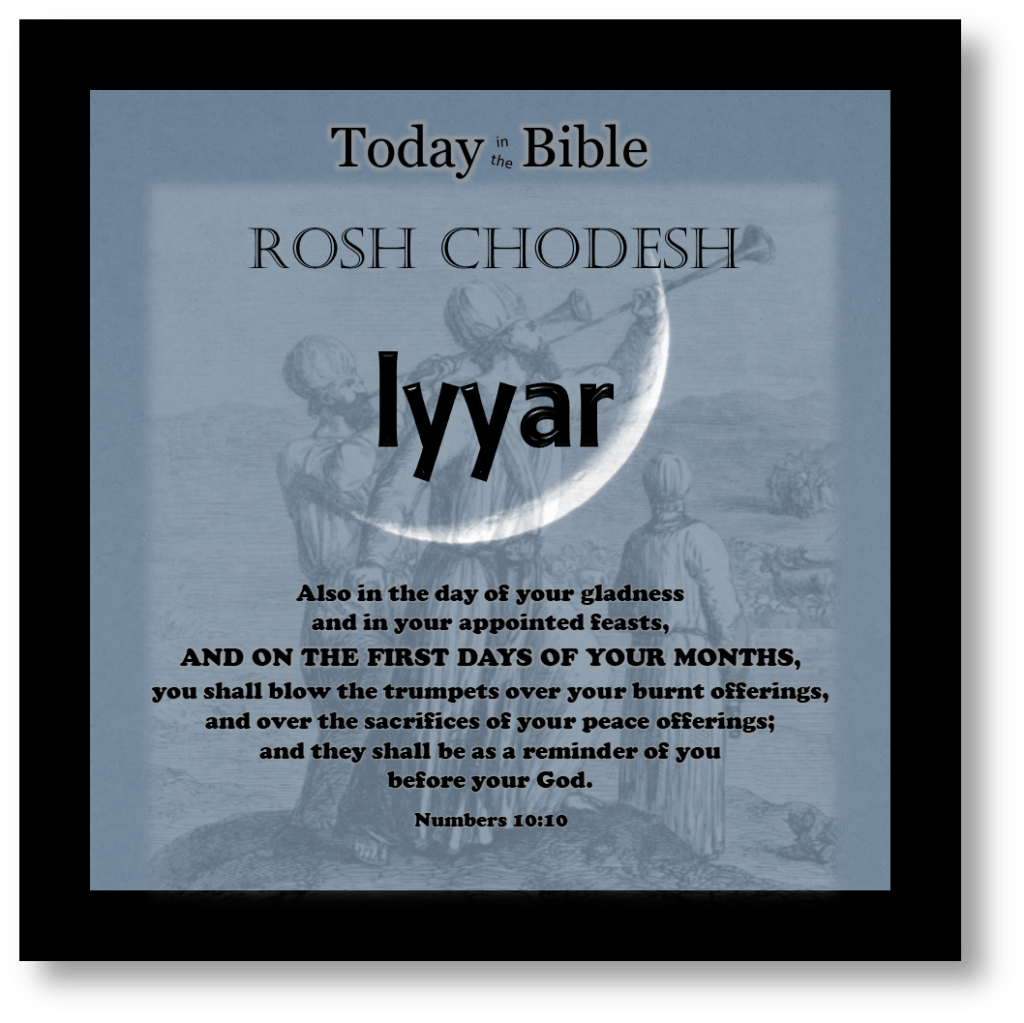
Also, in the day of your gladness, in your appointed feasts, and at the beginning of your months, you shall blow the trumpets over your burnt offerings and over the sacrifices of your peace offerings; and they shall be a memorial for you before your God: I am the LORD your God. – Numbers 10:10 (NKJ)
Iyyar (אִיָּר) is the second month of the biblical calendar. The Hebrew name “Iyyar” is cognate to an Akkadian word (“ayyaru”) meaning “rosette” or “blossom” – stemming from the flowers in bloom during this month.
Before the Babylonian exile, this month was referred to as the second month and, in 1 Kings, it was called “Ziv” which means “to bloom.”
And it came to pass, in the four hundred and eightieth year after the going forth of the children of Israel out of the land of Egypt, in the fourth year, in the month Ziv, which is the second month, of the reign of Solomon over Israel, that he built the house unto the Lord. – 1 Kings 6:1 (LEE)
Before the exodus from Egypt, this month was known as the eighth month of the year. But God changed the order of the months when He delivered the children of Israel from their bondage in Egypt. From then on, He wanted them to count their months beginning with the month that they were freed and became a nation.
Another thought is that the name Iyyar may come from a Babylonian word meaning “to heal.” Just a few days ago we remembered how God revealed Himself as “Ani ADONAI Rofecha” – I am the LORD, your Healer (Exodus 15:26). When this verse is spelled in Hebrew, it reads…
אֲנִי יְהוָֹה רֹפְאֶךָ
Hebrew is read from right to left, therefore, if we take the first letter on the right of each word, it spells “Iyyar.” I am the LORD your Healer.
אִיָּר
In previous posts, we promised to remember places in the Bible where the New Moon is mentioned. This month we’ll recall a story from the days of Elisha and his interactions with the Shunammite woman. Let’s review the prelude to the mention of the New Moon in our story.
There was a “notable woman” who lived in Shunem. The word translated as “notable” is the Hebrew word “gadol.” Gadol is often translated as “great” and may indicate that she was either righteous, wealthy, or both. She took note of Elisha and offered him food. She, then, went even further in her generosity and asked her husband to build a room for him on the roof of their home and furnish it. Elisha was then welcome to stay at any time he had need. Elisha took note of her kindness and wanted to do something for her in return. The woman’s husband was old, and she had no son, so Elisha promised that she would bear a son within the next year. This came to pass as he said, and the child grew. Then, one day during the harvest, her son had a terrible headache and he died. This is where we pick up our text…
And the child grew. Now it happened one day that he went out to his father, to the reapers. And he said to his father, “My head, my head!”
So he said to a servant, “Carry him to his mother.”
When he had taken him and brought him to his mother, he sat on her knees till noon, and then died. And she went up and laid him on the bed of the man of God, shut the door upon him, and went out. Then she called to her husband, and said, “Please send me one of the young men and one of the donkeys, that I may run to the man of God and come back.”
So he said, “Why are you going to him today? It is neither the New Moon nor the Sabbath.”
And she said, “It is well.”
Then she saddled a donkey, and said to her servant, “Drive, and go forward; do not slacken the pace for me unless I tell you.”
And so she departed, and went to the man of God at Mount Carmel. So it was, when the man of God saw her afar off, that he said to his servant Gehazi, “Look, the Shunammite woman! – 2 Kings 4:18-25
Elisha then goes on to bring the boy back from death. We’re remembering this story now because the text mentions that the boy was going out to meet his father and “the reapers.” We’re making the assumption that the reapers were harvesting either barley or wheat – both crops are ready for harvest in the months of April-June.
The text also tells us that the boy did NOT die on the New Moon. Did you catch that? Her husband didn’t understand why she was going to see the prophet – since it was not a New Moon or a Sabbath. From this, scholars reckon that it was common to go see a prophet on the New Moon. The dating of many of Ezekiel’s prophecies back up this theory, as several of them are dated to the first day of the month…the New Moon.
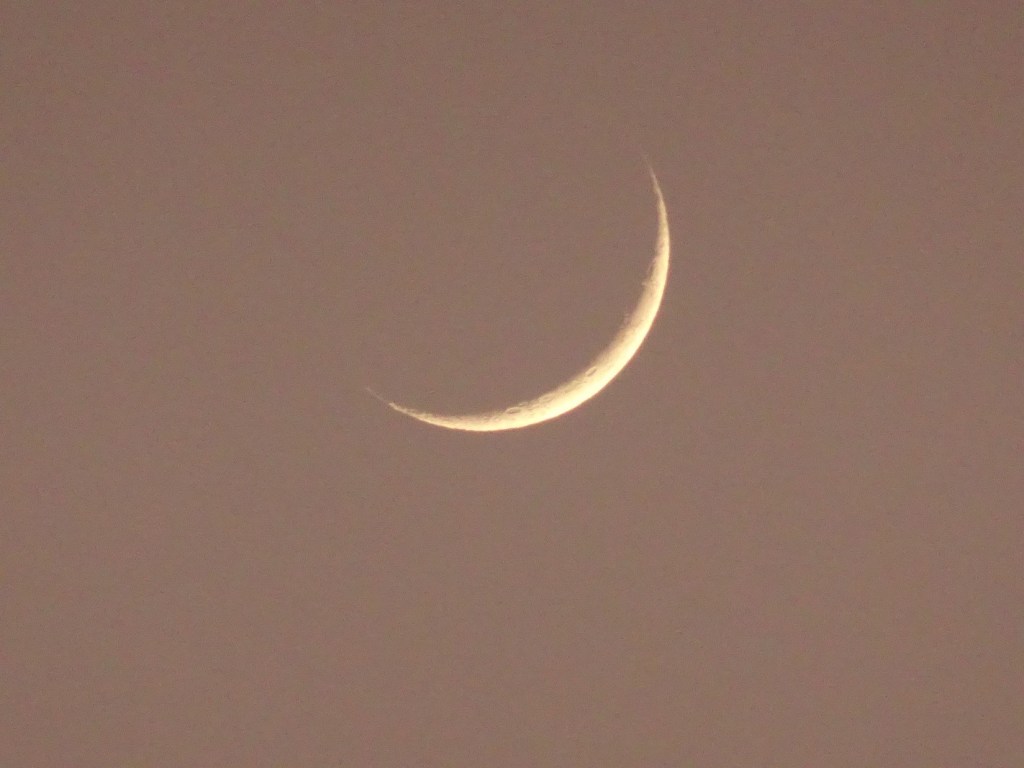
We hope that you’ll consider making it a part of your daily routine to pay attention to what phase the Moon is in. It will help you to connect with God’s calendar. You can join the many generations who, throughout the millennia, have used it to order their days.
Some of the highlights for the month of Iyyar are:
- The foundations for both the 1st and 2nd Temples were laid.
- The second Passover, “Pesach Sheni.”
- Manna begins to fall.
- Jesus’ ascension.
We hope you’ll continue to join us to learn what all happened this month in the Bible.
Many congregations take the opportunity to bless the upcoming new month on the Sabbath before. The blessing takes on different forms depending upon the congregation, below is a sample blessing.
Birkat Hachodesh
May it be Your will, LORD, our God and God of our fathers,
that You begin for us this month of Iyyar
for goodness and for blessing.
May You give to us long life,
a life of peace,
a life of goodness,
a life of blessing,
a life of sustenance,
a life of physical health,
a life in which there is fear of heaven and fear of sin,
a life in which there is no shame or humiliation;
a life of wealth and honor,
a life in which we love Torah and fear God;
a life in which the LORD fulfills the requests of our hearts for good.
Amen. Selah.
Did you know that you can view any of our posts whenever you’d like?
Visit our home page at https://todayinthebible.com
where you can find them organized by month
in the “Archives” section on the right side of the page.

© 2026 Today in the Bible

 Today in the Bible
You must be logged in to post a comment.