

Iyyar 3, 5785; from sunset April 30, 2025, to sunset May 1, 2025
(The third day of the second month)
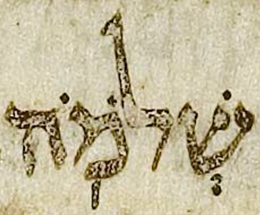
This is the name “Shelomoh” (שְׁלׄמׄה – Solomon) as seen in the Aleppo Codex, written over one thousand years ago. The name Solomon stems from the verb-root “shalam” meaning “to be complete, sound, or peaceful.” It’s the same root that the familiar word “shalom” comes from.
Today in the Bible, we’re going to take a moment to celebrate spring and the joy of love by exploring a few verses from the Song of Solomon. It’s springtime in Israel and the grape vines and pomegranate trees are in bloom.
לְכָה דוֹדִי נֵצֵא הַשָּׂדֶה נָלִינָה בַּכְּפָרִים
Lechah dodi, netze hassadeh, nalinah bakfarim.
Let’s go my love, let’s go out to the field, we will lodge in the villages.
נַשְׁכִּימָה לַכְּרָמִים
Nashkimah lakeramim.
We will go early to the vineyards.
נִרְאֶה אִם פָּרְחָה הַגֶּפֶן פִּתַּח הַסְּמָדַר
Nir’eh im parchah hagefen, pitach hasmadar,
We will see if the vines are budding, their blossoms are opening,
הֵנֵצוּ הָרִמּוֹנִים
henetzu harimmonim.
the pomegranate trees have bloomed.
שָׁם אֶתֵּן אֶת-דֹּדַי לָךְ
Sham eten et-dodai lach.
There I will give my love to you.
הַדּוּדָאִים נָתְנוּ-רֵיחַ
Haduda’im natnu-rei-ach,
The mandrakes will give us their fragrance,
וְעַל-פְּתָחֵינוּ כָּל-מְגָדִים
ve’al petacheinu kol-megadim,
and upon our doorways, all excellent things,
חֲדָשִׁים גַּם-יְשָׁנִים
chadashim gam-yeshanim,
the new ones, also the old ones,
דּוֹדִי צָפַנְתִּי לָךְ
dodi tzafanti lach.
my love, I will store up for you.
-Song of Solomon 7:11-13
It’s spring and love is in the air…and in the Hebrew! The words listed below are all included in the above verses, and they all come from the same verb-root – דוד (dalet-vav-dalet) – meaning to love or fondle.
- dodi (דּוֹדִי) – my love
- dodai (דֹּדַי) – my love
- haduda’im (הַדּוּדָאִים) – the mandrakes
A couple of days ago, we learned about the root of these words when we studied the commander for this month – Dodai. Dodai was appointed by King David (דָּוִד), whose name also comes from the same root word.
But how does a mandrake fall into the category of love? A mandrake is a plant which oftentimes has roots that appear humanoid…they can look like babies! In ancient times, they were thought to increase fertility.

Lechah Dodi
You may recognize the first two Hebrew words in Song of Solomon 7:12 – “lechah dodi.” Lechah Dodi is the name of a song composed in the 1600s, inspired by the Song of Solomon. In the song, my beloved and I are going out to meet the “bride” – which is the Sabbath. It is sung on Friday evenings to usher in the Sabbath.
It is said that for six thousand years, between Adam and the advent of the Messianic Era, man is appointed to work. These six thousand years correspond to the six days of Creation when God labored. The weekly Sabbath is a foreshadowing of the one-thousand-year reign of the Messiah (a time when each man will have his own vine and fig tree). In a Psalm attributed to Moses, we are told of the comparison of one day unto the LORD and a thousand years to mankind. The apostle Peter echoes this sentiment in one of his epistles.
For a thousand years in Your sight are like yesterday when it is past, and like a watch in the night. – Psalm 90:4 (NKJ).
But, beloved, do not forget this one thing, that with the Lord one day is as a thousand years, and a thousand years as one day. – 2 Peter 3:8 (NKJ)
The song is traditionally sung in Hebrew; below are the translated lyrics.
Lechah Dodi
Chorus:
Let’s go, my beloved, to meet the bride,
and let us welcome the presence of Shabbat.
“Safeguard” and “Remember” in a single utterance,
We were made to hear by the unified God,
God is one and God’s Name is one,
In fame and splendor and praiseful song.
To greet Shabbat let’s go, let’s travel,
For she is the wellspring of blessing,
From the start, from ancient times she was chosen,
Last made, but first planned.
Sanctuary of the king, royal city,
Arise! Leave from the midst of the turmoil;
Long enough have you sat in the valley of tears
And He will take great pity upon you compassionately.
Shake yourself free, rise from the dust,
Dress in your garments of splendor, my people,
By the hand of Jesse’s son of Bethlehem,
Redemption draws near to my soul.
Rouse yourselves! Rouse yourselves!
Your light is coming, rise up and shine.
Awaken! Awaken! Utter a song,
The glory of the Lord is revealed upon you.
Do not be embarrassed! Do not be ashamed!
Why be downcast? Why groan?
All my afflicted people will find refuge within you
And the city shall be rebuilt on her hill.
Your despoilers will become your spoil,
Far away shall be any who would devour you,
Your God will rejoice concerning you,
As a groom rejoices over a bride.
To your right and your left you will burst forth,
And the Lord will you revere
By the hand of a child of Peretz,
We will rejoice and sing happily.
Come in peace, crown of her husband,
Both in happiness and in jubilation
Amidst the faithful of the treasured nation
Come O Bride! Come O Bride!
Come O Bride! Shabbat Queen!
“Safeguard and Remember” these lyrics harken back to the Ten Commandments and remind us that it is incumbent upon us to guard the Sabbath day and keep it holy. On a weekly basis, we can “leave from the midst of the turmoil” which arises from the dustiness of our earthly lives; and, for one day a week, relish in the rest that God has prepared for us. We can spend one day a week enjoying peace and prosperity under the vine and fig tree.
The song recognizes the “son of Jesse of Bethlehem” as our Redeemer and alludes to the resurrection of the dead (awake! rouse yourself!). It calls us to dress in our “garments of splendor.” It is traditional to save the best of the week for the Sabbath – the best food, the best wine, and wear your best clothes. The “garments of splendor” which we wear on the Sabbath may be compared to the garments of “incorruption” and “immortality” spoken of by Paul in 1 Corinthians.
Behold, I tell you a mystery: We shall not all sleep, but we shall all be changed–in a moment, in the twinkling of an eye, at the last trumpet. For the trumpet will sound, and the dead will be raised incorruptible, and we shall be changed. For this corruptible must put on incorruption, and this mortal must put on immortality. – 1 Corinthians 15:51-53 (NKJ)
In our post “The First Yom Kippur?“, we compared the garments of skin, which God made for Adam and Eve after their sin, to Paul’s statement above. Adam and Eve were changed from immortal to mortal when they sinned. When we choose Jesus as our Savior, our mortal bodies will be changed to immortal in the resurrection – an undoing of what was done in Eden. By wearing our best clothing on the Sabbath, we are rehearsing for that day.
Exodus 31:13-18 tells us that the Sabbath was a sign between God and the children of Israel. By keeping the Sabbath, they would know that He is the LORD who sanctifies them. As believers in Jesus, it is no different for us. Observing the weekly Sabbath is a statement we can make now to show that Jesus is our Messiah who has sanctified us. We can keep the Sabbath in honor of Him and His future Messianic reign. Solomon wrote, “Nashkimah lekeramim” (we will go early to the vineyards) – by ceasing our labors on the Sabbath, we too can “go early” to the vineyards of the Messianic Era.
Did you know that you can see all of our posts on King Solomon in one place? Just click on the image above.

© 2026 Today in the Bible

 Today in the Bible
You must be logged in to post a comment.