
Sivan 5, 5785; from sunset May 31, 2025, to sunset June 1, 2025
(The fifth day of the third month)
The Bible tells us that Reuben found the mandrakes during the wheat harvest. Tradition tells us that event occurred on this day.
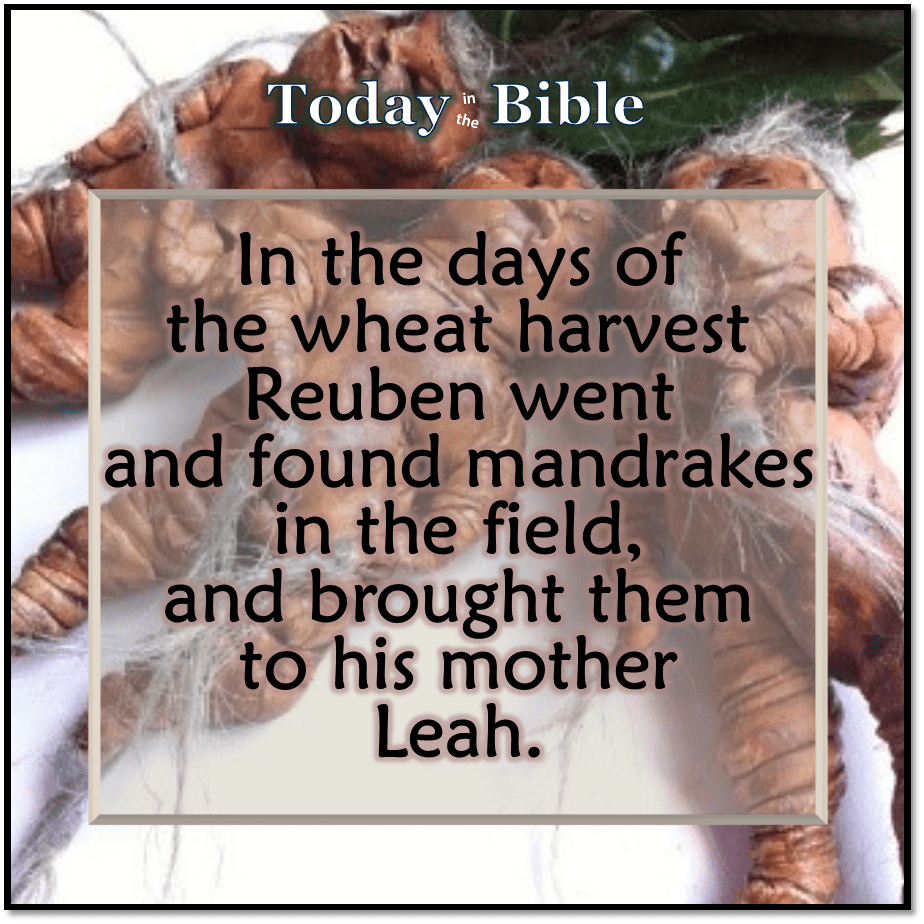
In the days of the wheat harvest Reuben went and found mandrakes in the field, and brought them to his mother Leah. Then Rachel said to Leah, “Give me, I pray, some of your son’s mandrakes.” But she said to her, “Is it a small matter that you have taken away my husband? Would you take away my son’s mandrakes also?” Rachel said, “Then he may lie with you tonight for your son’s mandrakes.”
When Jacob came from the field in the evening, Leah went out to meet him, and said, “You must come in to me; for I have hired you with my son’s mandrakes.” So he lay with her that night. And God hearkened to Leah, and she conceived and bore Jacob a fifth son. Leah said, “God has given me my hire because I gave my maid to my husband”; so she called his name Issachar. – Genesis 30:14-18 (RSV)
The Testaments of the Twelve Patriarchs is pseudepigraphic book of the dying words of the twelve sons of Jacob. It is considered apocalyptic literature. The Testaments were written in Hebrew or Greek, and reached their final form in the 2nd century CE. Below is a portion of the Testament of Issachar regarding the story of the mandrakes and his birth.
I was born the fifth son to Jacob, by way of hire for the mandrakes. For Reuben my brother brought in mandrakes from the field, and Rachel met him and took them. And Reuben wept, and at his voice Leah my mother came forth. Now these (mandrakes) were sweet-smelling apples which were produced in the land of Haran below a ravine of water.
And Rachel said: I will not give them to thee, but they shall be to me instead of children. For the Lord hath despised me, and I have not borne children to Jacob. Now there were two apples; and Leah said to Rachel: Let it suffice thee that thou hast taken my husband: wilt thou take these also?
And Rachel said to her: Thou shalt have Jacob this night for the mandrakes of thy son. And Leah said to her: Jacob is mine, for I am the wife of his youth. But Rachel said: Boast not, and vaunt not thyself; for he espoused me before thee, and for my sake he served our father fourteen years. And had not craft increased on the earth and the wickedness of men prospered, thou wouldst not now see the face of Jacob. For thou art not his wife, but in craft wert taken to him in my stead. And my father deceived me, and removed me on that night, and did not suffer Jacob to see me; for had I been there, this had not happened to him. Nevertheless, for the mandrakes I am hiring Jacob to thee for one night. And Jacob knew Leah, and she conceived and bare me, and on account of the hire I was called Issachar.
Then appeared to Jacob an angel of the Lord, saying: Two children shall Rachel bear, inasmuch as she hath refused company with her husband, and hath chosen continency. And had not Leah my mother paid the two apples for the sake of his company, she would have borne eight sons; for this reason she bare six, and Rachel bare the two: for on account of the mandrakes the Lord visited her. For He knew that for the sake of children she wished to company with Jacob, and not for lust of pleasure. For on the morrow also she again gave up Jacob. Because of the mandrakes, therefore, the Lord hearkened to Rachel. For though she desired them, she eat them not, but offered them in the house of the Lord, presenting them to the priest of the Most High who was at that time. – Testament of Issachar 1:2-2:5 (OTP)
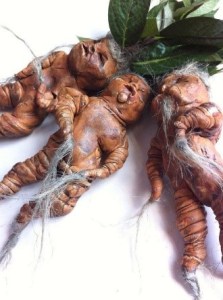
So why did Rachel say, “they shall be to me instead of children?” Mandrakes, or love apples, are a peculiar plant. They are part of the nightshade family and often their root takes a humanoid form. Because of this they have been used in pagan fertility rituals.
The Hebrew word for mandrake is “dudai,” which comes from the root “dod.” The verb root is thought to have something to do with fondling or love-making. This root is not used in the Bible as a verb – however, several nouns that come from the root are. The words, “beloved,” “uncle,” “aunt,” and “David” originate in this root. The word “jar” also comes from this root – perhaps due to the similarity of its shape to a woman’s breast – and both are containers of a sort. Hence, the word-play connection to Rachel and Leah’s conversation.
“They shall be unto me instead of children”
Rachel must have been hurting so badly for a child that she was like, “just give me these as babies since I can’t have any of my own; you can sleep with Jacob for all the good it does me!”
It must have felt like a slap in the face when it was “Reuben” who found them. Reuben’s name means – ra’ah (see), ben (son) – and here he comes back from the field, holding more “sons” – the baby-like mandrakes. She must’ve been on the verge of crazy and couldn’t take any more. To top it all off, Leah became pregnant from this encounter and gave birth to another son, Issachar. Sometimes we want something so badly that pain is the only thing we can see. Perhaps Rachel was dominating Jacob’s time and the act of letting him go to Leah was a way of giving up on trying to control the situation herself and hand everything over to God instead. In the end God blessed both Leah and Rachel in His own timing…and all of the sons of Jacob become the nation of Israel.
Did you know that you can view any of our posts whenever you’d like?
Visit our home page at https://todayinthebible.com
where you can find them organized by month
in the “Archives” section on the right side of the page.

© 2026 Today in the Bible

 Today in the Bible
You must be logged in to post a comment.