
Sivan 13, 5785; from sunset June 8, 2025, to sunset June 9, 2025
(The thirteenth day of the third month)
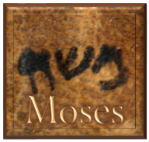
This is the name “Mosheh” (מֺשֶׁה – Moses) as seen in the Dead Sea Scrolls, written over two thousand years ago.
God phoned Moses the day after He spoke the Ten Commandments and said, “Hey Mo, wanna come up?” Moses said, “OK Boss,” and he climbed up the mountain, rang the doorbell, and God called out to him, “Just a minute, Moses.” (He probably wanted to tidy up a bit.) Six days later, God opened the door, invited Moses in, and started showing him around the place.
We’ve heard that a thousand years is like a day to the Lord…and now we know that six days is like a minute. 😉 Ok, so maybe the sages have a different view on the whole six-day waiting thing…they see it as a period of cleansing…not a cleansing as in God tidying up the place…but a period of cleansing for Moses before he can enter into the presence of God.
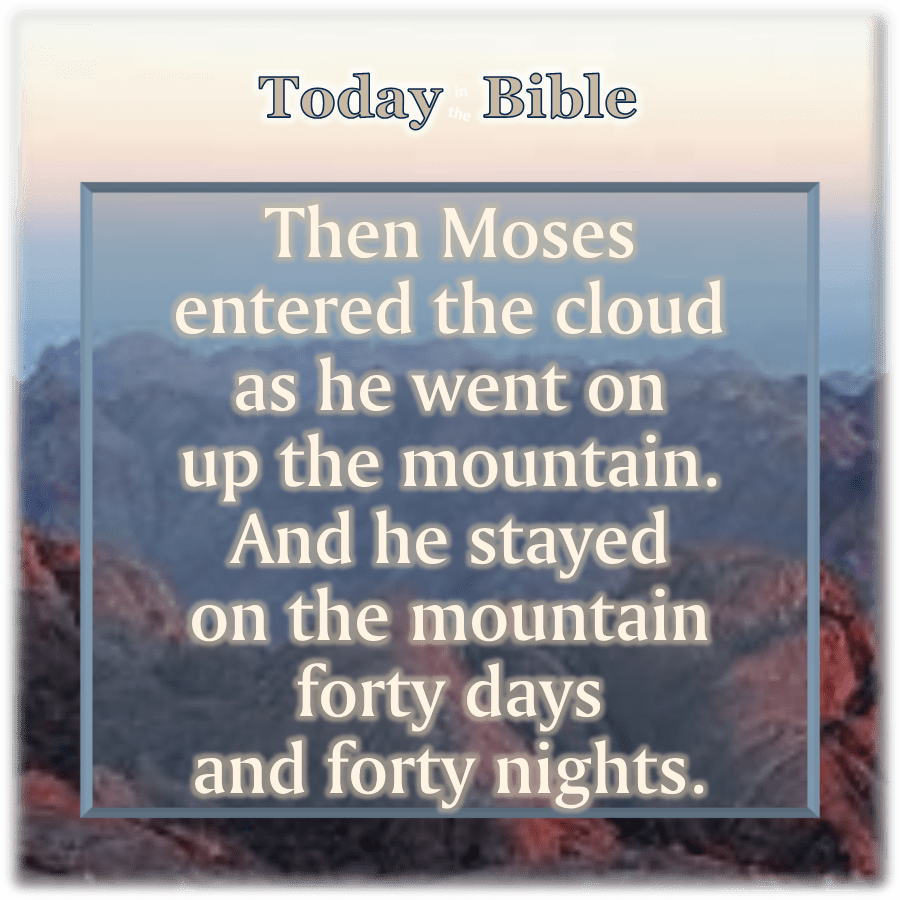
When Moses went up on the mountain, the cloud covered it, and the glory of the LORD settled on Mount Sinai. For six days the cloud covered the mountain, and on the seventh day the LORD called to Moses from within the cloud. To the Israelites the glory of the LORD looked like a consuming fire on top of the mountain. Then Moses entered the cloud as he went on up the mountain. And he stayed on the mountain forty days and forty nights. – Exodus 24:15-18 (NIV)
I don’t know about you, but I think I’ve kind of glossed over the whole six day waiting period when I’ve read these verses in the past. Do you ever wonder what Moses did up there for six days? What was going through his mind? Anyway, on the seventh day, God called out to Moses and invited him in. Over the next several chapters of the Torah, He shows Moses around and gives him specific instructions on how to build the Tabernacle. It was a “make it on earth as it is in heaven” kind of thing.
And what did He show Moses? All of the furnishings for the tabernacle. We believe that these furnishings, along with the appointed times of the LORD from Leviticus 23, are a representation of God’s plan to redeem humanity. The tabernacle furnishings may hold a correlation to the appointed times. The altar and the laver can be seen as the ultimate fulfillment of Passover – Jesus’ sacrifice that cleansed us. The menorah? Perhaps it represents the Feast of Weeks which we studied last week. To us, it represents illumination — just like the Torah given on Mount Sinai — and just like the Holy Spirit which writes the Torah upon our heart. These things were fulfilled at Jesus’ first coming. We believe the remainder of the appointed times will be fulfilled when Jesus returns a second time. And, this time, He will work His way through the rest of the tabernacle furnishings which end in the Holy of Holies, the place of the dwelling presence of the LORD. John’s vision in the book of Revelation ends in the same way.
In a way, the six-day waiting period is a mirror of Creation. The six days of Creation can be seen as corresponding to the six thousand years of humanity – from Adam to the return of the Messiah, the “Last Adam,” and the beginning of the Messianic Era. Moses had to wait for six days before he was allowed to enter the LORD’s domain. The seventh day may corresponds to the seventh day of Creation, the Sabbath, which in turn corresponds to the millennial reign of Messiah. Only this time, it’s Jesus who will invite us in and show us around. He’ll spend a whole day, a whole thousand years, teaching us (again) how to live in the kingdom.
He will teach us His ways, and we shall walk in His paths. For out of Zion shall go forth the law, and the word of the LORD from Jerusalem. – Isaiah 2:3
It’s like He’ll be saying, “This is what We want it to look like. Let’s make it on earth as it is in Heaven.” He will “tidy up the place;” both the earth (the adamah) and mankind (adam). He will make a sanctuary so that God may once again dwell among us – and the sanctuary will be “fully furnished” – because He will have fulfilled all of the appointed times.
When Adam and Eve first sinned, they had a change of status, from immortal to mortal. The wages of their sin – death. They could no longer dwell in paradise. Later, when God gave Israel the Torah, one of the instructions revolved around the uncleanness of coming into contact with a dead body. That person needed to be cleansed with the ashes of the red heifer – and it took seven days to become fully clean in order to be able to enter the Tabernacle. The Living God and death don’t mix.
The book of Revelation tells us that after the end of Jesus’ millennial reign, there will be a new heaven and a new earth and God will once again dwell with His people; just like in the garden of Eden before that fateful meeting with the serpent and the death that resulted from it. Seven days. Seven thousand years. Dwell with God.
Over the next 40 days, we’ll check in with Moses up there on Mount Sinai. We’ll work our way through Exodus chapters 25-31 to see what they talked about. These chapters can be hard to focus on because there is so much detail – but they are repeated twice in the Torah so they must be important. Let’s be careful not to fall into the same sin as the Israelites did so long ago when they thought that Moses wasn’t coming back. Let’s not think that Jesus is not coming back. He is. Let’s not build a golden calf!
Did you know that our posts are categorized and tagged by content?
When you visit our home page at https://todayinthebible.com and select any post,
you can find the associated categories and tags just to the right of the title.
Simply click on any tag and you will be taken to all related posts.

© 2026 Today in the Bible

 Today in the Bible
You must be logged in to post a comment.