
Tammuz 7, 5785; from sunset July 2, 2025, to sunset July 3, 2025
(The seventh day of the fourth month)
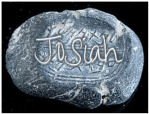
This is a 2,600-year-old clay seal believed to have belonged to Nathan-Melech, who is mentioned in 2 Kings and was a servant to King Josiah. The seal reads, “(belonging) to Nathan-Melech, Servant of the King.”
In March 2019, a clay bulla dated to the middle of the seventh or beginning of the sixth century B.C was found in the City of David bearing the inscription, “(belonging) to Nathan-Melech, servant of the king.” Nathan-Melech was one of King Josiah’s officials (2 Kings 23:11).
Josiah was the great grandson of Hezekiah. Hezekiah famously restored the worship of the LORD to its rightful place in Judah after the trouble-some reign of his father Ahaz. He struck down the altars strewn throughout the high places of the Land and restored the Temple and the Feasts. After Hezekiah, his son Manasseh became king and spent most of his long reign doing what was wrong before the LORD. Upon his death, his son Amon reigned briefly he also reverted to the evil ways. This brings us to Josiah, who became king at the tender age of eight years old.
When Josiah was about 16 years old, he began seeking the LORD. He was reunited with the Torah and began purging pagan worship and reinstating the Feasts, just like his great grandfather Hezekiah. He reigned for 31 years and did what was right in the sight of the LORD. Near the end of his reign, Pharaoh Necho came up to fight Carchemish in the north. Although advised against it, Josiah went out against Necho, which proved to be a fatal mistake.
…Necho king of Egypt came up to fight against Carchemish by the Euphrates; and Josiah went out against him. But he sent messengers to him, saying, “What have I to do with you, king of Judah? I have not come against you this day, but against the house with which I have war; for God commanded me to make haste. Refrain from meddling with God, who is with me, lest He destroy you.”
Nevertheless Josiah would not turn his face from him, but disguised himself so that he might fight with him, and did not heed the words of Necho from the mouth of God. So he came to fight in the Valley of Megiddo.
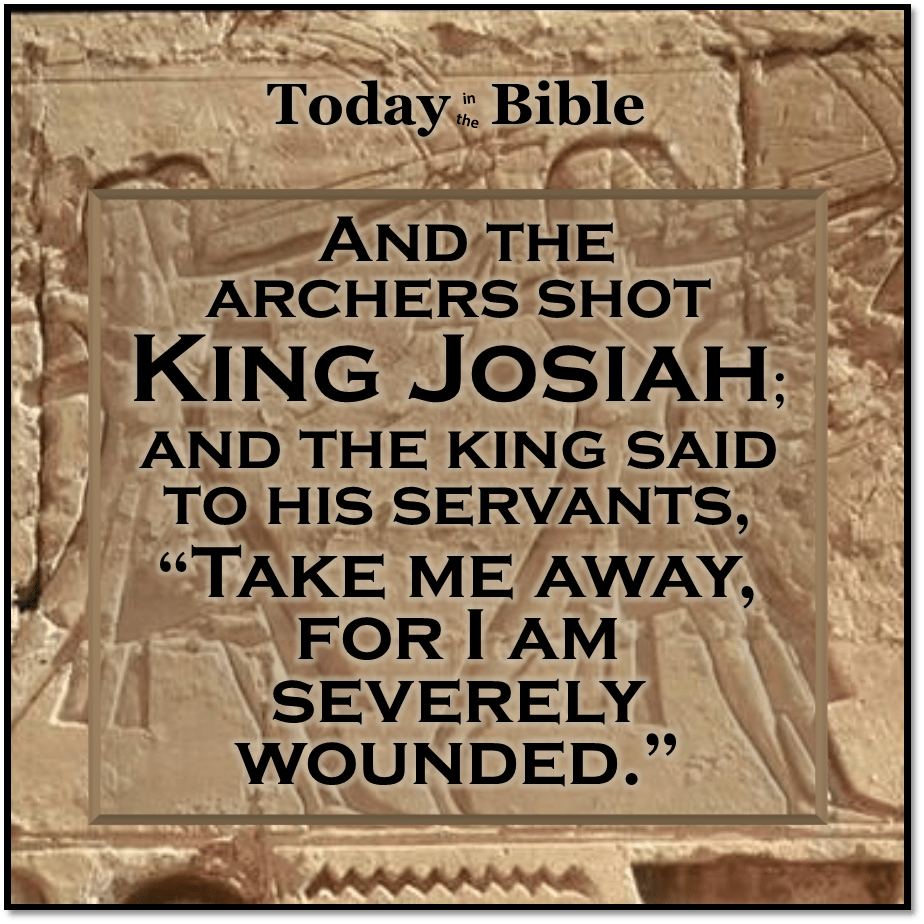
And the archers shot King Josiah…
And the archers shot King Josiah; and the king said to his servants, “Take me away, for I am severely wounded.” His servants therefore took him out of that chariot and put him in the second chariot that he had, and they brought him to Jerusalem. So he died, and was buried in one of the tombs of his fathers. And all Judah and Jerusalem mourned for Josiah. Jeremiah also lamented for Josiah. And to this day all the singing men and the singing women speak of Josiah in their lamentations. They made it a custom in Israel; and indeed they are written in the Laments.
Now the rest of the acts of Josiah and his goodness, according to what was written in the Law of the LORD, and his deeds from first to last, indeed they are written in the book of the kings of Israel and Judah. – 2 Chronicles 35:20-27 (NKJ)
This story is also recounted in 2 Kings 23.
The date of Josiah’s death can be established fairly accurately. The Babylonian Chronicle (discovered in Babylon in the 1800s) dates the battle at Harran between the Assyrians and their Egyptian allies against the Babylonians from Tammuz (July–August) to Elul (August–September) 609 BCE. On that basis, Josiah was killed in the month of Tammuz (July–August) 609 BCE, when the Egyptians were on their way to that battle in Harran. (Wikipedia) The Bible does not list a date for Josiah’s death, but based upon the Babylonian Chronicle it may have been sometime in early Tammuz. Today’s date was chosen at random to commemorate the event.
Did you know that our posts are categorized and tagged by content?
When you visit our home page at https://todayinthebible.com and select any post,
you can find the associated categories and tags just to the right of the title.
Simply click on any tag and you will be taken to all related posts.

© 2026 Today in the Bible

 Today in the Bible
You must be logged in to post a comment.