Tammuz 17, 5785; from sunset July 12, 2025, to sunset July 13, 2025
(The seventeenth day of the fourth month)
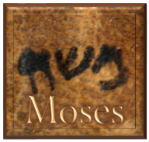
This is the name “Mosheh” (מֺשֶׁה – Moses) as seen in the Dead Sea Scrolls, written over two thousand years ago.
Yesterday Aaron fashioned the golden calf and declared a feast day for today…
Then they rose early on the next day, offered burnt offerings, and brought peace offerings; and the people sat down to eat and drink, and rose up to play.
And the LORD said to Moses, “Go, get down! For your people whom you brought out of the land of Egypt have corrupted themselves. They have turned aside quickly out of the way which I commanded them. They have made themselves a molded calf, and worshiped it and sacrificed to it, and said, `This is your god, O Israel, that brought you out of the land of Egypt!’”
And the LORD said to Moses, “I have seen this people, and indeed it is a stiff-necked people! Now therefore, let Me alone, that My wrath may burn hot against them and I may consume them. And I will make of you a great nation.”
Then Moses pleaded with the LORD his God, and said: “LORD, why does Your wrath burn hot against Your people whom You have brought out of the land of Egypt with great power and with a mighty hand? Why should the Egyptians speak, and say, `He brought them out to harm them, to kill them in the mountains, and to consume them from the face of the earth’? Turn from Your fierce wrath, and relent from this harm to Your people. Remember Abraham, Isaac, and Israel, Your servants, to whom You swore by Your own self, and said to them, `I will multiply your descendants as the stars of heaven; and all this land that I have spoken of I give to your descendants, and they shall inherit it forever.’”
So the LORD relented from the harm which He said He would do to His people. And Moses turned and went down from the mountain, and the two tablets of the Testimony were in his hand. The tablets were written on both sides; on the one side and on the other they were written. Now the tablets were the work of God, and the writing was the writing of God engraved on the tablets.
And when Joshua heard the noise of the people as they shouted, he said to Moses, “There is a noise of war in the camp.” But he said: “It is not the noise of the shout of victory, nor the noise of the cry of defeat, but the sound of singing I hear.”
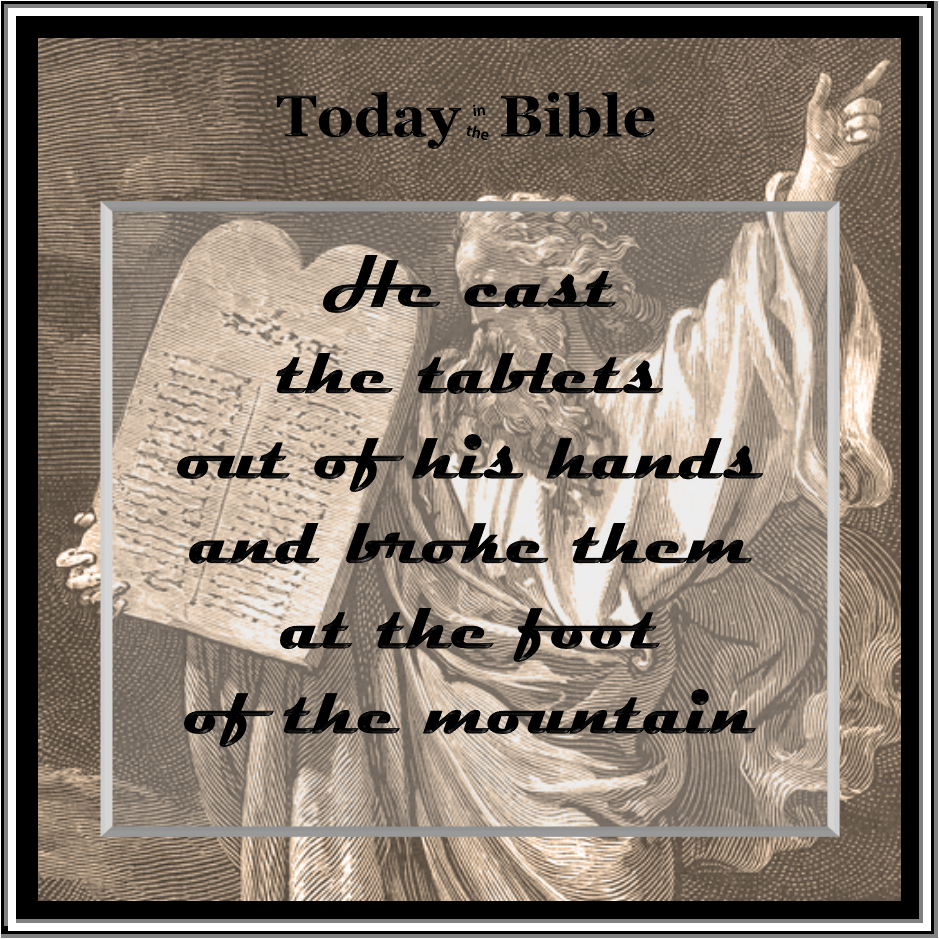
So it was, as soon as he came near the camp, that he saw the calf and the dancing. So Moses’ anger became hot, and he cast the tablets out of his hands and broke them at the foot of the mountain. Then he took the calf which they had made, burned it in the fire, and ground it to powder; and he scattered it on the water and made the children of Israel drink it. And Moses said to Aaron, “What did this people do to you that you have brought so great a sin upon them?”
So Aaron said, “Do not let the anger of my lord become hot. You know the people, that they are set on evil. For they said to me, `Make us gods that shall go before us; as for this Moses, the man who brought us out of the land of Egypt, we do not know what has become of him.’ And I said to them, `Whoever has any gold, let them break it off.’ So they gave it to me, and I cast it into the fire, and this calf came out.”
Now when Moses saw that the people were unrestrained (for Aaron had not restrained them, to their shame among their enemies), then Moses stood in the entrance of the camp, and said, “Whoever is on the LORD’S side– come to me.” And all the sons of Levi gathered themselves together to him. And he said to them, “Thus says the LORD God of Israel: `Let every man put his sword on his side, and go in and out from entrance to entrance throughout the camp, and let every man kill his brother, every man his companion, and every man his neighbor.’”
So the sons of Levi did according to the word of Moses. And about three thousand men of the people fell that day. Then Moses said, “Consecrate yourselves today to the LORD, that He may bestow on you a blessing this day, for every man has opposed his son and his brother.” – Exodus 32:6-29 (NKJ)
What do you think about that guy, Aaron? Yesterday, the text read, “And he received the gold from their hand, and he fashioned it with an engraving tool, and made a molded calf. “
Today we read, “I cast it into the fire, and this calf came out.” Like it was some kind of an accident. But if you think about it, we’re probably all a little guilty of things like that. I’m not saying we make golden calves, but we make decisions that lead to the same sort of outcome…and then we’re like, “I don’t know how it happened! Boo hoo!”
Well, the tragedies didn’t stop there in the desert. The Talmud (Taanit 28b) lists five tragic events in Jewish history that occurred on Tammuz 17, on account of which a fast was instituted on this day.
Moses Smashed the Tablets
Forty days after the Giving of the Torah on Sivan 6. Upon descending Mount Sinai and witnessing Israel’s worship of the Golden Calf, Moses smashed the tablets inscribed with the Ten Commandments which he was carrying down from the mountain.
Temple Service Disrupted
The daily sacrificial offerings (Korban Tamid) in the Holy Temple were discontinued, three weeks before the Babylonians’ destruction of the First Temple.
Jerusalem Walls Breached
The other three national tragedies mourned on Tammuz 17 are connected with the Roman conquest of Jerusalem and their destruction of the Second Temple:
- The walls of the besieged city of Jerusalem were breached
- The Roman general Apostomus burned the Torah
- Apostomus placed an idol in the Holy Temple
The fighting in Jerusalem continued for three weeks until the 9th of Av, when the Holy Temple was set aflame.
To mourn the breaching of Jerusalem’s walls and the other tragic events that occurred on this day and repent and rectify their causes, Tammuz 17 was instituted as a fast day. Those who choose to observe the fast should abstain from food and drink between dawn and nightfall.
“Three Weeks” Begin
The 17th of Tammuz also marks the beginning of The Three Weeks period of mourning which culminates on the 9th of Av, commemorating the conquest of Jerusalem, the destruction of the Holy Temple and the dispersion of the Jewish people.
Weddings and other joyful events are not held during this period; like mourners, we do not cut our hair, and various pleasurable activities are limited or proscribed.
The Lubavitcher Rebbe urged that the Three Weeks should be a time of increased giving of charity and Torah study. His inspiration for this is found in the book of the prophet Isaiah.
“Zion shall be redeemed by law, and her returnees by charity.” -Isaiah 1:27
Our studies should be concentrated on portions of the Torah that deal with the laws and the deeper significance of the Holy Temple.
Did you know that our posts are categorized and tagged by content?
When you visit our home page at https://todayinthebible.com and select any post,
you can find the associated categories and tags just to the right of the title.
Simply click on any tag and you will be taken to all related posts.

© 2026 Today in the Bible

 Today in the Bible
You must be logged in to post a comment.