
Tammuz 19, 5785; from sunset July 14, 2025, to sunset July 15, 2025
(The nineteenth day of the fourth month)
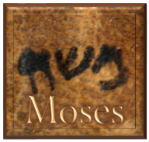
This is the name “Mosheh” (מֺשֶׁה – Moses) as seen in the Dead Sea Scrolls, written over two thousand years ago.
Yesterday we learned that Moses ascended Sinai in hopes of making atonement for the sin of the golden calf. That was in the first year of the Exodus. A year later, in the second year of the Exodus, the spies are in the middle of their 40-day mission to bring back a report of the land of Canaan. Let’s check in on them and see what the Bible says.
Then Moses sent them to spy out the land of Canaan, and said to them, “Go up this way into the South, and go up to the mountains, “and see what the land is like: whether the people who dwell in it are strong or weak, few or many; whether the land they dwell in is good or bad; whether the cities they inhabit are like camps or strongholds; whether the land is rich or poor; and whether there are forests there or not. Be of good courage. And bring some of the fruit of the land.” Now the time was the season of the first ripe grapes.
So they went up and spied out the land from the Wilderness of Zin as far as Rehob, near the entrance of Hamath. And they went up through the South and came to Hebron; Ahiman, Sheshai, and Talmai, the descendants of Anak, were there. (Now Hebron was built seven years before Zoan in Egypt.)
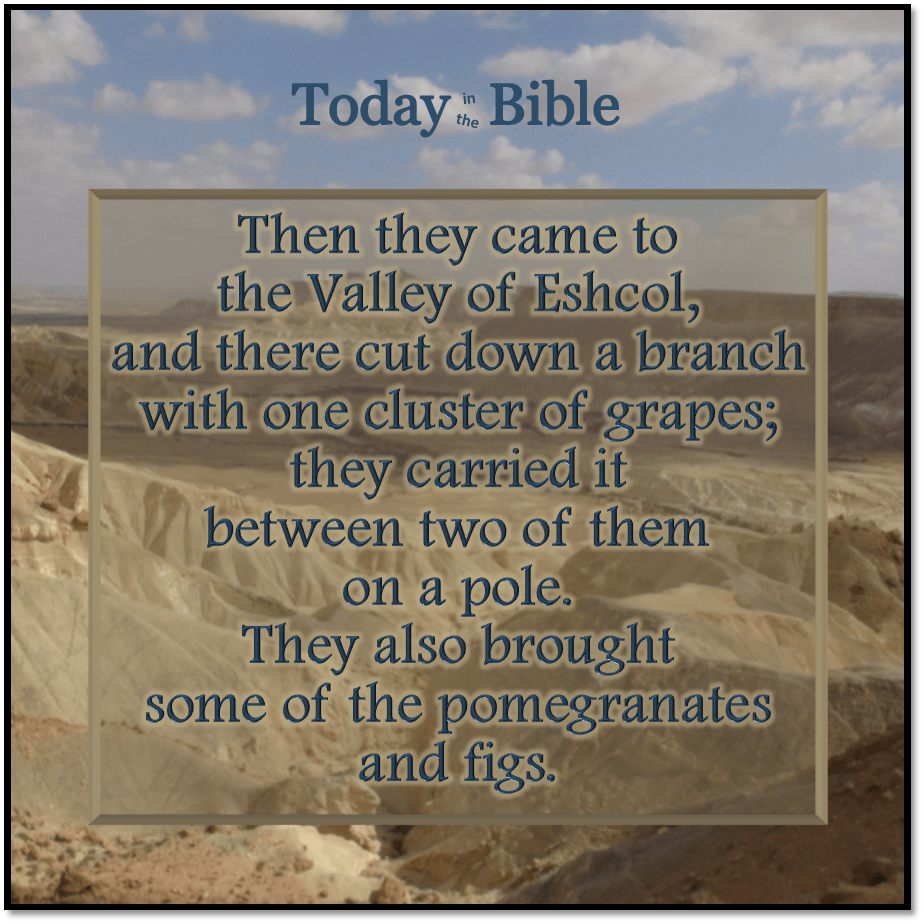
Then they came to the Valley of Eshcol, and there cut down a branch with one cluster of grapes; they carried it between two of them on a pole. They also brought some of the pomegranates and figs. The place was called the Valley of Eshcol, because of the cluster which the men of Israel cut down there. – Numbers 13:17-24
Yesterday we compared Moses and Jesus in regards to the atonement made for sin. Today, we’ll compare Moses’ sending out of the 12 spies to Jesus sending out the 12 apostles.
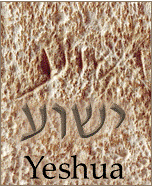
This is the name “Yeshua” (יֵשׁוּעַ – Jesus) as seen on the James Ossuary. Yeshua comes from the verb “yasha” meaning “to save or deliver.” Yeshua means “Salvation.”
And He called the twelve to Himself, and began to send them out two by two, and gave them power over unclean spirits. He commanded them to take nothing for the journey except a staff– no bag, no bread, no copper in their money belts–but to wear sandals, and not to put on two tunics.
Also He said to them, “In whatever place you enter a house, stay there till you depart from that place. And whoever will not receive you nor hear you, when you depart from there, shake off the dust under your feet as a testimony against them. Assuredly, I say to you, it will be more tolerable for Sodom and Gomorrah in the day of judgment than for that city!”
So they went out and preached that people should repent. And they cast out many demons, and anointed with oil many who were sick, and healed them. – Mark 6:7-13 (NKJ)
See also Matthew 10 and Luke 9.
Now let’s pick out some of the comparisons that can be made between these two stories.
- Moses sent out the 12 to the land of Canaan (soon to be Israel).
- Jesus sent out the 12 to the land of Israel, “do not go into the way of the Gentiles or the cities of Samaria but only to the lost sheep of Israel.”
- Moses seems to have sent out the spies in groups of two – Joshua and Caleb are apparently grouped together; also Joshua later sent two spies to Jericho.
- Jesus sent out the apostles in groups of two (Mark 6:7).
- The spies sent out by Moses returned with the fruit of the Land – grapes, pomegranates, and figs.
- The apostles sent out by Jesus returned with the fruit of the Kingdom – repentance, the casting out of demons, and the healing of the sick.
Another note of interest, Moses changed Joshua’s name from “Hoshea” (Salvation) to “Yehoshua” (The Lord Saves) just prior to sending him out. Jesus’ name in Hebrew is Yeshua, a shortened form of Yehoshua.
To see all of our posts regarding “Yeshua” (יֵשׁוּעַ – Jesus), click on the image below.

© 2026 Today in the Bible

 Today in the Bible
You must be logged in to post a comment.