
Av 14, 5785; from sunset August 7, 2025, to sunset August 8, 2025
(The fourteenth day of the fifth month)
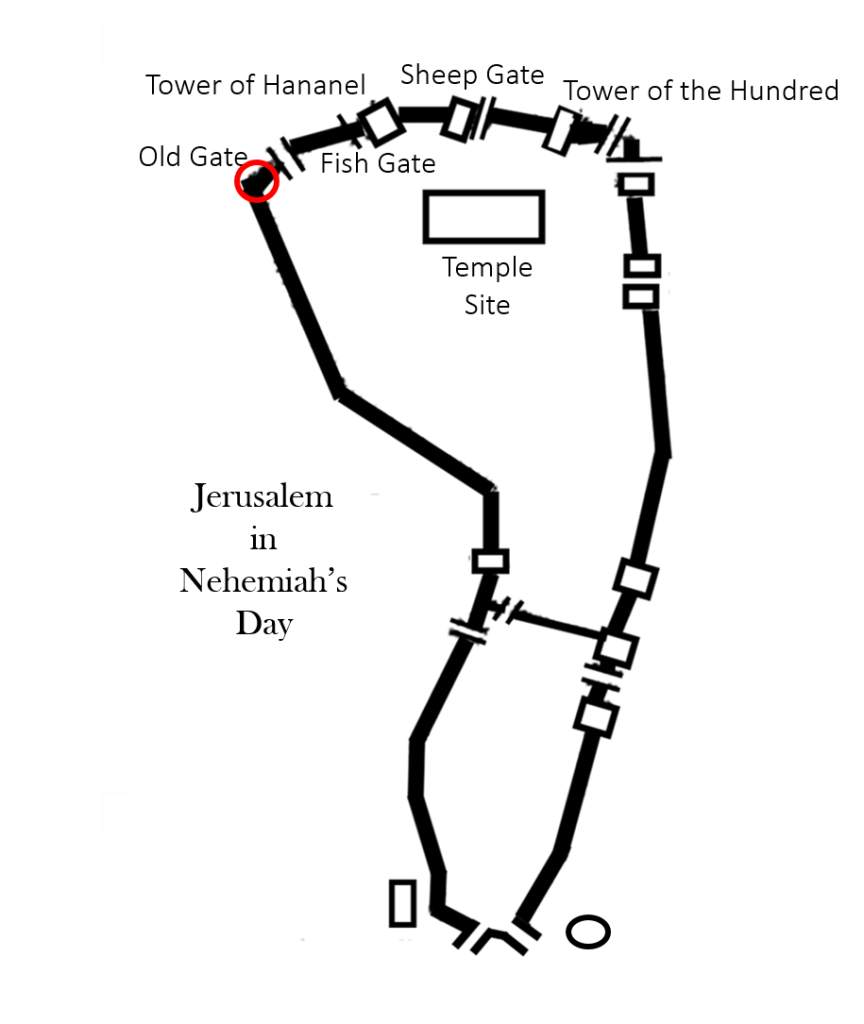
This is an image of a portion of the wall rebuilt by Nehemiah and company.
We’re working along-side the men and women who put their strength to the rebuilding of Jerusalem’s city wall. I love how God remembers so many individuals throughout the Bible. He cares about each of us – and acknowledges our words and deeds. Today in the Bible, we’ll get to know Uzziel and Hananiah a little bit better.
Uzziel son of Harhaiah, one of the goldsmiths, repaired the next section; and Hananiah, one of the perfume-makers, made repairs next to that. They restored Jerusalem as far as the Broad Wall. – Nehemiah 3:8
עֻזִּיאֵל
Uzzi’el = Uzziel
The name “Uzziel” is an ancient one. The Bible first records this name as one of the great, great grandsons of Abraham and Sarah. Exodus 6:18 lists Uzziel as one of Levi’s grandsons. There have been many others who have been given this name throughout the generations of the children of Israel. Our Uzziel, son of Harhaiah, is only mentioned once in the Bible. The name Uzziel is another two-part one. It consists of the verb-root “azaz” (עזז), meaning “to be strong” and “El” (אל), meaning “God.” The letter “ayin” (ע), is silent in Hebrew; but it can carry the sound of any vowel. Therefore, the name Uzziel is able to stem from the root-word “azaz.”
| Root Word | Transliteration | Meaning |
| עזז | azaz | to be stong |
| Prefix/Suffix | Transliteration | Meaning |
| אל | El/el | God/god |
The name “Uzziel” means “Strength of God” or “God is My Strength.”
Uzziel was the son of Harhaiah.
חַרְהֲיָה
Charhayah = Harhaiah
In Hebrew this name is pronounced like “Khar-ha-yah.” Many translators will transliterate the letter ח as “h” instead of “ch” because it’s a little bit easier to pronounce. When you see “ch” in a Hebrew transliteration, it makes the sound of the “ch” as found in “Bach” – not like the “ch” as found in “church.” Harhaiah is composed of the verb-root “charah” (חרה) meaning “to ignite, kindle, or cause to burn.” It is often associated with the idea of burning with anger. The ending of Harhaiah is becoming a very familiar one; it’s “Yah,” a truncated form of God’s Holy Name.
| Verb Root | Transliteration | Meaning |
| חרה | charah | to burn, to be kindled |
| Prefix/Suffix | Transliteration | Comments |
| י | y, i | sometimes, just a “yod” (י), the first letter of God’s Holy Name, may serve as an indicator of its presence |
| ה | h | “yah” (יה) this combination of the 1st and 2nd letters of “The Name” is often translated as “iah” & is a very common name ending |
| ו | v, w, u, o | “yahu” (יהו) – the first three letters – is not quite as common but still found – as in “Elijah” – “Eliyahu” |
| ה | h | adding all four letters of “The Name” is not done |
These four letters represent God’s Holy Name. Many proper nouns use a combination of two or three of these letters as a prefix or a suffix to indicate an attachment to the Name of the LORD.
“Harhaiah” means something like “Kindling of the LORD” or “Ignition of the LORD” or even “Anger of the LORD.”
חֲנַנְיָה
Chananyah = Hananiah
Hananiah is another name that starts with the dreaded “ch” sound…”Chananyah.” Chanan (חנן) is a verb-root that means “to be gracious.” We’re probably starting to become very familiar with the “iah” name-ending and recognize it as a truncated form of God’s Holy Name. The name Hananiah is mentioned six times in the book of Nehemiah alone. It is found more than twenty other times throughout the Bible. Hananiah “the perfumer,” however, is unique to our verse for today.
| Verb Root | Transliteration | Meaning |
| חנן | chanan | to be gracious |
| Prefix/Suffix | Transliteration | Comments |
| י | y, i | sometimes, just a “yod” (י), the first letter of God’s Holy Name, may serve as an indicator of its presence |
| ה | h | “yah” (יה) this combination of the 1st and 2nd letters of “The Name” is often translated as “iah” & is a very common name ending |
| ו | v, w, u, o | “yahu” (יהו) – the first three letters – is not quite as common but still found – as in “Elijah” – “Eliyahu” |
| ה | h | adding all four letters of “The Name” is not done |
These four letters represent God’s Holy Name. Many proper nouns use a combination of two or three of these letters as a prefix or a suffix to indicate an attachment to the Name of the LORD.
“Hananiah” means “The LORD Has Been Gracious.”
הַחוֹמָה הָרְחָבָה
Hachomah Harchavah = The Broad Wall
The Broad Wall is mentioned twice in Nehemiah. Once in this verse and once in the description of the celebratory dedication of the wall’s restoration. A part of this wall was discovered in the 1970s and during its excavation it was dated to the time of King Hezekiah – a wall built during First Temple times! This wall is 2,700 years old! When my mother and I visited Israel, we saw a portion of the Broad Wall. I can still remember our tour guide – he must have thought that he wasn’t getting it through our heads how old the wall was and how fantastic it was that we were able to be standing there looking at it – he had us say in unison, “Wow! A wall from the First Temple times!”
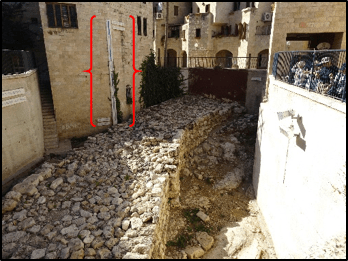
Photo credit: Today in the Bible
Hezekiah built up the wall to protect Jerusalem from the Assyrians. The white measuring stick (between the red brackets) attached to the wall of the building on the left-side of the photo is an indication of how high the wall was in the time of Hezekiah, about 26 feet.
After these deeds of faithfulness, Sennacherib king of Assyria came and entered Judah; he encamped against the fortified cities, thinking to win them over to himself.
And when Hezekiah saw that Sennacherib had come, and that his purpose was to make war against Jerusalem, he consulted with his leaders and commanders to stop the water from the springs which were outside the city; and they helped him. Thus many people gathered together who stopped all the springs and the brook that ran through the land, saying, “Why should the kings of Assyria come and find much water?
“And he strengthened himself, built up all the wall that was broken, raised it up to the towers, and built another wall outside; also he repaired the Millo in the City of David, and made weapons and shields in abundance. Then he set military captains over the people, gathered them together to him in the open square of the city gate, and gave them encouragement, saying, “Be strong and courageous; do not be afraid nor dismayed before the king of Assyria, nor before all the multitude that is with him; for there are more with us than with him. With him is an arm of flesh; but with us is the LORD our God, to help us and to fight our battles.” And the people were strengthened by the words of Hezekiah king of Judah. – 2 Chronicles 32:1-8 (NKJ)
Ok, everybody say, “Wow! A wall from the First Temple times!” (Our tour guide would be proud! 😊)
To read all of our posts on Nehemiah, click on the image above.

© 2026 Today in the Bible

 Today in the Bible
You must be logged in to post a comment.