
Av 18, 5785; from sunset August 11, 2025, to sunset August 12, 2025
(The eighteenth day of the fifth month)
This is an image of a portion of the wall rebuilt by Nehemiah and company.
Welcome back to Today in the Bible. We’ve been working our way through the names of the men who worked together to restore the walls and gates of the Holy City. The Bible tells us it took 52 days to complete the job, we’re in the middle of those days. Today we’ll be meeting Malchijah and Hashub.
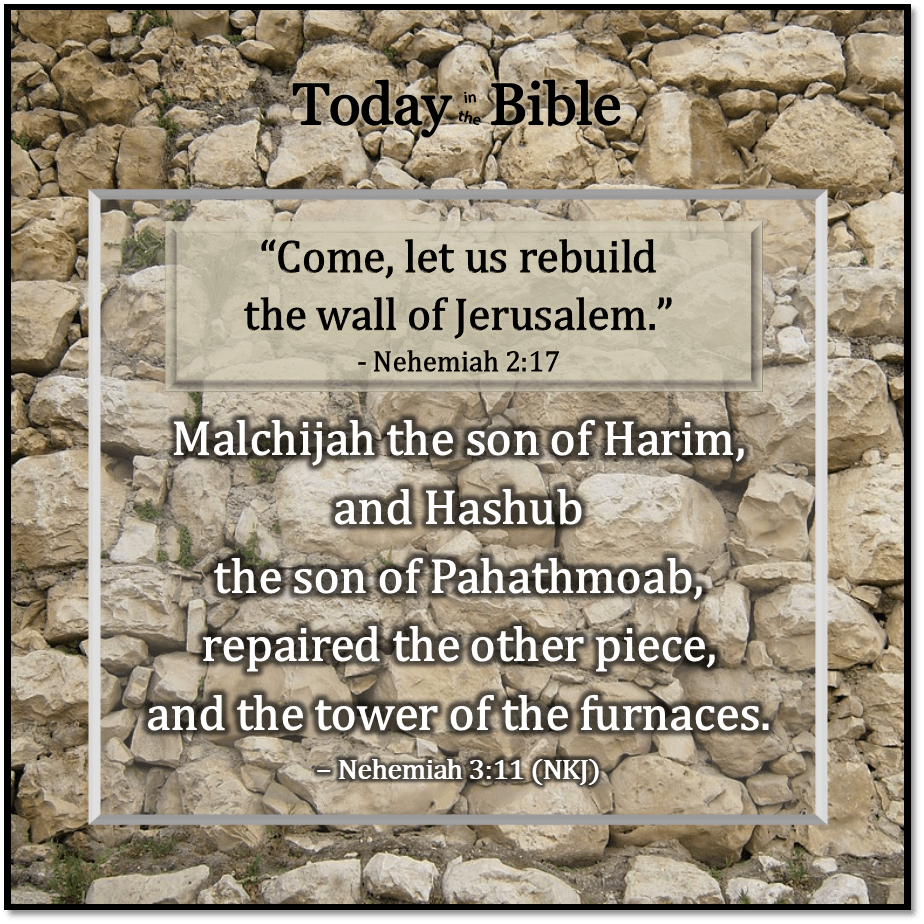
Malchijah the son of Harim, and Hashub the son of Pahathmoab, repaired the other piece, and the tower of the furnaces. – Nehemiah 3:11 (KJV)
מַלְכִּיָּה
Malkiyah = Malchijah
The beginning of the name Malchijah comes from the verb-root “malak” which means “to be or become a king or queen, to reign.” The ending of his name has become very familiar to us. When “iah” is found at the end of a word, it represents the Holy Name of our God.
The name Malchijah made its way into the Bible twelve times. Seven times in Nehemiah, three in 1 Chronicles, and twice in Ezra. In fact, our Malchijah, son of Harim, is enumerated among the people of Israel who had taken foreign wives during the exile and who had children with those women. Malchijah also had brothers who had done the same, their names are Eliezer, Ishijah, Shemaiah, Shimeon, Benjamin, Malluch, and Shemariah (Ezra 10:31-32).
| Verb Root | Transliteration | Meaning |
| מלך | malak | to be or become a king or queen, to reign |
| Prefix/Suffix | Transliteration | Comments |
| י | y, i | sometimes, just a “yod” (י), the first letter of God’s Holy Name, may serve as an indicator of its presence |
| ה | h | “yah” (יה) this combination of the 1st and 2nd letters of “The Name” is often translated as “iah” & is a very common name ending |
| ו | v, w, u, o | “yahu” (יהו) – the first three letters – is not quite as common but still found – as in “Elijah” – “Eliyahu” |
| ה | h | adding all four letters of “The Name” is not done |
These four letters represent God’s Holy Name. Many proper nouns use a combination of two or three of these letters as a prefix or a suffix to indicate an attachment to the Name of the LORD.
“Malchijah” means “The LORD is King.”
Malchijah was the son of Harim.
חָרִם
Charim = Harim
Harim is another one of those words that actually begin with a letter that makes a “kh” sound and should be transliterated with a “ch.” Many translators try to smooth out the pronunciation and choose to substitute the letter “h” instead. The name Harim is found twelve times in the Bible, six times in Nehemiah, four times in Ezra, and once in 1 Chronicles.
According to Ezra 10, our Harim had at least eight sons (we mentioned them by name when we studied Malchijah). All of those sons married pagan wives and had children by them. Can you imagine the pain that family endured when those sons “put away” their wives and children? But we understand that those pagan wives were tearing their husbands away from the LORD, instead of the men winning their wives for the LORD. Sometimes there is a great cost to turn our lives over to God – we may have to walk away from people or things that are precious to us. But, in the end, they could drive a wedge between us and the LORD, leaving us in a bad place.
The root-word for this name is “charam” (חרם), we studied this root just a few days ago when we met Harumaph. We learned that the root “charam” has two separate meanings. Let’s review.
| Root Word | Transliteration | Meaning |
| חרם | charam (I) | to ban, devote, destroy utterly |
| חרם | charam (II) | to split, mutilate |
Harim means: “Consecrated” or “Snub-Nosed.”
חַשּׁוּב
Chashuv = Hashub
Hashub is another name where we’ve already studied its root, “chashav” (חשב), meaning “to think, plan, make a judgment, imagine, or count.” It was found in the name Hashabneiah. Hashub is only found in this verse and in no other place in the Bible.
| Verb Root | Transliteration | Meaning |
| חשב | chashav | to think, plan, make a judgment, imagine, or count |
Hashub means “Thoughtful,” “Considerate,” or “Much Esteemed.“
Hashub was a son of Pahathmoab.
פַּחַת מוֹאָב
Pachat Mo’av = Pahathmoab
The noun “pachat” means “pit.” Moab was a son of Abraham’s nephew Lot. Genesis 19 tells the story of his birth. Lot and his family had escaped from Sodom, just before the LORD destroyed it. Lot’s wife looked back and was turned into a pillar of salt. But Lot and his daughters continued on and sought shelter in a cave. The daughters had lost all hope of finding a husband; either because they thought there were no other men alive on Earth, or because all of the men they knew were not interested in women. So, they came up with a plan to get their father drunk so he would sleep with them. Both girls became pregnant. Moab was born to Lot’s elder daughter and his descendants were known as the Moabites. Ben-Ammi was born to his younger daughter; his descendants became known as the Ammonites.
Pahath-Moab is mentioned six times in the Bible. Half of those are in the book of Ezra and half are in Nehemiah. Was Pahath-Moab the name of a location in Moab? Or was Pahath-Moab the name of an individual? The Wikipedia page for this name suggests that this individual was likely held captive in Moab. They connect Pahath-Moab with the “people (sons) of Nebo” (Ezra 2:29, 10:43; Nehemiah 7:33). Nebo is the name of a city in Moab (Is. 15:2, 46:1).
“Pahath-Moab“ means: “Pit of Moab.”
מִגְדַּל הַתַּנּוּרִים
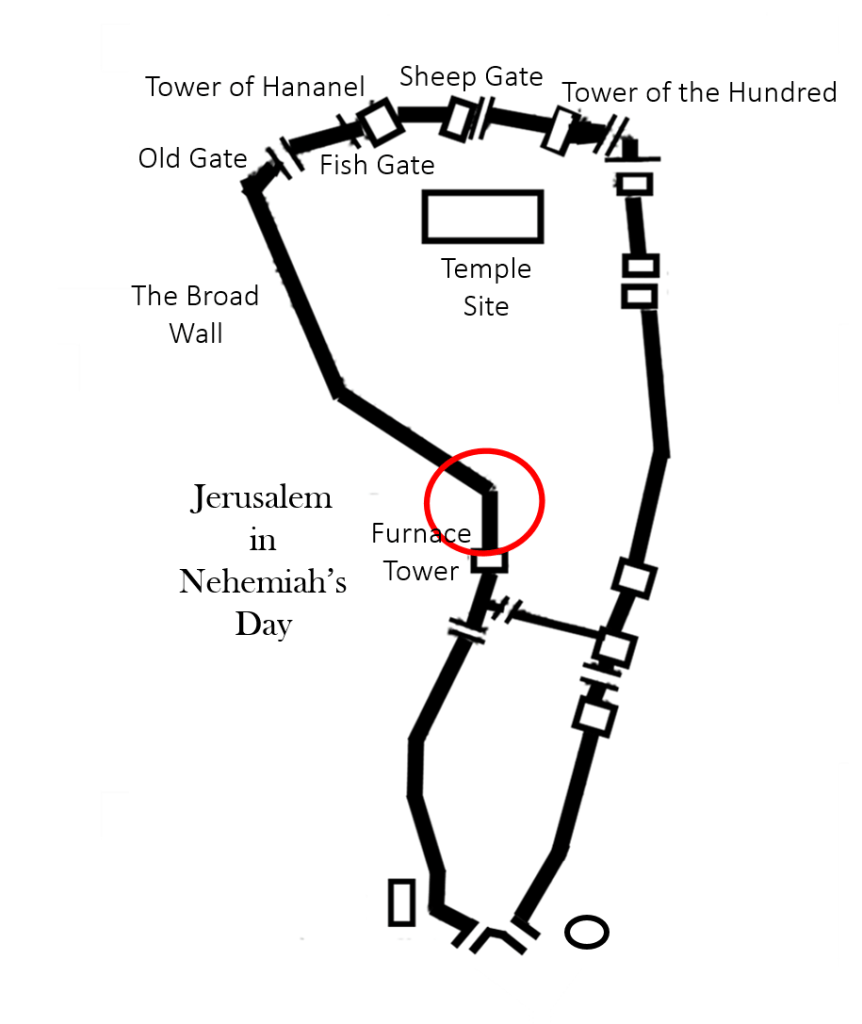
Migdal Hatannurim = Tower of the Furnaces
This tower is believed to be related to the Bakers’ Street referenced in Jeremiah 37:21. A “tannur” is a small beehive-shaped oven used mainly for baking bread. This is the same word as the mysterious “smoking oven” that was present with the “flaming torch” that moved between the animal parts of the covenant while Abraham slept (Genesis 15:17). The “Migdal Tannurim” is mentioned once again in Nehemiah 12.
To read all of our posts on Nehemiah, click on the image above.

© 2026 Today in the Bible

 Today in the Bible
You must be logged in to post a comment.