
Av 20, 5785; from sunset August 13, 2025, to sunset August 14, 2025
(The twentieth day of the fifth month)
This is an image of a portion of the wall rebuilt by Nehemiah and company.
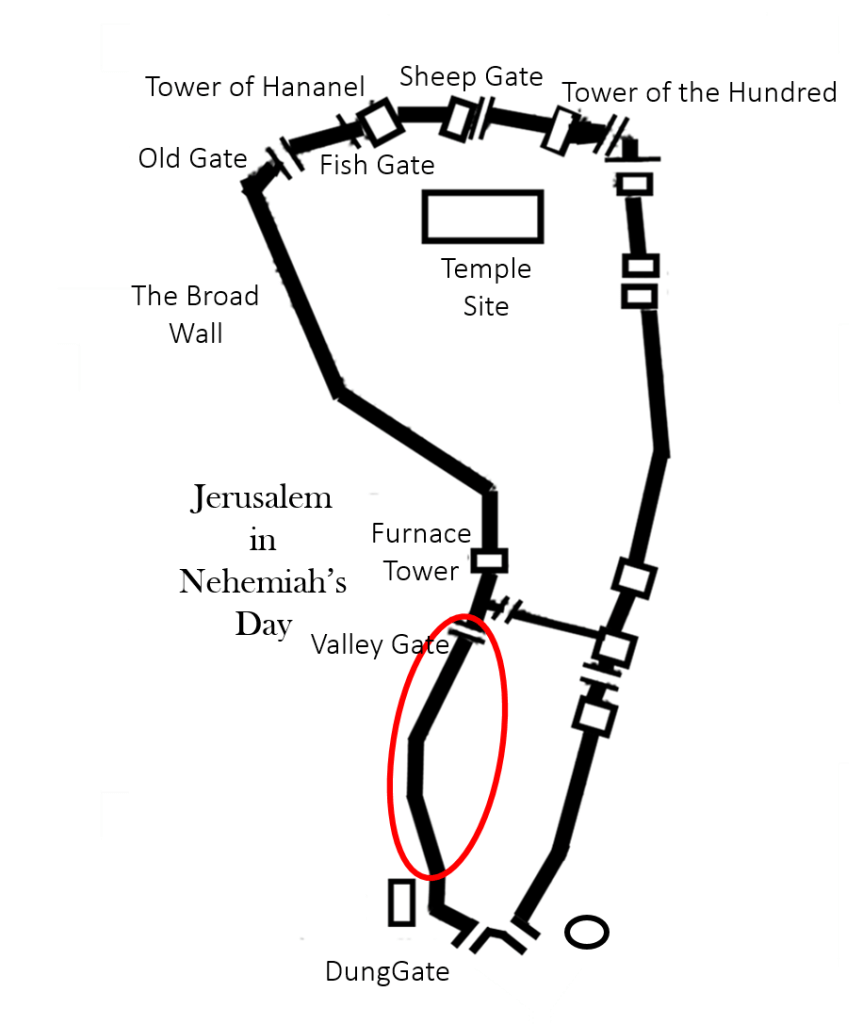
Today in the Bible, we’ll meet Hanun and the inhabitants of Zanoah. They repaired a portion of the wall that not everyone would volunteer to work on. The Bible says it took 52 days to restore the wall of Jerusalem after Nebuchadnezzar’s army destroyed it. We’re in the midst of those days and learning what we can about the men and women who put their hand to the task.
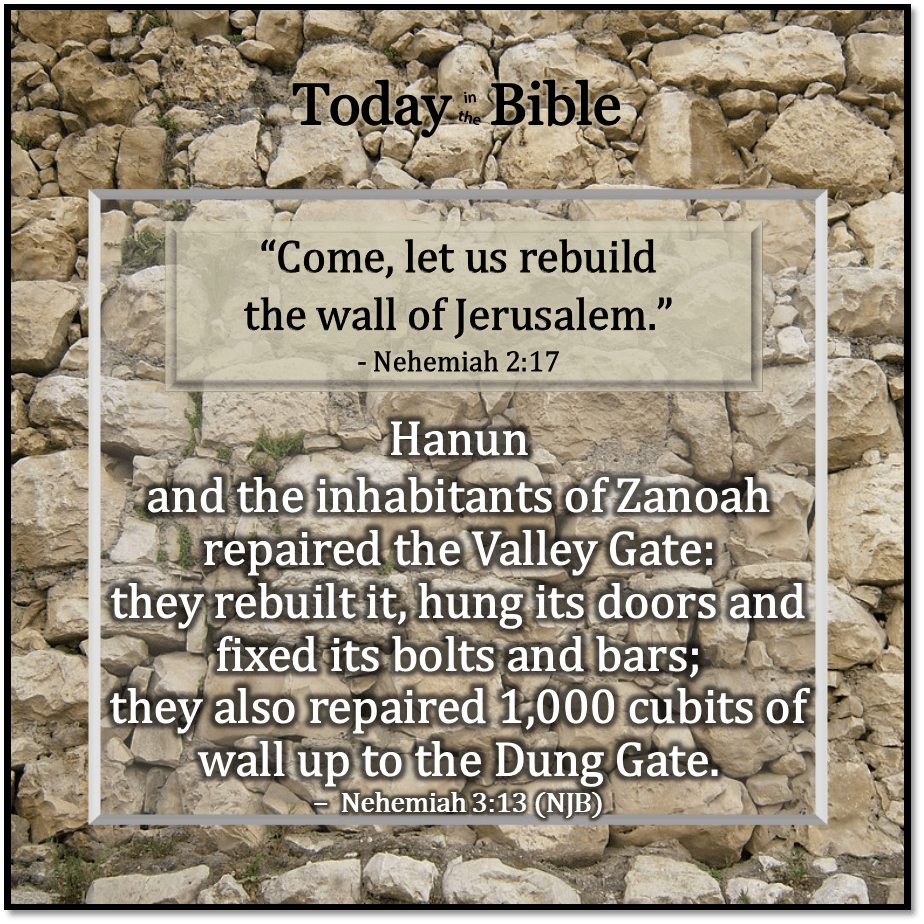
Hanun and the inhabitants of Zanoah repaired the Valley Gate: they rebuilt it, hung its doors and fixed its bolts and bars; they also repaired a thousand cubits of wall up to the Dung Gate. – Nehemiah 3:13 (NJB)
חָנוּן
Chanun = Hanun
The name Hanun is found 11 times in the Bible. These incidents refer mainly to just two men. During the days of King David, Hanun became the king of the Ammonites after the death of his father, Nahash. Nahash had been kind to David and David wanted to show kindness in turn to Hanun. It turns out that Hanun didn’t feel like he could trust David, so he cut off half of the beards of the men that David had sent to comfort him. Hanun also had their garments cut off “down to their buttocks” and then sent them home. The result of all of this ended in a multi-national battle resulting in the death of more than 40,000 people. (And we think things are crazy in our days.) This story is repeated twice, first in 2 Samuel 10 and then in 1 Chronicles 19. The Hanun from our story today is mentioned twice in the book of Nehemiah.
Hanun originates from the verb-root “chanan” (חנן) which mainly means “to be gracious.” It’s another one of those root-words with multiple meanings. Scholars split out a second meaning, “to be loathsome.” We often find that one root can carry meanings at opposite ends of the spectrum. Apparently, King Hanun of the Ammonites didn’t realize that being gracious was a much better end than being loathsome. Perhaps he would have fulfilled that portion of the meaning of his name instead. The Hanun in our story for today seems to have grabbed onto the graciousness end of the root, as we find him pulling double-duty on the wall by lending his hand to another portion of its restoration. We’ll be running into him again in a few days.
| Verb Root | Transliteration | Meaning |
| חנן | chanan I | to be gracious |
| חנן | chanan II | to be loathsome |
“Hanun” means “Favored” (NOBSE & BDB) or “Giving for Nought” (Jones’).
Hanun worked alongside the men from Zanoah.
זָנוֹחַ
Zanoach = Zanoah
The name Zanoah is found five times in the Bible. One of them appears to be the name of an individual; the remainder refer to two villages carrying the name Zanoah. The villages of Zanoah were already established in the days of Joshua. One was situated in the lowlands to the south and west of Jerusalem (Joshua 15:34). It resided in the portion of the Land apportioned to the tribe of Judah. The other town with that name was situated in the Judean mountains to the south of Jerusalem (Joshua 15:56). We are not entirely sure which Zanoah our Hanun was affiliated with, but some scholars feel it was likely the one in the lowlands given the locations of associated peoples at the time.
This word comes from the root-word “zanach” (זנח) from which two types of word groups stem. Words from zanach (I) carry the meanings of “to reject, spurn, or cast off.” Words from zanach (II) carry the meanings of “to stink or to emit a stench.”
| Root Word | Transliteration | Meaning |
| זנח | zanach (I) | to reject, spurn, or cast off |
| זנח | zanach (II) | to stink or to emit a stench |
“Zanoah“ means “Rejected” (NOBSE Study Bible) or “Stinking” (BDB Theological Dictionary).
שַׁעַר-הַגַּיְא
“Sha’ar-Haggai” – “Valley Gate”
This is the second time that we have run into the Valley Gate in the story of Nehemiah. The first time we studied out this word was in our article on Nehemiah’s secret nighttime ride to inspect the walls and gates of the city. Hebrew utilizes several different words for “valley,” depending upon what the physical attributes of the valley are. “Gai” indicates that the valley is an elongated, flat-bottomed depression.
שַׁעַר הָאַשְׁפֹּת
“Sha’ar Ha’Ashpot” – “The Refuse Gate”
We also studied the name of this gate a little over a month ago in our article on Nehemiah’s secret nighttime ride to inspect the walls and gates of the Holy City. The name of this gate comes from a word having to do with fire and ashes. Though it is most often rendered as the “Dung Gate,” “Refuse Gate” may be a better translation.
The favored (Hanun) and the rejected (Zanoah) rebuilt the wall up to the Dung Gate.
-or-
They gave for nothing (Hanun), the stinking ones (Zanoah), and built up to the Dung Gate.
The men from Zanoah were the right ones for the job. Who better to fix the Dung Gate than those from a town whose name means “to stink or reject.” I feel like there’s a beautiful message here though. God appreciates the humility of those who do the dirty jobs. He can show favor to those whom others reject. In addition, these men appear to have repaired the largest section of the wall.
To read all of our posts on Nehemiah, click on the image above.

© 2026 Today in the Bible

 Today in the Bible
You must be logged in to post a comment.