
Av 26, 5785; from sunset August 19, 2025, to sunset August 20, 2025
(The twenty-sixth day of the fifth month)
This is an image of a portion of the wall rebuilt by Nehemiah and company.
Today in the Bible, we’re continuing our study of the men and women who contributed their labor to the restoration of the walls and gates of Jerusalem. It took 52 days, according to the Bible, for this work to be completed. We’re in the middle of those days and have already made some amazing discoveries. God has placed these treasures right there in His Word, just waiting for us to discover them. Let’s take a look at today’s text.
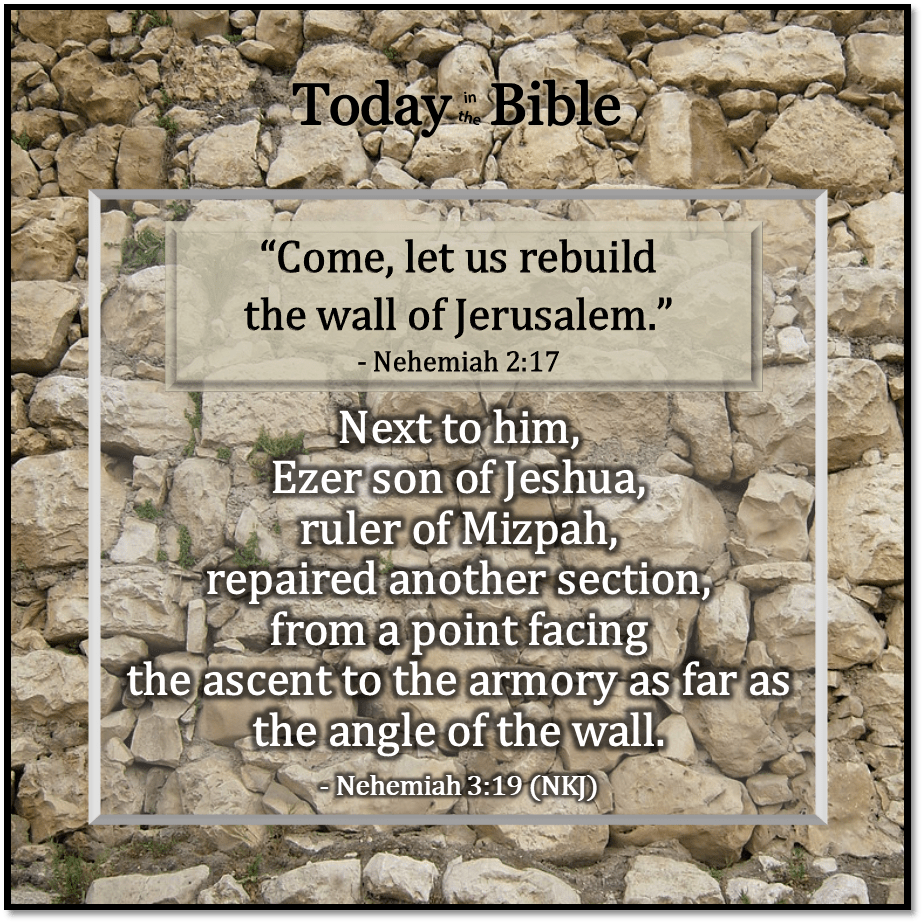
Next to him, Ezer son of Jeshua, ruler of Mizpah, repaired another section, from a point facing the ascent to the armory as far as the angle of the wall. – Nehemiah 3:19 (NKJ)
עֵזֶר
Ezer
The name “Ezer” originates from the verb-root “azar” (עזר), meaning “to help or support.” This root word was used to describe the woman created to be a companion for Adam, because it was “not good” for him to be alone. But before we go thinking that Eve was created to wait on Adam hand and foot – we must realize that she was not described as his “eved,” his “servant” – but as a helpmate, his “ezer.” While “azar” is used to describe Adam’s helper, it is also used to describe the source of divine help. In Psalm 121, one of the Psalms of ascents, the first verses state, “I lift up my eyes to the mountains, where does my “help” (ezri) come from? My “help” (ezri) comes from the LORD, maker of Heaven and Earth.” (And Eve.) We would not define the LORD as our servant, nor should we consider Eve in that light. The familiar name Ezra also comes from this same root.
The name Ezer is an ancient one. It shows up ten times in the Bible. The first instance dates clear back to Genesis 36 where we find a chief of the Horites utilizing this name. Half of its occurrences are found in 1 Chronicles and Ezer shows up twice in the book of Nehemiah – once in our verse for today and once in chapter 12 as a member of the thanksgiving choir which participated in the ceremony for the dedication of the restored wall and possibility our same man.
| Verb Root | Transliteration | Meaning |
| עזר | azar | to help or support |
“Ezer” means “Help.”
Ezer was the son of Jeshua.
יֵשׁוּעַ
Yeshua = Jeshua
This name is a familiar one to those of us who have studied the Hebrew roots of Christianity. Yeshua made its way into English as Jesus. This name comes from the root “yasha” (ישע) which means “to save or deliver.” Jeshua, Yeshua, Jesus – mean Salvation. When Mary conceived, Joseph considered putting her away quietly when the angel appeared to him.
But while he thought about these things, behold, an angel of the Lord appeared to him in a dream, saying, “Joseph, son of David, do not be afraid to take to you Mary your wife, for that which is conceived in her is of the Holy Spirit. And she will bring forth a Son, and you shall call His name JESUS, for He will save His people from their sins.” – Matthew 1:20-21 (NKJ)
To Joseph’s ears, the angel said, “You shall call His name Salvation, for He will save His people from their sins.”
There are many proper names in the Bible which stem from this same root; after Jesus, the most famous one is probably Joshua, whose name means, “The LORD Saves.” Elisha, Hosea, and Isaiah are just a few more. Jeshua is a popular name and is found 29 times in the Hebrew Scriptures alone – the majority are found in Ezra and Nehemiah. We like that this name was popular during the time when the people repented and were brought back from exile and are looking forward to when that time comes again.
| Root Word | Transliteration | Meaning |
| ישע | yasha | to save or deliver, to be safe, to preserve, to take vengeance, to give victory |
“Jeshua“ means “Salvation.”
מִצְפָּה
Mitzpah = Mizpah
We’ve already run into the name Mizpah a couple of times in our study of the restoration of Jerusalem during the days of Nehemiah. If you’d like to review, please follow this link: Mizpah.
To read all of our posts on Nehemiah, click on the image above.

© 2026 Today in the Bible

 Today in the Bible
You must be logged in to post a comment.