

Av 30, 5785; from sunset August 23, 2025, to sunset August 24, 2025
(The thirtieth day of the fifth month)
This is an image of a portion of the wall rebuilt by Nehemiah and company.
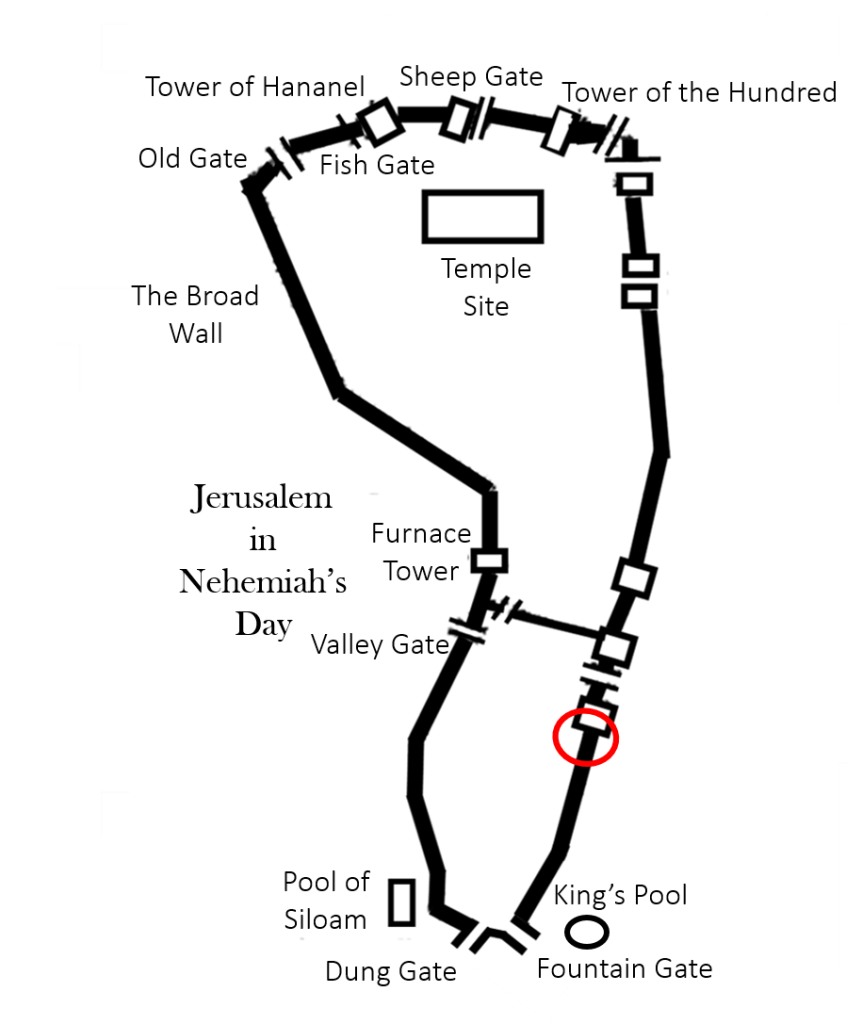
Over the past few weeks, we’ve been introducing ourselves to the men and women who had a heart to work on the restoration of the walls and gates of Jerusalem. The Bible says their work was completed on the 25th day of the sixth month — we’re a little more than three weeks away from that date. It took them 52 days to complete their mission. Today in the Bible, we’ll meet Benjamin and Hasshub.
בִּנְיָמִן
Binyamin = Benjamin
The name Benjamin is a two-part word. Many of you are probably familiar with what this name means because of the famous story of how Benjamin, son of Jacob and Rachel, was born. The first part of his name is “ben” (בן), meaning “son.” The second part of this name is “yamin” (ימן), meaning “right hand.”
The name Benjamin appears 162 times in the Bible. The vast majority of them refer to either Benjamin, the son of Jacob and Rachel, the tribe of Benjamin, or the tribal land of Benjamin. There is another incident of a man named Benjamin found in the book of Nehemiah, chapter 12. He is one of the leaders who partook in the celebration of the completion of the wall and, perhaps, our Benjamin from today’s verse.
Benjamin means “Son of the Right Hand.”
חַשּׁוּב
Chashuv = Hasshub
The name Hassub comes from a verb-root that we’ve already studied a couple of times, “chashav” (חשב), meaning “to think, plan, make a judgment, imagine, or count.” The name Hasshub is mentioned four times in the Bible. Once in 1 Chronicles 9:14 and the other three in Nehemiah (3:23, 10:23, and 11:15). It’s unclear if its mention in Nehemiah refers to one man or three different men.
The name Hasshub means, “Thoughtful” or “Considerate.”
הֶחֱזִיק
hechezik
Since we’ve had kind of an easy day of learning, I thought we would take a look at another Hebrew word that’s been popping up a lot in the verses we’ve been studying…”hechezik.” It is derived from the verb-root “chazak” (חזק). This root means “to be or become strong, to strengthen, prevail, harden, or be courageous.” If you were paying attention to our article from yesterday (which I know you were 😉 ), we included the Young’s Literal Translation of the verse as our last example. If you were really paying attention, you may have noticed that, while most of the other translations utilized the word, “repaired,” to describe the work of the men, the YLT used “strengthened.” Hechezik is used throughout Nehemiah 3 to describe the actions of those repairing the wall…they literally “strengthened” the wall.
If we want to take it a step further, perhaps we could apply this knowledge to our theory that the act of restoring the walls and gates could be seen as repentance on the part of the people. We explained this in detail in our article from Tammuz 13 where we explored the name of Nehemiah using the ancient pictographs. Using this analogy, we can see how the repentance of each individual may add strength to the kingdom.
To read all of our posts on Nehemiah, click on the image above.

© 2026 Today in the Bible

 Today in the Bible
You must be logged in to post a comment.