
August/September
Elul (אֱלוּל) – 6th month; 29 days

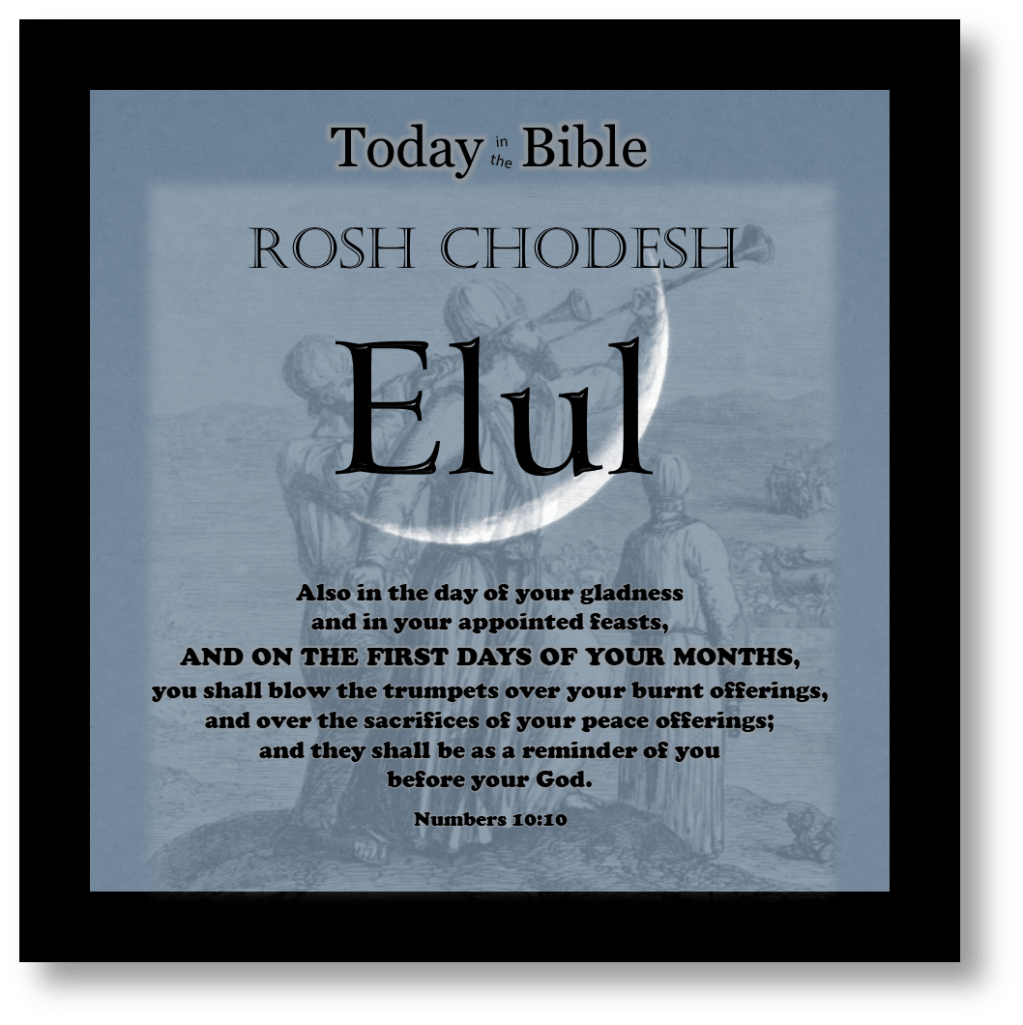
Also in the day of your gladness, in your appointed feasts, and at the beginning of your months, you shall blow the trumpets over your burnt offerings and over the sacrifices of your peace offerings; and they shall be a memorial for you before your God: I am the LORD your God. – Numbers 10:10 (NKJ)
Originally, the month of Elul took its place as the twelfth month on the biblical calendar. Then, right before the exodus from Egypt, God decided to switch things up.
Now the LORD spoke to Moses and Aaron in the land of Egypt, saying, “This month shall be your beginning of months; it shall be the first month of the year to you. – Exodus 12:1-2 (NKJ)
Ever since that time, it has been known as the sixth month, that is, the sixth month since springtime.

The name of the month Elul, like the names of the rest of the months on the Hebrew calendar in use today, was brought back from the Babylonian captivity. It originated with the Akkadian word for “harvest.” The month of Elul is the beginning of the fruit harvest…olives, pomegranates, figs, and dates.
In the Hebrew language, the name Elul has been affiliated with the word אֱלִיל (elil). Elil stems from a verb root that is not used in the Bible; meaning “to be weak or deficient.” The word “elil,” itself, is found in the Bible and means “something worthless.” It is mainly used in association with idols or other gods.
The month of Elul is typically seen as a month for repentance. A time to make amends with those with whom you’ve found your relationship strained, either because of a wrong committed by you or by the other party. Our God desires no less than peace and harmony among His children. It’s the whole “love your neighbor as yourself” thing. Since the following month (Tishrei) contains the “High Holy Days” (Feast of Trumpets, Day of Atonement, Feast of Tabernacles, Eighth Day Assembly), also known as the autumn Appointed Times (see Leviticus 23), we want to find ourselves in harmony with our fellow man and our Maker. Because of this, it is tradition to blow the shofar daily during the month. This is seen as a warning, to remind us of the upcoming Holy Days. Other traditions include reciting the “selichot,” which are special penitential prayers and reading Psalm 27 on a daily basis.
Elul is often associated as a backronym for the Song of Solomon 6:3:
I am my beloved’s, and my beloved is mine.
| א | אֲנִי | ani | I am |
| ל | לְדוֹדִי | ledodi | for my beloved |
| ו | וְדוֹדִי | vedodi | and my beloved is |
| ל | לִי | li | for me |
“Ani ledodi vedodi li” is viewed as the relationship between God and one’s self. Elul is seen as a time to search one’s heart and draw close to God in preparation for the coming Day of Judgement, Rosh Hashanah, and Day of Atonement, Yom Kippur.
Rabbi Shneur Zalman of Liadi compared, by way of analogy, the month of Elul to a king visiting his peasants in the field before returning to his palace.[1]
[1] cf. Wikipedia https://en.wikipedia.org/wiki/Elul
Did you know that you can view any of our posts whenever you’d like?
Visit our home page at https://todayinthebible.com
where you can find them organized by month
in the “Archives” section on the right side of the page.

© 2026 Today in the Bible

 Today in the Bible
You must be logged in to post a comment.