
Elul 4, 5785; from sunset August 27, 2025, to sunset August 28, 2025
(The fourth day of the sixth month)
This is an image of a portion of the wall rebuilt by Nehemiah and company.
Today in the Bible, we’ll meet Palal, the son of Uzai. He was just one of the men who worked to rebuild the broken walls of Jerusalem. We’ve been making our way around the Holy City, getting to know those who worked alongside of him. The Bible tells us it took the people 52 days to complete the job. We’re in the midst of those days. Let’s learn what we can about Palal, the son of Uzai.
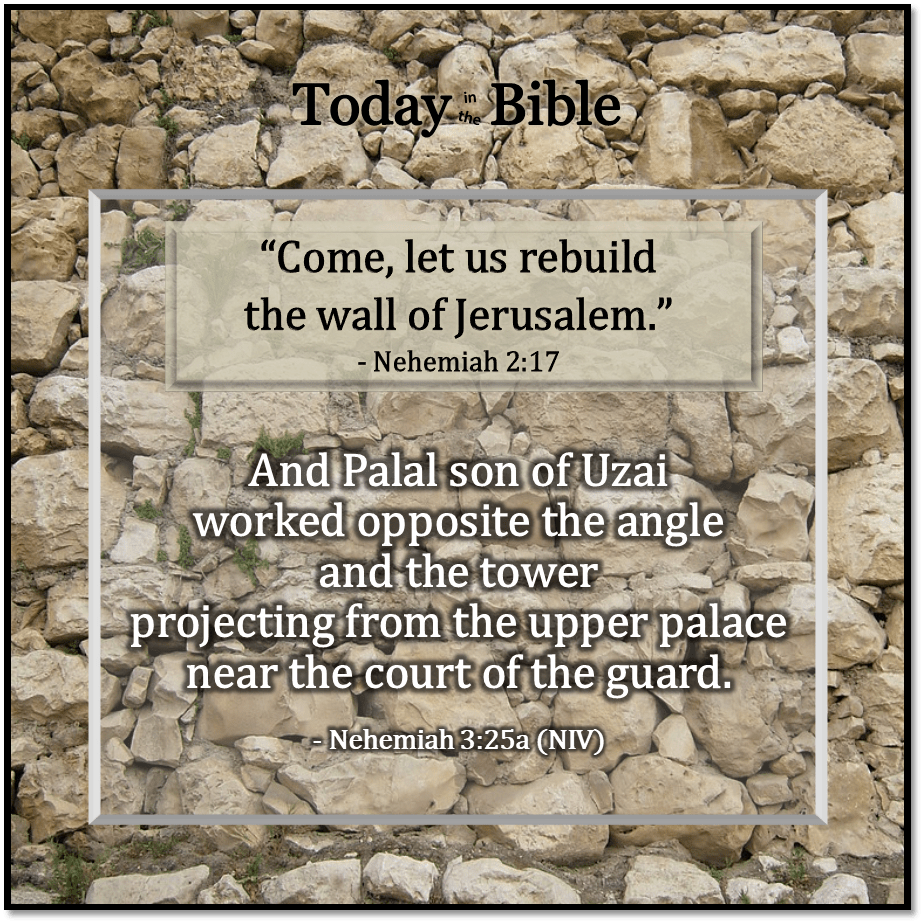
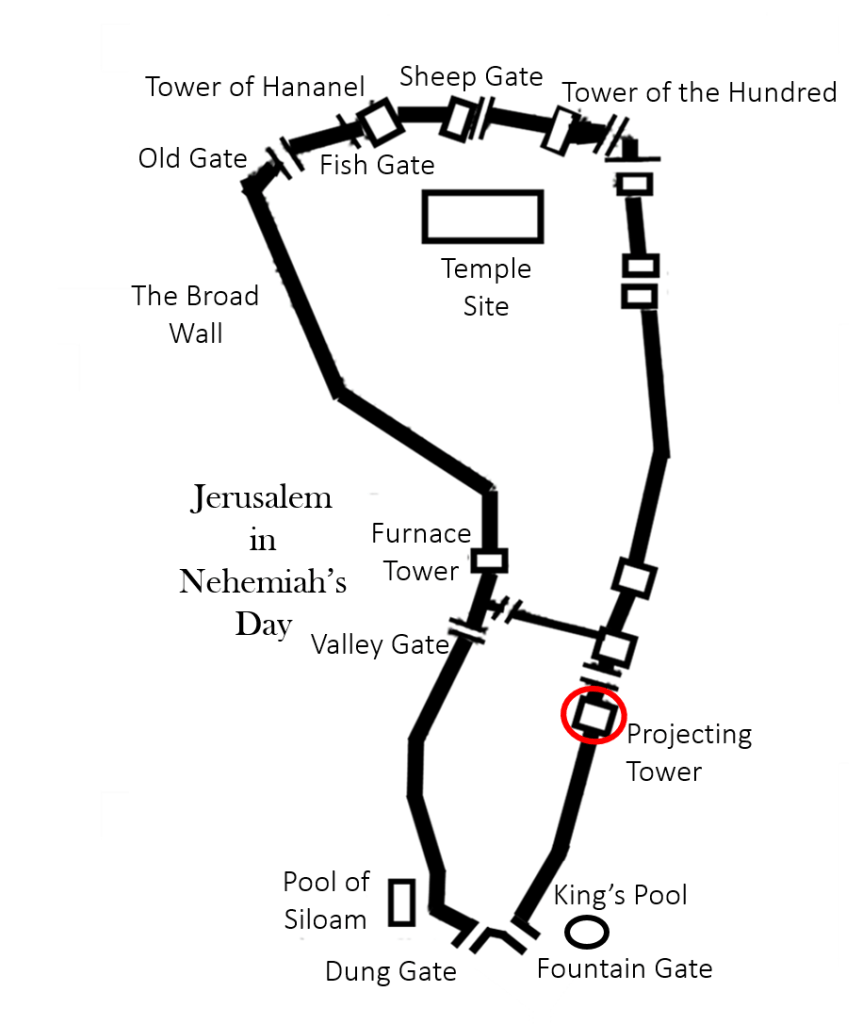
And Palal son of Uzai worked opposite the angle and the tower projecting from the upper palace near the court of the guard. – Nehemiah 3:25a (NIV)
פָּלָל
Palal
As the name of a man, Palal is only found once in the Bible. Palal comes from a verb-root of the same name. As a verb, “palal” (פלל) means “to distinguish, discern, intervene, judge, interpose, or pray.” Even though it’s only found once as the name of a man, as a verb, “palal” appears 84 times in the Hebrew Scriptures and is largely used to describe prayer. Some scholars believe “palal” (פלל) is related to the verb “niphal” (נפל) which means “to fall, lie down, cast down, or fail.” They see the act of lying down as an integral part of prayer. Prostrating oneself before the King, a pleading before the Judge.
Most Bible dictionaries define the name “Palal” as “Judge.”
Palal was the son of Uzai.
אוּזַי
Uzai
The name Uzai also appears just once in the Bible. Many Bible dictionaries do not offer a definition for this name. There does not appear to be a root word in Hebrew that it could be associated with. However, it’s been assumed that the first part of Uzai (אוז) may be a transliteration of a similar verb in Hebrew’s sister language, Arabic. That verb, in Hebrew, translates to אוץ (utz), meaning “to hurry, urge, or be pressed.” That said, let’s look at the possible meanings of the name Uzai.
Jones’ Dictionary renders “Velocity of the LORD.” Abarim Publications reads, “The LORD Hastens.” The NOBSE Study Bible lists “Hoped For” – but doesn’t offer an explanation of how they arrived there.
Just a reminder that it’s tradition to read Psalm 27 daily through the Feast of Tabernacles. You can find it by clicking on the link.
To read all of our posts on Nehemiah, click on the image above.

© 2026 Today in the Bible

 Today in the Bible
You must be logged in to post a comment.