Elul 10, 5785; from sunset September 2, 2025, to sunset September 3, 2025
(The tenth day of the sixth month)
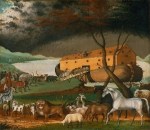
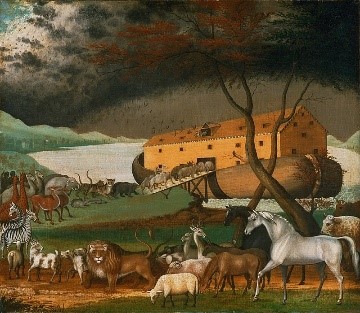
Noah’s Ark (1846), by the American folk painter Edward Hicks.
Today in the Bible, we’re meeting up again with Noah and those with him in the ark. Today, according to Jewish tradition, is the day that Noah opened the window and released the raven. We’ve been following Rashi’s timeline for Noah’s year-long sojourn in the ark. On the first day of last month, Rashi placed a mark on the calendar for when the mountain tops were seen for the first time. Now, 40 days later, Rashi places the release of the raven. Let’s explore the Hebrew behind this translation to find a deeper meaning behind this act.
So it came to pass, at the end of forty days, that Noah opened the window of the ark which he had made. Then he sent out a raven, which kept going to and fro until the waters had dried up from the earth. – Genesis 8:6-7 (NKJ)
The story of Noah is a type of a “re-creation” of the world. Why do we say this? Let’s take a look at the parallels between Noah’s story and the Creation narrative.
First, God “undoes” creation:
| Creation: | God separated the waters above from the waters below. (Gen 1:6-8) |
| Flood: | The windows of heaven were opened and the waters were reunited. (Gen 7:11) |
| Creation: | God breathed the breath of life into Adam. (Gen 2:7) |
| Flood: | All living beings who had the breath of life died. (Gen 7:22) |
Then, He started all over again…
| Creation: | The earth was formless and void. (Gen 1:2) |
| Flood: | Even the mountaintops were covered…there were no forms to be seen. (Gen 7:20) |
| Creation: | And darkness was upon the face of the deep. (Gen 1:2) |
| Flood: | Noah released the raven and it flew upon the face of the deep. (Gen 8:7) |
| The word “raven,” in Hebrew, is “orev” (עֹרֵב). Orev contains the same three letters as the word “erev” (עֶרֶב), meaning “evening.” The three-letter root word “arav” (ערב), from which they both stem, means “to grow dark.” The raven flying to and fro upon the face of the deep can be seen as “darkness upon the face of the deep!” | |
| Creation: | The Spirit (“Ruach”) of God hovered over the face of the waters. (Gen 1:2) |
| Flood: | God made a “wind” or “ruach” to move across the earth (in Hebrew, “ruach” means wind, breath, or spirit). (Gen 8:1) |
| Creation: | Let there be a firmament to divide the waters above from the waters below. (Gen 1:6) |
| Flood: | The windows of heaven were closed. (i.e the waters above and the waters below were separated again.) (Gen 8:2) |
| Creation: | Let the waters be gathered into one place and let the dry land appear. (Gen 1:9) |
| Flood: | In the tenth month, on the first day of the month, the tops of the mountains were seen. (i.e. the dry ground began to appear.) (Gen 8:5) |
| Creation: | Let the earth bring forth grass, herbs, and trees. (Gen 1:11) |
| Flood: | The dove returned with a freshly plucked olive leaf. (Gen 8:11) |
| Creation: | Let there be birds in the air. (Gen 1:20) |
| Flood: | The raven and the dove were released to the air. (Gen 8:7-8) |
| Creation: | Let the earth bring forth living creatures. (Gen 1:24) |
| Flood: | God commanded Noah to release every living thing from the ark; they were returned to fill the earth. (Gen 8:17) |
| Creation: | God created man – tradition holds that Adam was made on the first day of the first month (of the year) – Rosh Hashanah. (Gen 1:26) |
| Flood: | Noah went out of the ark and returned to the earth. Tradition places Noah’s birthday on the first day of the first month (of the year) – Rosh Hashanah. (Gen 8:18) |
| Creation: | God made lights in the firmament to be for signs, seasons, day, and years. (Gen 1:14) |
| Flood: | God promised Noah that seedtime and harvest, cold and heat, winter and summer, and day and night shall not cease. (Gen 8:22) |
So, let’s review the creation narrative:
- Day 1 – Let there be light
- Day 2 – Separate waters above and waters below
- Day 3 – Dry ground, vegetation
- Day 4 – Lights in the firmament
- Day 5 – Fish and birds
- Day 6 – Cattle, creeping things, mankind
The only thing that seems to be missing from the flood narrative is, a “Let there be light” moment. Maybe it’s in there somewhere and we just don’t see it.
Some other interesting things from the Hebrew.
- Noah opened the window – the Hebrew in this verse for “window” is “challon.” It comes from the verb “challah” meaning to wound (fatally), bore through, or pierce…a window is seen as a “piercing” or “boring through” of a wall.
- Then he “sent out” a raven – in Hebrew the word for “sent out” is “shalach” – a person who is “sent out” is a “shaliach;” in the New Testament we would call these people “apostles” (Greek for “sent ones”).
- In Genesis 1 the word for “dry land” is “yabashah” – the same word is used in the story of Noah.
- In the creation narrative, when the water is collected into pools and the “yabashah” appears, the word used to describe the collection of water comes from the root word “kavah.” The word “mikvah” is derived from this root – a mikvah is a ritual immersion. In the story of Noah, the world received a “mikvah” – a ritual cleansing.
- The raven “went out” (yatza) and kept “going out” (yatza) and “returning” (shuv) until the waters dried up. Now, I don’t know about you, but I always thought that, once Noah let the raven go, it just kept flying around and never came back. But when you read it in Hebrew, it says that it would “go out and return” – most translations render “to and fro.”
Just a reminder that it’s tradition to read Psalm 27 daily through the Feast of Tabernacles. You can find it by clicking on the link.
If you’d like to read all of our posts on Noah, please click on the image above.

© 2026 Today in the Bible

 Today in the Bible
You must be logged in to post a comment.