Elul 13, 5785; from sunset September 5, 2025, to sunset September 6, 2025
(The thirteenth day of the sixth month)
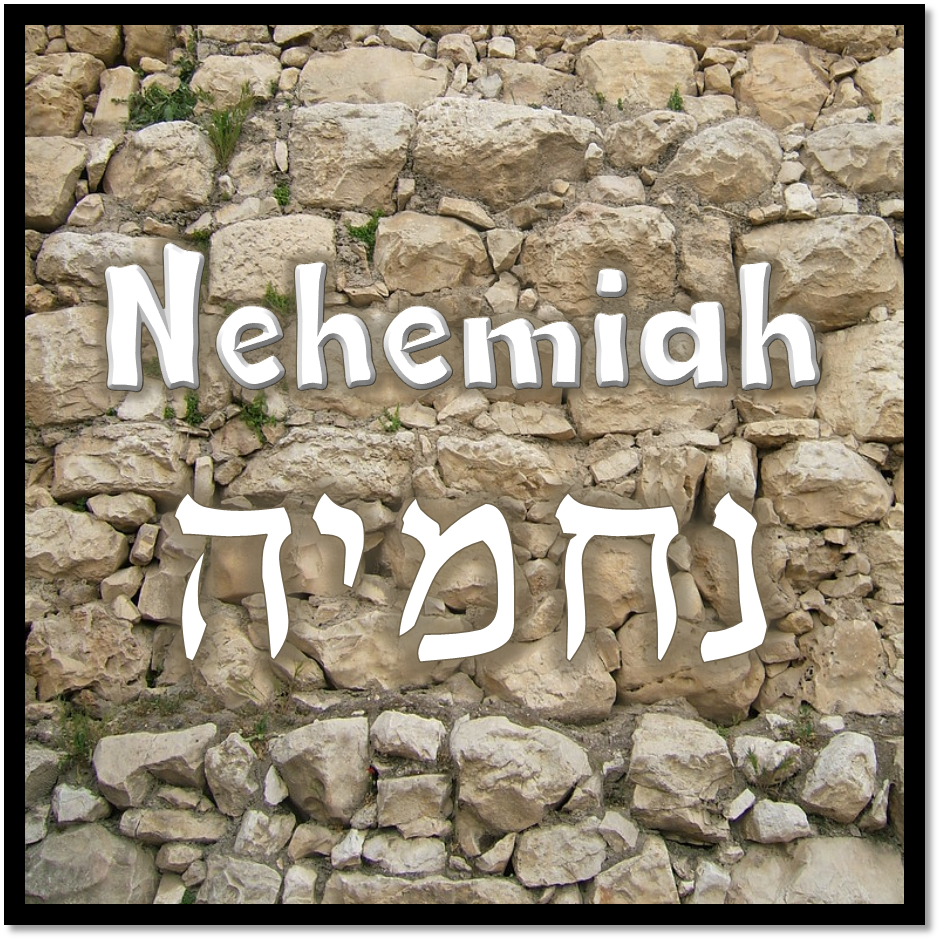
This is an image of a portion of the wall rebuilt by Nehemiah and company.
Today in the Bible we’ll meet Shemaiah, the son of Shechaniah and keeper of the east gate. We’re in the middle of the 52 days that it took the men and women who returned from Babylon to restore the walls and gates of Jerusalem. Let’s see what we can learn about Shemaiah.
After him repaired also Shemaiah the son of Shechaniah, the keeper of the east gate. – Nehemiah 3:29b (KJV)
If you were with us yesterday, you’ll remember that we met Zadok, the son of Immer. We learned that Zadok means “Righteous” and Immer comes from a verb-root meaning “to speak.” By combining those two names, we end up with “The Righteous Speak.” Today, we meet the man who worked right next to them, Shemaiah, whose name means “The LORD Hears.”
שְׁמַעְיָה
Shema’yah = Shemaiah
The name Shemaiah is a popular one. It is found 41 times in the Bible. Its earliest mention is found as a “man of God” in the days of Rehoboam, the son of Solomon. He advised the king not to go up against Jeroboam and the northern tribes. (1 Kings 12). Other than its mention in 1 Kings, this name is concentrated in the books of 1 & 2 Chronicles, Jeremiah, Ezra, and Nehemiah.
As we first hinted in the title for today’s article, the name Shemaiah, comes from the verb-root “shama” (שמע) which means “to hear, listen to, or obey.” If you’ve been following us these past few weeks, you are probably familiar with what the “iah” of our name-ending means. It’s a shorted version of the LORD’s Holy Name.
| Verb Root | Transliteration | Meaning |
| שמע | shama | to hear, listen to, or obey |
| Prefix/Suffix | Transliteration | Comments |
| י | y, i | sometimes, just a “yod” (י), the first letter of God’s Holy Name, may serve as an indicator of its presence |
| ה | h | “yah” (יה) this combination of the 1st and 2nd letters of “The Name” is often translated as “iah” & is a very common name ending |
| ו | v, w, u, o | “yahu” (יהו) – the first three letters – is not quite as common but still found – as in “Elijah” – “Eliyahu” |
| ה | h | adding all four letters of “The Name” is not done |
These four letters represent God’s Holy Name. Many proper nouns use a combination of two or three of these letters as a prefix or a suffix to indicate an attachment to the Name of the LORD.
“Shemaiah“ means “The LORD Hears” or “The LORD Has Heard.”
“The Righteous Speak and the LORD Hears“
Shemaiah was the son of Shecaniah.
שְׁכַנְיָה
Shechanyah = Shechaniah
The name Shechaniah is found seven times in the Bible. The name Shechaniah begins with the verb-root “shachan” (שכן) meaning “to dwell or tabernacle” and ends with our familiar “iah” – a shortened form of God’s Holy Name. 1 Chronicles 3 contains a listing of the descendants of David. Included in that list are Shechaniah and his son Shemaiah — who was the father of six sons.
The son of Shechaniah was Shemaiah. The sons of Shemaiah were Hattush, Igal, Bariah, Neariah, and Shaphat… – 1 Chronicles 3:22 (NKJ)
| Verb Root | Transliteration | Meaning |
| שכן | shachan | to dwell or tabernacle |
| Prefix/Suffix | Transliteration | Comments |
| י | y, i | sometimes, just a “yod” (י), the first letter of God’s Holy Name, may serve as an indicator of its presence |
| ה | h | “yah” (יה) this combination of the 1st and 2nd letters of “The Name” is often translated as “iah” & is a very common name ending |
| ו | v, w, u, o | “yahu” (יהו) – the first three letters – is not quite as common but still found – as in “Elijah” – “Eliyahu” |
| ה | h | adding all four letters of “The Name” is not done |
These four letters represent God’s Holy Name. Many proper nouns use a combination of two or three of these letters as a prefix or a suffix to indicate an attachment to the Name of the LORD.
“Shechaniah” means “The Dwelling of the LORD.”
שַׁעַר הַמִּזְרָח
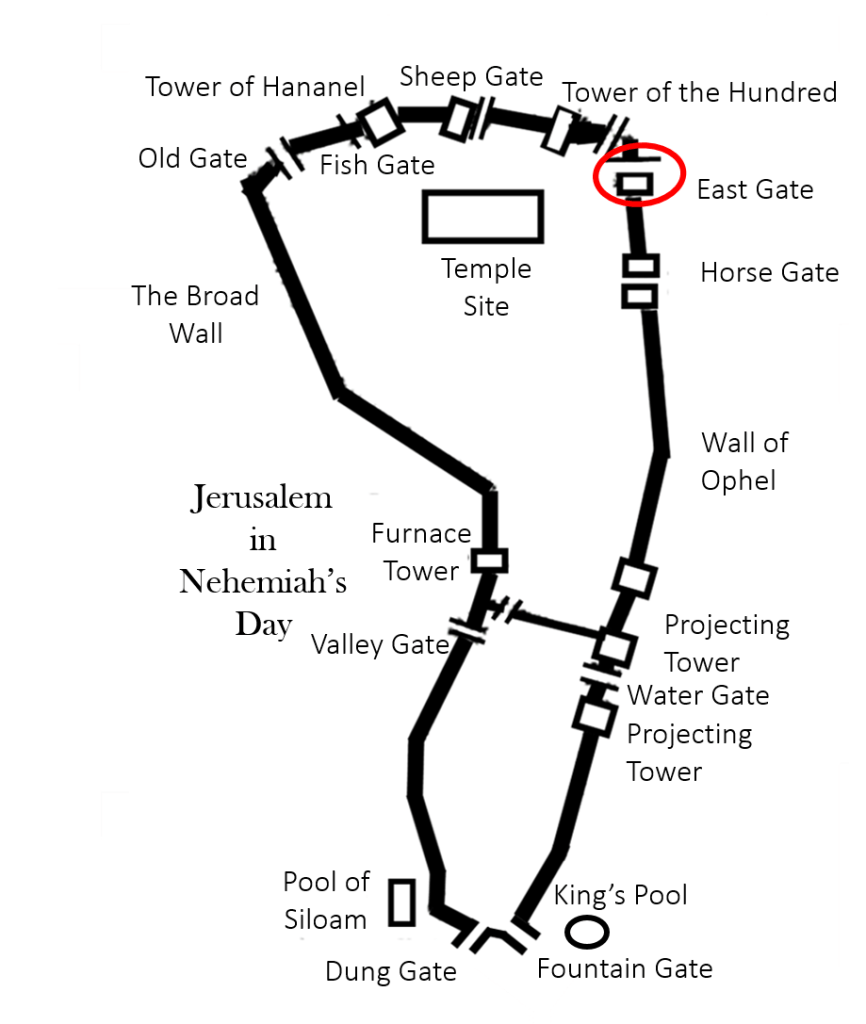
Sha’ar HaMizrach = The Gate of the Rising Sun = The East Gate
From the root “zerach” (זרח) meaning “to arise, rise up, or to shine.” Mizrach means the place of the sunrise, the east. Many associate the Eastern Gate of Jerusalem with the Beautiful Gate mentioned in Acts 3:2 – but the Beautiful Gate is likely referring to one of the Temple gates. The Golden Gate of today is located in the same area as the East Gate and is blocked up so no one may enter or exit.
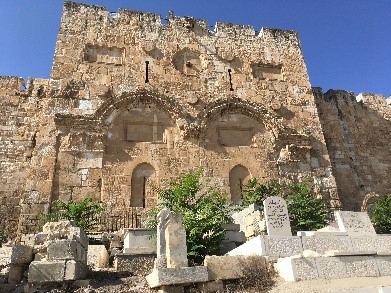
Photo credit: Today in the Bible
1 Chronicles contains a description of the various areas of organization put into place by king David. Chapter 6 tells of the assignments for the gatekeepers; verse 14 says that the lot for the East Gate fell to Shelemiah. In the days of Hezekiah, Kore the son of Imnah the Levite, was the keeper of the East Gate (2 Chronicles 31:14). But the book of Ezekiel contains, by far, the most references to the East Gate. Many of them revolve around the entering and exiting of the “Glory (Kavod) of the LORD” to and from the Holy City.
You may be familiar with the term “Shechinah Glory.” Shechinah Glory is defined as a visible manifestation of God’s dwelling presence on earth. This presence is usually portrayed through a natural occurrence:
- Burning Bush
- Pillar of Fire
- Pillar of Cloud
- Glory of the LORD descending on the Tabernacle in the wilderness
- Glory of the LORD descending on Solomon’s Temple
- Jesus
These are all examples of the Shechinah Glory. The word “shechinah” comes from our root word “shachan.” Suprisingly, “shechinah” is actually not used in the Bible to describe the Glory of the LORD. This term was first used by rabbis in the targums and other literature written after the completion of the Old Testament.
Still, it is amazing that, in this verse of Nehemiah, a man named Shechaniah is the keeper of the East Gate from whence the Shechinah Glory enters and exits!
Just a reminder that it’s tradition to read Psalm 27 daily through the Feast of Tabernacles. You can find it by clicking on the link.
To read all of our posts on Nehemiah, click on the image above.

© 2026 Today in the Bible

 Today in the Bible
You must be logged in to post a comment.