Elul 26, 5785; from sunset September 18, 2025, to sunset September 19, 2025
(The twenty-sixth day of the sixth month)
According to Jewish tradition, today is the second day of creation, when God separated the waters below from the waters above.
Then God said, “Let there be a firmament in the midst of the waters, and let it divide the waters from the waters.” Thus God made the firmament, and divided the waters which were under the firmament from the waters which were above the firmament; and it was so. And God called the firmament Heaven. So the evening and the morning were the second day. – Genesis 1:6-8 (NKJ)
This is the only day of creation that is not declared as “tov” — “good.” There are many theories as to why that is. One is that day three is a continuation of the separating of the waters that began on day two. Once that separation was completed…then it was good. After all, when God was finished, He looked upon His entire creation and declared it all good. If this day was a part of creation, wouldn’t it have to be good as well?
Another view is that the waters above are a separation between heaven and earth. Revelation 4 tells us that God sits on a throne with a “sea” of glass before it; He sits above or outside of the separated waters. Elsewhere in the Bible, God speaks through the prophet Micah, who tells us that God will cast our sins into the sea.
Who is a God like Thee, who pardons iniquity and passes over the rebellious act of the remnant of His possession? He does not retain His anger forever, because He delights in unchanging love. He will again have compassion on us; He will tread our iniquities under foot. Yes, Thou wilt cast all their sins into the depths of the sea. – Micah 7:18-19 (NAS)
Returning to the book of Revelation, chapter 21 reveals a new heaven and a new earth where there is no longer any sea…no longer a separation, no longer sin…and the dwelling place of God is with His people once again.
Now I saw a new heaven and a new earth, for the first heaven and the first earth had passed away. Also there was no more sea. Then I, John, saw the holy city, New Jerusalem, coming down out of heaven from God, prepared as a bride adorned for her husband. And I heard a loud voice from heaven saying, “Behold, the tabernacle of God is with men, and He will dwell with them, and they shall be His people. God Himself will be with them and be their God. And God will wipe away every tear from their eyes; there shall be no more death, nor sorrow, nor crying. There shall be no more pain, for the former things have passed away.” – Revelation 21:1-4 (NKJ)
Ancient Picture Language
The Hebrew letters we use today originally began as pictographs. A pictograph is similar to an Egyptian hieroglyph. Today we could compare them to an emoji. A picture spans the language barrier which makes me wonder if they began at the Tower of Babel when God confused the languages. It makes sense that people could have begun drawing pictures as an attempt to communicate with each other again.
מַיִם
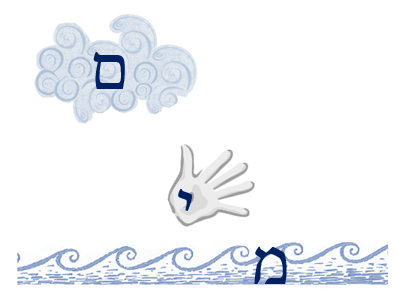
Today in the Bible, God separated the waters…the “mayim” (מַיִם). Mayim seems like a good word to examine in the picture language. It consists of three consonants: mem – yod – mem. Unlike most other languages, the Hebrew alphabet does not contain letters for vowel sounds. It wasn’t until about a thousand years ago that a group called the Masoretes devised a system of dots and dashes that are placed over, within, or under the letters to indicate the vowel sound associated with each consonant. The chart below shows the relationship of the modern letters “mem”-“yod”-“mem” to their ancient pictographs.
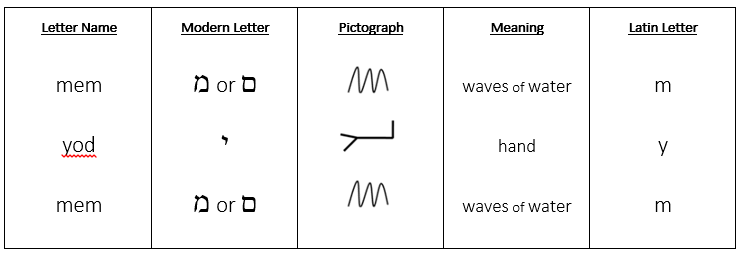
The pictograph for the letter “mem” (מ or ם) is represented by waves of water. The picture of the waves even influenced the shape of our Latin letter “m”. In the sea, the waters swell into waves that crash and churn. The sea – the waters – can be representative of chaos, confusion, disorder, sin, and the unknown. There are two letter forms for the letter mem, the modern letter shown on the left in our chart is the form the letter takes when it appears in the beginning or the middle of a word. The form shown on the right is called a “mem sofit.” A mem sofit is the form that the letter takes when it is the final letter of a word.
The letter “yod” (י) is an image of a hand in the picture language. The word for hand in Hebrew is “yad” and is derived from this letter. The letter yod represents the works of our hands, our power, even our praises.
The word mayim creates a word picture of the second day of creation…God’s hand separating the waters.
Just a reminder that it’s tradition to read Psalm 27 daily through the Feast of Tabernacles. You can find it by clicking on the link.
Did you know that you can view any of our posts whenever you’d like?
Visit our home page at https://todayinthebible.com
where you can find them organized by month
in the “Archives” section on the right side of the page.
© 2026 Today in the Bible
 Today in the Bible
You must be logged in to post a comment.