
Elul 27, 5785; from sunset September 19, 2025, to sunset September 20, 2025
(The twenty-seventh day of the sixth month)
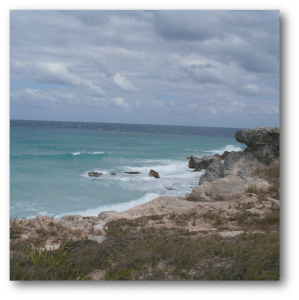
According to Jewish tradition, today is the third day of creation, when God separated the waters below the heavens from the dry ground and made plants appear on the earth.
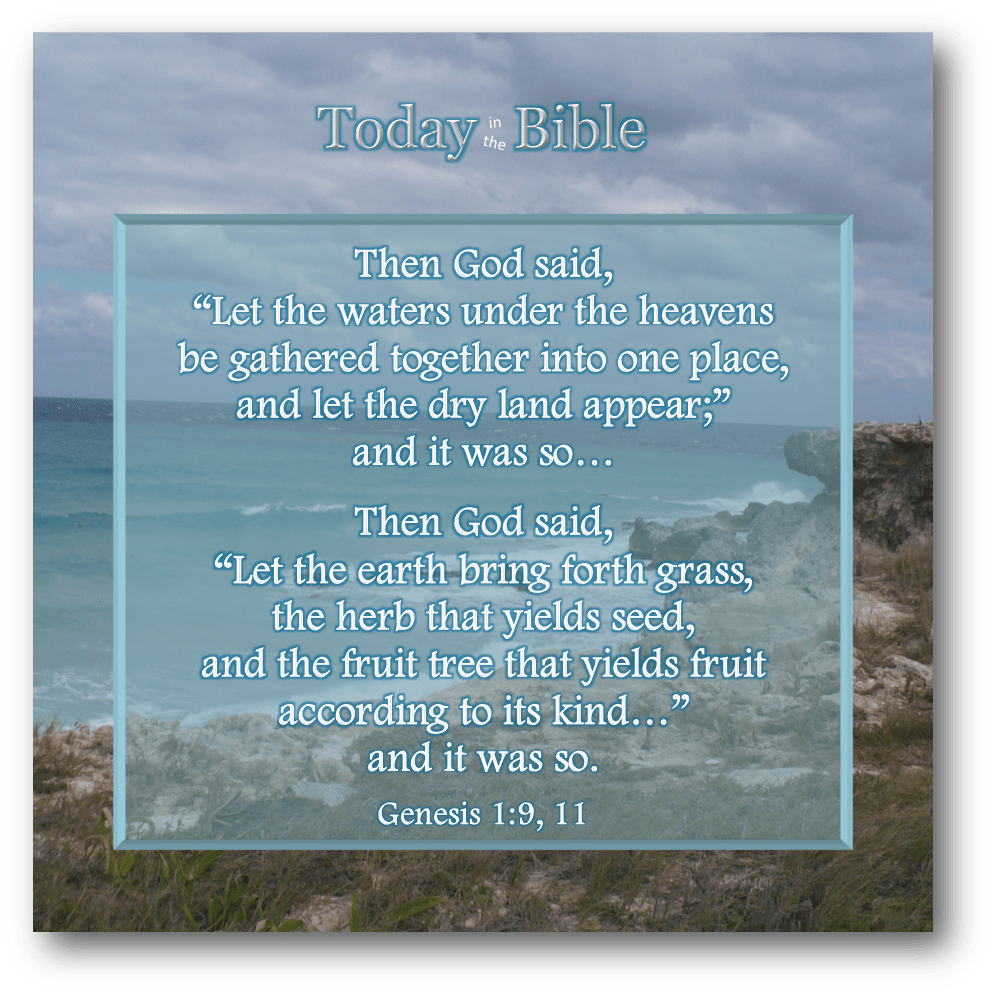
Then God said, “Let the waters under the heavens be gathered together into one place, and let the dry land appear;” and it was so. And God called the dry land Earth, and the gathering together of the waters He called Seas. And God saw that it was good.
Then God said, “Let the earth bring forth grass, the herb that yields seed, and the fruit tree that yields fruit according to its kind, whose seed is in itself, on the earth”; and it was so. And the earth brought forth grass, the herb that yields seed according to its kind, and the tree that yields fruit, whose seed is in itself according to its kind. And God saw that it was good.
So the evening and the morning were the third day. – Genesis 1:9-13 (NKJ)
When God commanded the waters under the heavens, that “they be gathered together…” (Genesis 1:9), He used the word יִקָּווּ (“yikavu”), from the verb קוה (kvh); in its simplest form, “kvh” is pronounced “kavah.” Kavah is a word that has two different sets of meanings.
- To wait, look for or hope
- To collect
In our story, the word carries the second meaning, “to collect.” God commanded the waters to be “collected.” If we keep reading, verse ten tells us that God called the “gathered” waters “seas” (“yamim”). He used the word וּלְמִקְוֵה (ulemikveh – “and to the gathered waters…”).
The Hebrew language contains inseparable prepositions, which is a fancy way of saying that preposition words, like “and” or “to” are actually attached to the front of the word in the form of a single letter. Ulemikveh is a word that has two inseparable prepositions. The “u” sound (וּ) in this word means “and” and the “le” (לְ) sound means “to or for.” If we separate these inseparable prepositions, we are left with the word “mikveh” (מִקְוֵה). This word may be familiar to you if you’ve spent any time studying Judaism or the Hebrew roots of Christianity. Further breaking the word down, if we separate the letter “mem” (מ), we end up with our root “kvh” (קוה). When the letter “mem” (מ) is prefixed to a verb, it represents an agent or instrument of the verb. A “mikveh” is the “instrument” that “collects” the water; “kvh” (קוה) represents the action of collecting or gathering.
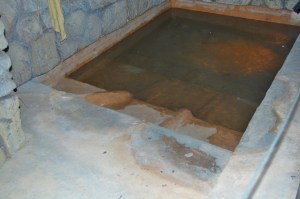
A mikveh is a bath used for the purpose of ritual immersion – to achieve ritual purity.
| Root | Prefix | Preposition | Preposition |
| קְוֵה | מִ | לְ | וּ |
| kvah | mi | le | u |
| to gather, collect | this prefix represents an agent or instrument of a verb | to, for | and |
The act of a entering a “mikveh” (a ritual immersion) was a way of symbolically rinsing off sin and death before entering the Temple. Our Living God has nothing to do with sin or death. It was also prescribed for other ordinary, everyday life events that are not sinful, but perhaps, have some sort of a connection to death.
After the destruction of the Temple, the mikveh’s main uses are as follows:
- For a woman to achieve ritual purity after menstruation (the “death of her egg”) or after she gives birth, in either instance a mikveh is prescribed before resuming marital relations with her husband
- For a man to achieve ritual purity after ejaculation (the “death of his seed”)
- Converts to Judaism (the “death of their old life”)
- And preparing a corpse for burial
So, you could say that the “mikveh” was created on the third day. I wonder if this has anything to do with Jesus’ rising on the third day – a day of cleansing, a separating of life and death? Now that was certainly something to “hope for” (the other meaning of our root “kavah”)!
Just a reminder that it’s tradition to read Psalm 27 daily through the Feast of Tabernacles. You can find it by clicking on the link.
Did you know that our posts are categorized and tagged by content?
When you visit our home page at https://todayinthebible.com and select any post,
you can find the associated categories and tags just to the right of the title.
Simply click on any tag and you will be taken to all related posts.

© 2026 Today in the Bible

 Today in the Bible
You must be logged in to post a comment.