
Tishrei 1, 5786; from sunset September 22, 2025, to sunset September 23, 2025
(The first day of the seventh month)

Today, according to Leviticus 23, is one of the LORD’s Appointed Times. Leviticus 23 is a special chapter which is the key to unlocking a greater understanding of the Bible. Why? These are God’s self-proclaimed Holy Days. These are days when He has acted in the past and/or will act again in the future. They are His plan to redeem His creation. Let’s take a broader look at these Holy Days.
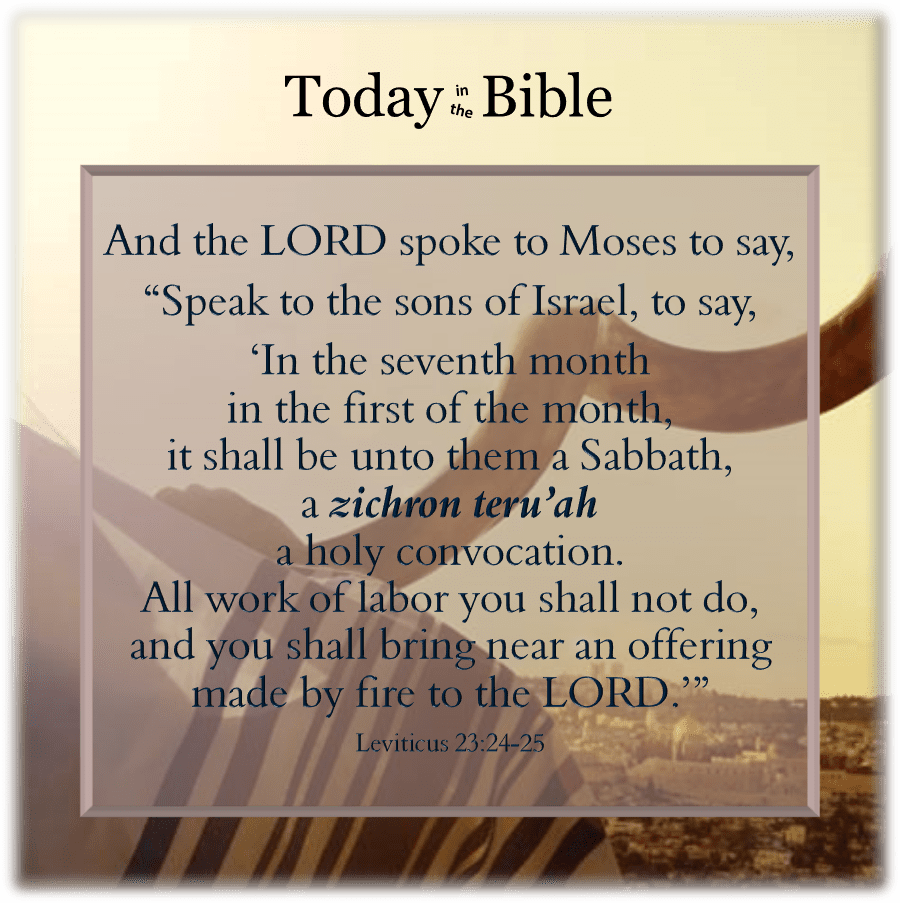
Today is commonly called, “The Feast of Trumpets.” The translation above calls it “a sacred assembly with trumpet blasts.” However, in the original Hebrew, the word “trumpets” is not present. Instead, it is called a “zichron teru’ah.”
Zichron (זִכְרוֹן) comes from the root זכר (zkr) which means “to think (about), meditate (upon), pay attention (to); remember, recollect; mention, declare, recite, proclaim, invoke, commemorate, accuse, or confess.”
Teru’ah (תְּרוּעָה) comes from the root רוע (rua) which means “to shout, raise a sound, or cry out.” A teru’ah is “an alarm or signal.”
So, the Appointed Time is really more about the sound that is made rather than the instrument making a sound. It can be from a trumpet, a shofar, or a human voice…a shout.
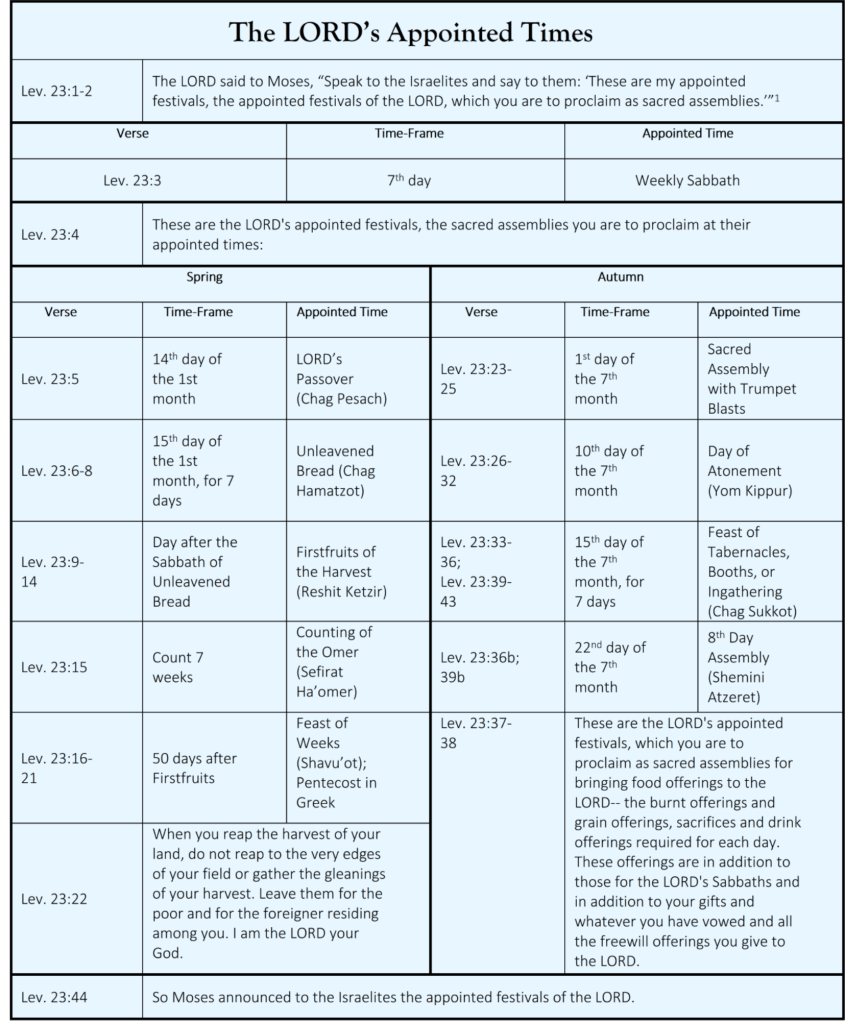
As you can see from the chart, it is the first Appointed Time occurring in the late summer/early autumn timeframe (of the northern hemisphere). If we pan over to the Appointed Times occurring in the springtime, they all seem to be related to Jesus’ first coming. He is our Passover Lamb (1 Corinthians 5:7). He is the Firstfruits of those who have fallen asleep (1 Corinthians 15:20). The Holy Spirit was made available to us on the first Feast of Weeks (aka Pentecost) after His death and resurrection (Acts 2:1-4). Do you see a pattern here? The LORD’s Appointed Times are times when God will act on our behalf. Jesus fulfilled these Appointed Times when He came the first time.
Since Jesus fulfilled the spring Appointed Times, we anticipate that He will fulfill the remainder of them when He returns. For this reason alone, it is worth studying them to gain a better understanding of what to expect when He returns. So, let’s take a look at Leviticus 23:23-25 where the LORD introduces us to this Appointed Time.
Again the LORD spoke to Moses, saying, “Speak to the sons of Israel, saying, ‘In the seventh month on the first of the month, you shall have a rest, a reminder by blowing of trumpets, a holy convocation. You shall not do any laborious work, but you shall present an offering by fire to the LORD.’” – Leviticus 23:23-25 (NAS)
This date is mentioned again in Numbers 29 which gives us a more detailed description of what the offering made by fire should look like.
Now in the seventh month, on the first day of the month, you shall also have a holy convocation; you shall do no laborious work. It will be to you a day for blowing trumpets.
And you shall offer a burnt offering as a soothing aroma to the LORD: one bull, one ram, and seven male lambs one year old without defect; also their grain offering, fine flour mixed with oil, three-tenths of an ephah for the bull, two-tenths for the ram, and one-tenth for each of the seven lambs. And offer one male goat for a sin offering, to make atonement for you, besides the burnt offering of the new moon, and its grain offering, and the continual burnt offering and its grain offering, and their libations, according to their ordinance, for a soothing aroma, an offering by fire to the LORD. – Numbers 29:1-6 (NAS)
Both of these texts tell us that we are to do no laborious work on this day. Perhaps an indicator that we can’t even act on our own behalf? The day belongs to the LORD.
So, how do we anticipate that Jesus will fulfill this Appointed Time? Many believe that this could be the day that Jesus will return again. Jesus, Himself, hints at this in the book of Matthew.
Then the sign of the Son of Man will appear in heaven, and then all the tribes of the earth will mourn, and they will see the Son of Man coming on the clouds of heaven with power and great glory. And He will send His angels with a great sound of a trumpet, and they will gather together His elect from the four winds, from one end of heaven to the other. – Matthew 24:30-31 (NKJ)
Paul, also, seems to connect this Appointed Time with the return of Jesus and the resurrection of the dead.
Behold, I tell you a mystery: We shall not all sleep, but we shall all be changed–in a moment, in the twinkling of an eye, at the last trumpet. For the trumpet will sound, and the dead will be raised incorruptible, and we shall be changed. – 1 Corinthians 15:51-52 (NKJ)
For if we believe that Jesus died and rose again, even so God will bring with Him those who sleep in Jesus. For this we say to you by the word of the Lord, that we who are alive and remain until the coming of the Lord will by no means precede those who are asleep. For the Lord Himself will descend from heaven with a shout, with the voice of an archangel, and with the trumpet of God. And the dead in Christ will rise first. Then we who are alive and remain shall be caught up together with them in the clouds to meet the Lord in the air. And thus we shall always be with the Lord. – 1 Thessalonians 4:14-17 (NKJ)
One interesting thing about this Appointed Time is that it is regularly celebrated for two days. Why? Back in the days of the Sanhedrin, on the 30th day of each month, witnesses would testify whether or not they had seen the first sliver of the crescent Moon — indicating the first day of the biblical month. It takes roughly 29 1/2 days for the Moon to cycle through all of its phases. Since a biblical month is based upon this natural cycle, that means each month is either 29 or 30 days long. If the New Moon had been verified by witnesses, signal fires would be lit that evening (the second day of the month) to let the rest of the nation know that the New Moon had been sanctified. This helped to keep everyone on the same calendar date, something that was especially important if there was a Holy Day to be celebrated in that month. As you can imagine, having a Holy Day on the first day of the month could cause a problem for those living outside of Jerusalem. Since that is the case for the Feast of Trumpets, the solution was to celebrate both the 30th and the 31st day from the sanctification of the sixth New Moon. This is explained in detail in our article on biblical months. So, it was uncertain what day the Feast of Trumpets would begin. Because of this, there are some who find another Bible verse that may point to today as the date of Jesus’ return.
But of that day and hour no one knows, not even the angels of heaven, but My Father only. – Matthew 24:36 (NKJ)
Today, this Holy Day is commonly referred to as Rosh Hashanah. This practice didn’t come to be until after the destruction of the Second Temple by the Romans. Rosh Hashanah literally means “Head (rosh) of the Year (hashanah)” because today is the first day of the new year. According to Jewish tradition, today begins the 5,786th year since creation.

Just a reminder that it’s tradition to read Psalm 27 daily through the Feast of Tabernacles. You can find it by clicking on the link.
Did you know that our posts are categorized and tagged by content?
When you visit our home page at https://todayinthebible.com and select any post,
you can find the associated categories and tags just to the right of the title.
Simply click on any tag and you will be taken to all related posts.

© 2026 Today in the Bible

 Today in the Bible
You must be logged in to post a comment.