
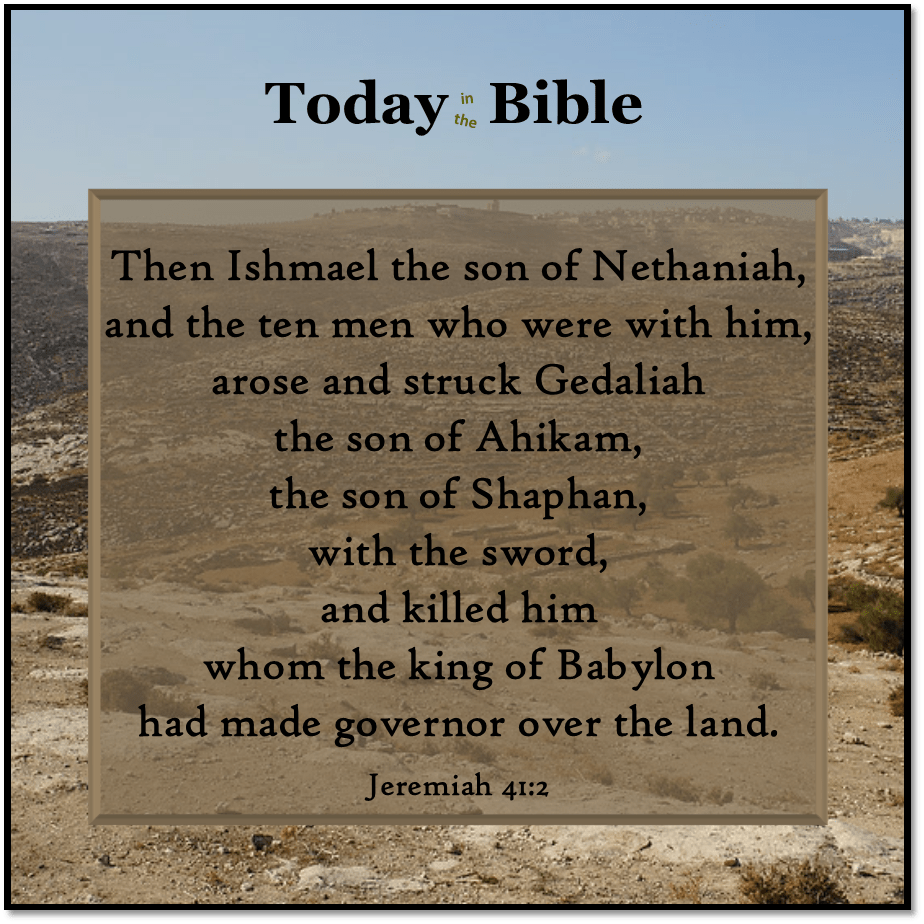
Tishrei 3, 5786; from sunset September 24, 2025, to sunset September 25, 2025
(The third day of the seventh month)
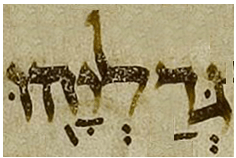
Above is the name “Gedalyahu” (Gedaliah), as seen in the Aleppo Codex which was written over one thousand years ago.
Today in the Bible marks the commemoration of the day that Gedaliah, governor of Judea was assassinated.
The text tells us that Gedaliah was the grandson of Shaphan. Shaphan was the “sofer” – the scribe/secretary to King Josiah. Josiah sent Shaphan to take funds to the high priest Hilkiah for repair of the Temple. When Shaphan reached Hilkiah with the instructions to hire repairmen for the work on the Temple, Hilkiah showed Shaphan the “Sofer Hatorah” – the book of the Torah – which he had found in the Temple. Shaphan took the book to Josiah and read it before him. This catapulted Josiah to make massive reforms within the Temple itself; and he ordered all of the high places and areas of improper worship to be destroyed.
Shaphan had a son, his name was Ahikam. Ahikam was a contemporary of the prophet Jeremiah. It so happened that during the reign of King Jehoiakim (Josiah’s son), Jeremiah received a word from the LORD against the people of Judea, imploring them to return to the LORD or the city would be destroyed. Now, the priests, the prophets, and the people were greatly angered at his words. They seized him and said that he must die for his words. There were some who stood up for Jeremiah, but the matter ultimately ended up before the king, who also wanted him to die. Ahikam was integral in standing up for Jeremiah and, in the end, helped to save his life (Jeremiah 26).
Ahikam had a son, his name was Gedaliah, the subject of our Today in the Bible event. After Nebuchadnezzar had destroyed the Temple and carried most of the people into captivity, he installed Gedaliah as governor over Judea. Jeremiah had been released and he returned to dwell with Gedaliah in the city of Mizpah. Let’s pick up the story from there…
When all the army officers and their men who were still in the open country heard that the king of Babylon had appointed Gedaliah son of Ahikam as governor over the land and had put him in charge of the men, women and children who were the poorest in the land and who had not been carried into exile to Babylon, they came to Gedaliah at Mizpah— Ishmael son of Nethaniah, Johanan and Jonathan the sons of Kareah, Seraiah son of Tanhumeth, the sons of Ephai the Netophathite, and Jaazaniah the son of the Maakathite, and their men.
Gedaliah son of Ahikam, the son of Shaphan, took an oath to reassure them and their men. “Do not be afraid to serve the Babylonians,” he said. “Settle down in the land and serve the king of Babylon, and it will go well with you. I myself will stay at Mizpah to represent you before the Babylonians who come to us, but you are to harvest the wine, summer fruit and olive oil, and put them in your storage jars, and live in the towns you have taken over.”
When all the Jews in Moab, Ammon, Edom and all the other countries heard that the king of Babylon had left a remnant in Judah and had appointed Gedaliah son of Ahikam, the son of Shaphan, as governor over them, they all came back to the land of Judah, to Gedaliah at Mizpah, from all the countries where they had been scattered. And they harvested an abundance of wine and summer fruit.
Johanan son of Kareah and all the army officers still in the open country came to Gedaliah at Mizpah and said to him, “Don’t you know that Baalis king of the Ammonites has sent Ishmael son of Nethaniah to take your life?” But Gedaliah son of Ahikam did not believe them. Then Johanan son of Kareah said privately to Gedaliah in Mizpah, “Let me go and kill Ishmael son of Nethaniah, and no one will know it. Why should he take your life and cause all the Jews who are gathered around you to be scattered and the remnant of Judah to perish?” But Gedaliah son of Ahikam said to Johanan son of Kareah, “Don’t do such a thing! What you are saying about Ishmael is not true.”
In the seventh month Ishmael son of Nethaniah, the son of Elishama, who was of royal blood and had been one of the king’s officers, came with ten men to Gedaliah son of Ahikam at Mizpah. While they were eating together there, Ishmael son of Nethaniah and the ten men who were with him got up and struck down Gedaliah son of Ahikam, the son of Shaphan, with the sword, killing the one whom the king of Babylon had appointed as governor over the land. Ishmael also killed all the men of Judah who were with Gedaliah at Mizpah, as well as the Babylonian soldiers who were there.
The day after Gedaliah’s assassination, before anyone knew about it, eighty men who had shaved off their beards, torn their clothes and cut themselves came from Shechem, Shiloh and Samaria, bringing grain offerings and incense with them to the house of the LORD. Ishmael son of Nethaniah went out from Mizpah to meet them, weeping as he went. When he met them, he said, “Come to Gedaliah son of Ahikam.” When they went into the city, Ishmael son of Nethaniah and the men who were with him slaughtered them and threw them into a cistern. But ten of them said to Ishmael, “Don’t kill us! We have wheat and barley, olive oil and honey, hidden in a field.” So he let them alone and did not kill them with the others.
Now the cistern where he threw all the bodies of the men he had killed along with Gedaliah was the one King Asa had made as part of his defense against Baasha king of Israel. Ishmael son of Nethaniah filled it with the dead. Ishmael made captives of all the rest of the people who were in Mizpah– the king’s daughters along with all the others who were left there, over whom Nebuzaradan commander of the imperial guard had appointed Gedaliah son of Ahikam. Ishmael son of Nethaniah took them captive and set out to cross over to the Ammonites. When Johanan son of Kareah and all the army officers who were with him heard about all the crimes Ishmael son of Nethaniah had committed, they took all their men and went to fight Ishmael son of Nethaniah. They caught up with him near the great pool in Gibeon.
When all the people Ishmael had with him saw Johanan son of Kareah and the army officers who were with him, they were glad. All the people Ishmael had taken captive at Mizpah turned and went over to Johanan son of Kareah. But Ishmael son of Nethaniah and eight of his men escaped from Johanan and fled to the Ammonites.
Then Johanan son of Kareah and all the army officers who were with him led away all the people of Mizpah who had survived, whom Johanan had recovered from Ishmael son of Nethaniah after Ishmael had assassinated Gedaliah son of Ahikam– the soldiers, women, children and court officials he had recovered from Gibeon. And they went on, stopping at Geruth Kimham near Bethlehem on their way to Egypt to escape the Babylonians. They were afraid of them because Ishmael son of Nethaniah had killed Gedaliah son of Ahikam, whom the king of Babylon had appointed as governor over the land. – Jeremiah 40:7-41:18 (NIV)
Why did Ishmael kill Gedaliah? There are a few theories. One being, Ishmael was “of royal blood and had been one of the king’s officers.” Perhaps he felt the governorship should have been given to him instead – or maybe he was upset by Gedaliah’s readiness to submit to Babylon. Another theory is that King Baalis of the Ammonites (who had sent Ishmael to kill Gedaliah), was trying to make a power-grab in the midst of the chaos after the fall of Judah.
Whatever the motive, Gedaliah was now dead and his death is still mourned today. The “fast of the seventh month” (Zechariah 8) commemorates Gedaliah’s death, the end of Jewish autonomy following the destruction of the First Temple.
Many believe that Gedaliah’s assassination actually occurred on the first day of the seventh month, which is one of the LORD’s Appointed Times (Yom Teruah) and also recognized as New Year’s Day (Rosh Hashanah). Jeremiah 41:1 states that the assassination occurred, “in the seventh “’chodesh’” – which gets translated as the “seventh month.” The word “chodesh” is used often to refer to the New Moon, which is the first day of the biblical month. Therefore, it is believed that Gedaliah’s death may have occurred on the first day of the month at a celebratory meal, but the fast is held on the third day of the month in order to honor Yom Teruah/Rosh Hashanah, which is observed as a two-day festival.
The full story of Gedaliah can be found in 2 Kings 25 and Jeremiah 40-41.
Those choosing to observe the Fast of Gedaliah should refrain from both food and drink from sunrise to sunset. If Tishrei 3 falls upon the weekly Sabbath, the fast is pushed back to the following day.

Just a reminder that it’s tradition to read Psalm 27 daily through the Feast of Tabernacles. You can find it by clicking on the link.
Did you know that our posts are categorized and tagged by content?
When you visit our home page at https://todayinthebible.com and select any post,
you can find the associated categories and tags just to the right of the title.
Simply click on any tag and you will be taken to all related posts.

© 2026 Today in the Bible

 Today in the Bible
You must be logged in to post a comment.