Tishrei 21, 5786; from sunset October 12, 2025, to sunset October 13, 2025
(The twenty-first day of the seventh month)
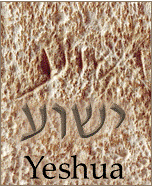
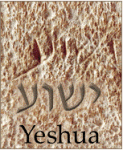
This is the name “Yeshua” (יֵשׁוּעַ – Jesus) as seen on the James Ossuary. Yeshua comes from the verb “yasha” meaning “to save or deliver.” Yeshua means “Salvation.”
Rivers of Living Water
In the autumn of the final year of His ministry, Jesus attended the Feast of Tabernacles in Jerusalem, and on the last day of the festival, He spoke these words to the people:
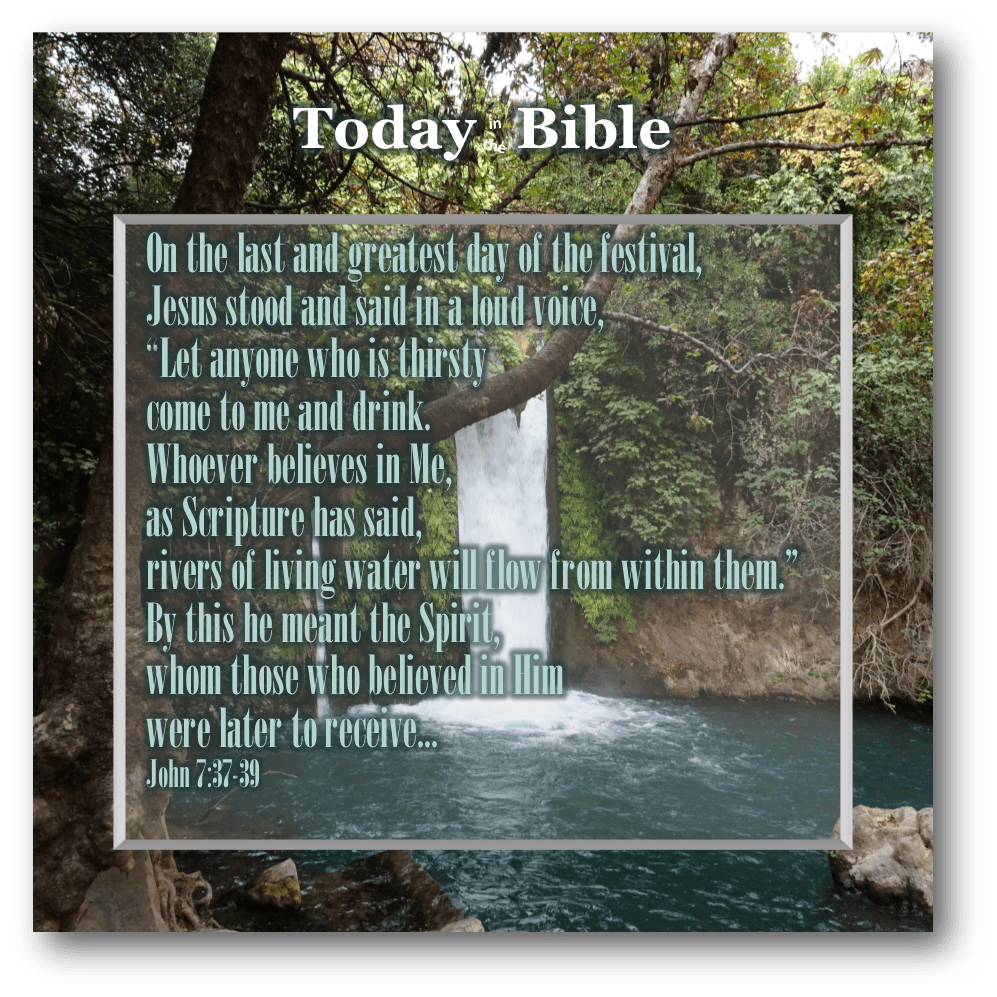
On the last and greatest day of the festival, Jesus stood and said in a loud voice, “Let anyone who is thirsty come to me and drink. Whoever believes in me, as Scripture has said, rivers of living water will flow from within them.” By this he meant the Spirit, whom those who believed in him were later to receive. Up to that time the Spirit had not been given, since Jesus had not yet been glorified.
On hearing his words, some of the people said, “Surely this man is the Prophet.” Others said, “He is the Messiah.” Still others asked, “How can the Messiah come from Galilee? Does not Scripture say that the Messiah will come from David‘s descendants and from Bethlehem, the town where David lived?”
Thus the people were divided because of Jesus. Some wanted to seize him, but no one laid a hand on him. Finally the temple guards went back to the chief priests and the Pharisees, who asked them, “Why didn’t you bring him in?”
“No one ever spoke the way this man does,” the guards replied.
“You mean he has deceived you also?” the Pharisees retorted. “Have any of the rulers or of the Pharisees believed in him? No! But this mob that knows nothing of the law– there is a curse on them.”
Nicodemus, who had gone to Jesus earlier and who was one of their own number, asked, “Does our law condemn a man without first hearing him to find out what he has been doing?”
They replied, “Are you from Galilee, too? Look into it, and you will find that a prophet does not come out of Galilee.”
Then they all went home, but Jesus went to the Mount of Olives. – John 7:37-8:1 (NIV).
The Feast of Tabernacles occurs at the end of a long, hot, dry summer; where rain is almost non-existant in Israel. One of the traditions for the Feast is to pray for rain for the upcoming planting and growing season. In Israel, the rains usually begin in November. The barley and wheat crops are planted November-December and harvested April-June.
The Mishnah describes a ritual called the water libation ceremony that was held during the Feast. It states that water was collected from the Siloam Spring and brought up by a lavish procession through the Water Gate, ending at the Temple. There the priest would pour the water into a pitcher with two compartments, one for water and the other for wine. Both liquids would be poured upon the altar at the same time (Mishnah Sukkah, ch. 4). It is said that long palm branches were waved during the procession, making a whooshing sound similar to rushing wind or flowing water. In Hebrew, the word for “wind” is “ruach” (pronounced like “roo-ahkh). Ruach also means “spirit” or “breath.” It is likely that Jesus’ declaration was made during this ceremony.
When we studied the first day of the seventh month (aka Feast of Trumpets, Rosh Hashanah, or Yom Teruah), we read in Nehemiah 8 that the people had gathered by the Water Gate to hear Ezra read to them from the Torah. These people had just recently returned from captivity in Babylon and here they were, back in Jerusalem, “drinking” in the Torah. It was an emotional day for all. Now we see Jesus, the Living Torah, standing in the same place and inviting all to who are thirsty to come to Him and drink.
The last day of the Feast of Tabernacles is also known as Hoshana Rabbah. Hoshana means “please save us.” Rabbah means “great.” Hoshana Rabbah means the “Great Salvation.” Jesus’ name in Hebrew is “Yeshua.” Yeshua means “Salvation.” His name comes from the same root word as hoshana (ישע – yasha). Before Jesus was born, an angel came to Joseph and told him not to be afraid to take Mary as his wife. The angel said to him,
“She will bring forth a Son, and you shall call His name JESUS, for He will save His people from their sins.” (Matthew 1:21)
To Joseph’s ears, it would have sounded like, “You shall call His name ‘Salvation’ for He will ‘save’ His people from their sins.” When we studied Revelation yesterday, we highlighted “Salvation belongs to our God” as one of the connections between Revelation 7 and the Feast of Tabernacles.
It is customary to celebrate Hoshana Rabbah by parading around the synagogue, carrying the etrog (a citrus fruit) and a lulav (a combination of myrtle, willow, and palm branches) along with the Torah scroll and blasts of the shofar to complete the celebration of the Feast of Tabernacles.
A few days ago, when we studied Zechariah 14, we made the connection between the Feast of Tabernacles, the nations, and rain.
And it shall come to pass that everyone who is left of all the nations which came against Jerusalem shall go up from year to year to worship the King, the LORD of hosts, and to keep the Feast of Tabernacles. And it shall be that whichever of the families of the earth do not come up to Jerusalem to worship the King, the LORD of hosts, on them there will be no rain. – Zechariah 14:16-17 (NKJ)
If we back up a few verses, Zechariah also mentions “living waters.”
And in that day it shall be that living waters shall flow from Jerusalem, half of them toward the eastern sea and half of them toward the western sea; in both summer and winter it shall occur. – Zechariah 14:8 (NKJ)
Sometime near the beginning of His ministry, Jesus and His disciples were passing through Samaria. Here, He revealed to the Samaritan woman who came to the well that He is the Messiah and He spoke of living waters and worshipping the Father in Spirit and Truth.
So He came to a city of Samaria which is called Sychar, near the plot of ground that Jacob gave to his son Joseph. Now Jacob’s well was there. Jesus therefore, being wearied from His journey, sat thus by the well. It was about the sixth hour [mid-day].
A woman of Samaria came to draw water. Jesus said to her, “Give Me a drink.” For His disciples had gone away into the city to buy food.
Then the woman of Samaria said to Him, “How is it that You, being a Jew, ask a drink from me, a Samaritan woman?” For Jews have no dealings with Samaritans.
Jesus answered and said to her, “If you knew the gift of God, and who it is who says to you, `Give Me a drink,’ you would have asked Him, and He would have given you living water.”
The woman said to Him, “Sir, You have nothing to draw with, and the well is deep. Where then do You get that living water? Are You greater than our father Jacob, who gave us the well, and drank from it himself, as well as his sons and his livestock?”
Jesus answered and said to her, “Whoever drinks of this water will thirst again, but whoever drinks of the water that I shall give him will never thirst. But the water that I shall give him will become in him a fountain of water springing up into everlasting life.”
The woman said to Him, “Sir, give me this water, that I may not thirst, nor come here to draw.” Jesus said to her, “Go, call your husband, and come here.”
The woman answered and said, “I have no husband.” Jesus said to her, “You have well said, `I have no husband,’ for you have had five husbands, and the one whom you now have is not your husband; in that you spoke truly.”
The woman said to Him, “Sir, I perceive that You are a prophet. Our fathers worshiped on this mountain, and you Jews say that in Jerusalem is the place where one ought to worship.”
Jesus said to her, “Woman, believe Me, the hour is coming when you will neither on this mountain, nor in Jerusalem, worship the Father. You worship what you do not know; we know what we worship, for salvation is of the Jews. But the hour is coming, and now is, when the true worshipers will worship the Father in spirit and truth; for the Father is seeking such to worship Him. God is Spirit, and those who worship Him must worship in spirit and truth.”
The woman said to Him, “I know that Messiah is coming ” (who is called Christ). “When He comes, He will tell us all things.”
Jesus said to her, “I who speak to you am He.” – John 4:5-26 (NKJ)
Samaritans were related to the Jews. Samaritan tradition claims the group descends from the northern Israelite tribes who were not deported by the Neo-Assyrian Empire after the destruction of the Kingdom of Israel (Wikipedia). They had built their own temple on Mount Gerizim and claimed that it was the true temple, the holiest place on Earth. This issue was addressed by Jesus with the Samaritan woman. He said that the time was coming when true worshippers will worship the Father in spirit and truth. The themes that He shared with this woman are mirrored in His speech on the last day of the Feast of Tabernacles.
Yesterday, when we studied allusions of the Feast of Tabernacles in Revelation 7, we also read how, “He will lead them to springs of living water…” which is mentioned again in Revelation chapters 21 and 22. God also used the same language to speak through the prophet Isaiah:
Everyone who thirsts, come to the waters; and you who have no money, come, buy and eat. Yes, come, buy wine and milk without money and without price. Why do you spend money for what is not bread, and your wages for what does not satisfy? Listen carefully to Me, and eat what is good, and let your soul delight itself in abundance. Incline your ear, and come to Me. Hear, and your soul shall live; and I will make an everlasting covenant with you– the sure mercies of David. – Isaiah 55:1-3 (NKJ)
All of these are reflections of how the LORD provided for Israel in the wilderness after their exodus from Egypt.
I will stand there before you by the rock at Horeb. Strike the rock, and water will come out of it for the people to drink.” So Moses did this in the sight of the elders of Israel. – Exodus 17:6 (NIV)
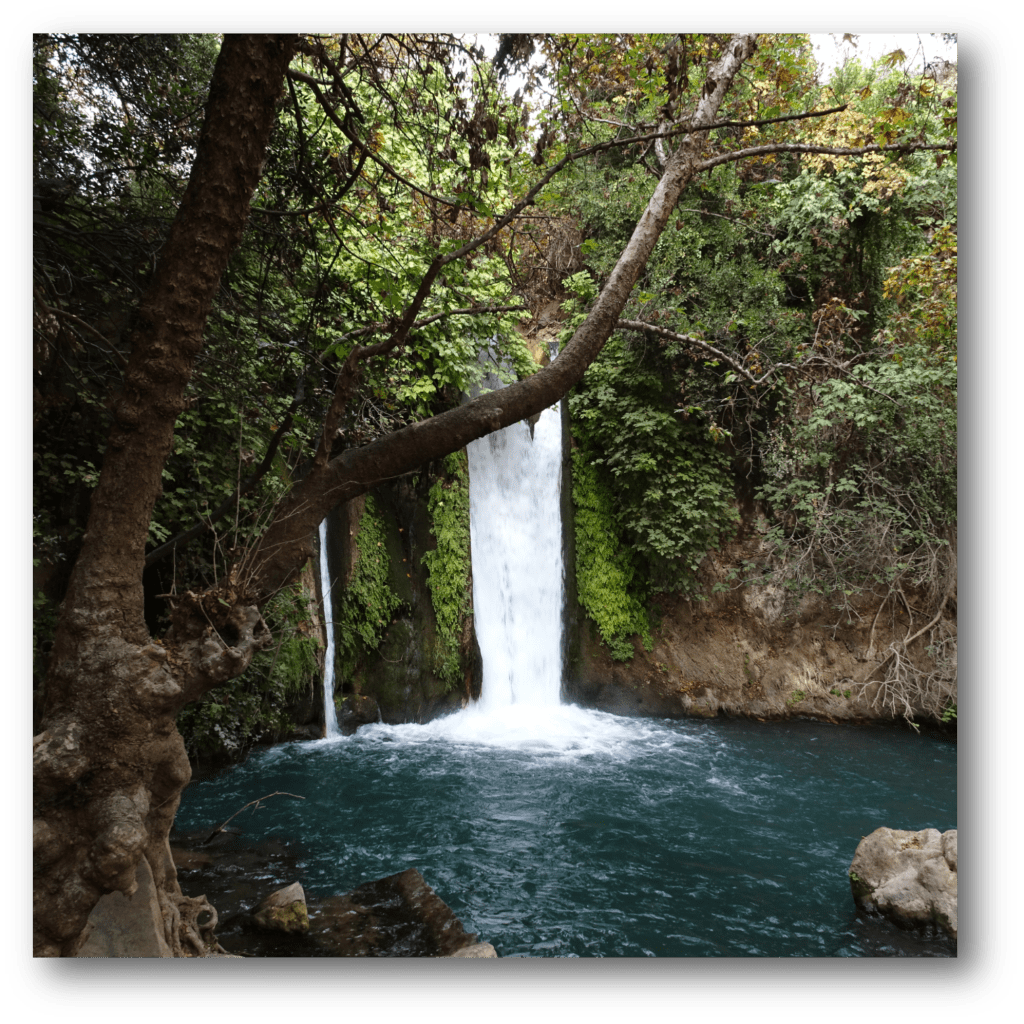
Photo credit: Today in the Bible
To see all of our posts regarding “Yeshua” (יֵשׁוּעַ – Jesus), click on the image below.

© 2026 Today in the Bible

 Today in the Bible
You must be logged in to post a comment.