Cheshvan 19, 5786; from sunset November 9, 2025, to sunset November 10, 2025
(The nineteenth day of the eighth month)
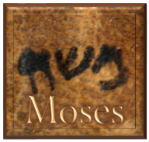
This is the name “Mosheh” (מֺשֶׁה – Moses) as seen in the Dead Sea Scrolls, written over two thousand years ago.
We’re checking in with the Israelites who are occupied with the construction of the Tabernacle which started about a month ago. Today we’ll learn about the curtains, posts, and hooks. Note the three underlined words and when we get to the end of the text, we’ll explain why.
And all the able men among the workmen made the tabernacle with ten curtains; they were made of fine twined linen and blue and purple and scarlet stuff, with cherubim skillfully worked. The length of each curtain was twenty-eight cubits, and the breadth of each curtain four cubits; all the curtains had the same measure. And he coupled five curtains to one another, and the other five curtains he coupled to one another.
And he made loops of blue on the edge of the outmost curtain of the first set; likewise he made them on the edge of the outmost curtain of the second set; he made fifty loops on the one curtain, and he made fifty loops on the edge of the curtain that was in the second set; the loops were opposite one another.
And he made fifty clasps of gold, and coupled the curtains one to the other with clasps; so the tabernacle was one whole.
He also made curtains of goats’ hair for a tent over the tabernacle; he made eleven curtains. The length of each curtain was thirty cubits, and the breadth of each curtain four cubits; the eleven curtains had the same measure. He coupled five curtains by themselves, and six curtains by themselves.
And he made fifty loops on the edge of the outmost curtain of the one set, and fifty loops on the edge of the other connecting curtain. And he made fifty clasps of bronze to couple the tent together that it might be one whole.
And he made for the tent a covering of tanned rams’ skins and goatskins. Then he made the upright frames for the tabernacle of acacia wood. Ten cubits was the length of a frame, and a cubit and a half the breadth of each frame. Each frame had two tenons, for fitting together; he did this for all the frames of the tabernacle. The frames for the tabernacle he made thus: twenty frames for the south side; and he made forty bases of silver under the twenty frames, two bases under one frame for its two tenons, and two bases under another frame for its two tenons.
And for the second side of the tabernacle, on the north side, he made twenty frames and their forty bases of silver, two bases under one frame and two bases under another frame.
And for the rear of the tabernacle westward he made six frames. And he made two frames for corners of the tabernacle in the rear. And they were separate beneath, but joined at the top, at the first ring; he made two of them thus, for the two corners. There were eight frames with their bases of silver: sixteen bases, under every frame two bases.
And he made bars of acacia wood, five for the frames of the one side of the tabernacle, and five bars for the frames of the other side of the tabernacle, and five bars for the frames of the tabernacle at the rear westward. And he made the middle bar to pass through from end to end halfway up the frames. And he overlaid the frames with gold, and made their rings of gold for holders for the bars, and overlaid the bars with gold.
And he made the veil of blue and purple and scarlet stuff and fine twined linen; with cherubim skillfully worked he made it.
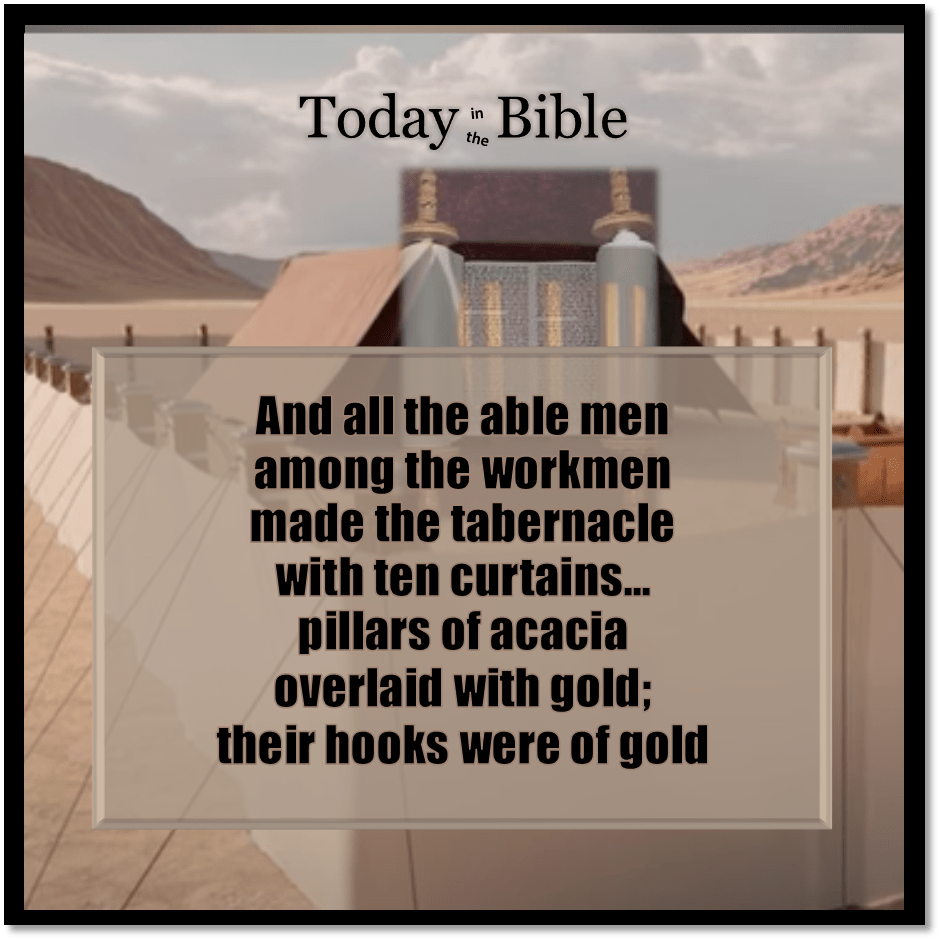
And for it he made four pillars of acacia, and overlaid them with gold; their hooks were of gold, and he cast for them four bases of silver.
He also made a screen for the door of the tent, of blue and purple and scarlet stuff and fine twined linen, embroidered with needlework; and its five pillars with their hooks. He overlaid their capitals, and their fillets were of gold, but their five bases were of bronze. – Exodus 36:8-38 (RSV)
That’s a lot of detail but let’s try to get a picture of this. There are columns which are connected to curtains via hooks. Big deal, right? Well, the scribes who write the Torah scrolls think so. The Tabernacle was designed to be a place for the God of Abraham, Isaac, and Jacob to dwell. The scribes designed the Torah scrolls in a similar manner…a place for the Word of God to dwell.
The word used for column (amud) is the same word that is used to describe a column of print. The word used for curtain (yeri’ah) is the same word used to describe a sheet of parchment. The word used for hook (vav) is the same as the letter vav in the Hebrew language. The Hebrew letters began as pictures, and in the picture language, the letter vav was a hook, peg, or nail. The letter vav is added to the beginning of a Hebrew word and is used to “hook” one word to another. Its function is the same as our word “and” in English. How many times do you read in the Bible, “And the LORD said to Moses…”? Each one of those “ands” is the letter vav.
Each Torah scroll has 245 precisely ruled columns, each one forty-two lines in length. There are no chapter or verse markings and no capitalization or punctuation to indicate the end of one sentence and the beginning of the next. The only indication that you have reached the end of a book is four blank lines that are left between the end of one book and the beginning of the next. In most Torah scrolls all of these columns (of print), except for five, begin with the letter “vav” – a hook – which connects them to the curtains (parchment); just as in the Tabernacle.
The Tabernacle contained the Dwelling Presence of God, so it is fitting that the Torah scroll, which contains the Word of God, is constructed in a like manner. Each scroll is made with great care and lovingkindness; we should handle it with love and respect too; and now when we hold a Bible, we can visualize the Tabernacle in our hands.
To read all of our posts on the building of the Tabernacle, click on the image above.
© 2026 Today in the Bible
 Today in the Bible
You must be logged in to post a comment.