
Adar 13, 5786; from sunset March 1, 2026, to sunset March 2, 2026
(The thirteenth day of the twelfth month)

The Battle Between Sisera and Barak
Today in the Bible we’re remembering the prophetess Deborah and her role in defeating Sisera, the commander of the Canaanite army of King Jabin of Hazor. The Bible doesn’t give us a firm date for these events, however scholars picked up on clues in the text which led them to believe the battle may have taken place in early spring. Today in the Bible, we’re reading Judges 4:10-24 where we find Deborah along with Barak and his men on Mount Tabor, ready to take on the well-armed chariot-fighters of the Canaanites.
The text tells us that Jabin’s army consisted of 900 chariots of iron. At the time, this was indicative of the world’s most powerful army. Only large city-states were capable of producing iron weaponry. Chariots were expensive to build and maintain. The Bible tells us that Sisera, the commander of Jabin’s army was stationed in Harosheth Hagoyim. Harosheth comes from a verb that means to craft, manufacture, or carve. Hagoyim means “the nations.” By its name, scholars infer that Harosheth Hagoyim was a center of military might – full of defense contractors, skilled craftsmen with the ability to fabric metal and keep the chariots in top working order.
Jabin reigned over the Jezreel Valley, a flat, fertile plain – perfect for chariots. It was a major trade route and whoever controlled this area was able to maintain power and wealth. Harosheth Hagoyim was likely located here, near the Kishon River which flowed through the valley. Sisera had spies in place (Heber the Kenite) to bring intelligence on the movements of the Israelites. With the resources and backing of Jabin, Sisera was almost undefeatable.
But Barak was no fool. He had stationed his men high upon Mount Tabor, which rises steeply from the plain of the Jezreel. A perfect vantage point to view the movement of Sisera’s troops. Chariots could not ascend it. Horses would be limited to a few narrow pathways. This gave the Israelites a place to lie in wait until Deborah gave the word.
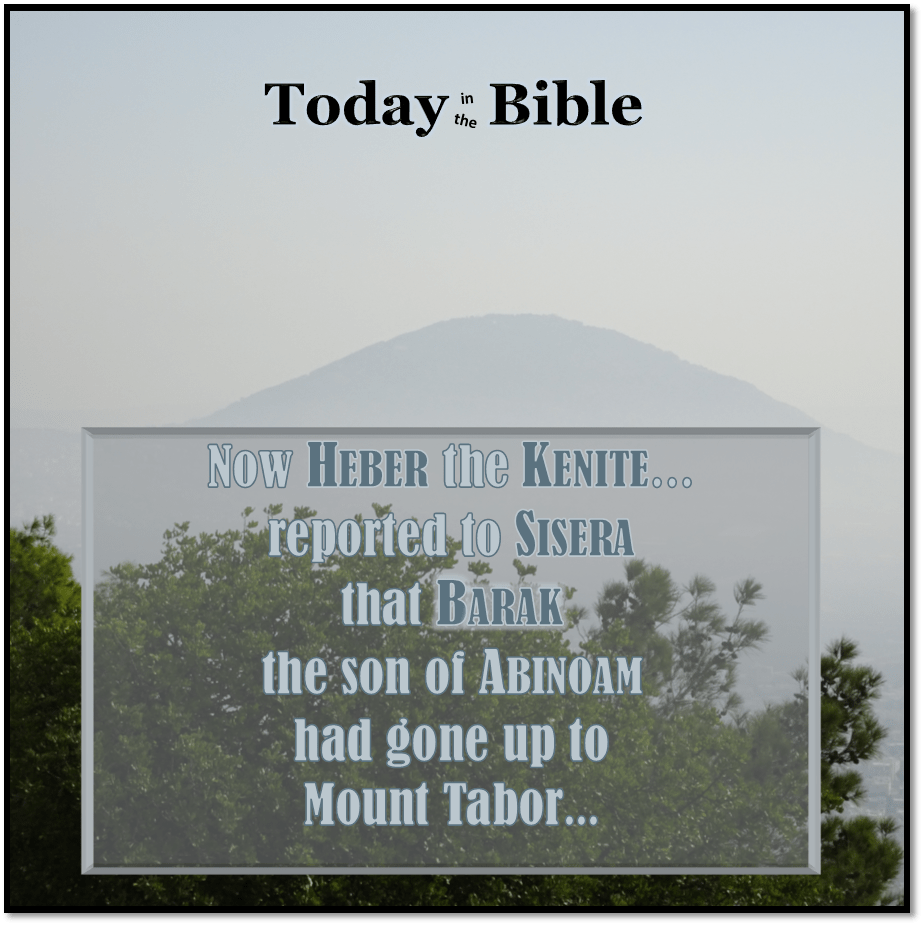
Now Heber the Kenite, of the children of Hobab the father-in-law of Moses, had separated himself from the Kenites and pitched his tent near the terebinth tree at Zaanaim, which is beside Kedesh. And they reported to Sisera that Barak the son of Abinoam had gone up to Mount Tabor.
So Sisera gathered together all his chariots, nine hundred chariots of iron, and all the people who were with him, from Harosheth Hagoyim to the River Kishon.
Up! For this is the day in which the LORD has delivered Sisera into your hand!
Then Deborah said to Barak, “Up! For this is the day in which the LORD has delivered Sisera into your hand. Has not the LORD gone out before you?” So Barak went down from Mount Tabor with ten thousand men following him. And the LORD routed Sisera and all his chariots and all his army with the edge of the sword before Barak; and Sisera alighted from his chariot and fled away on foot.
But Barak pursued the chariots and the army as far as Harosheth Hagoyim, and all the army of Sisera fell by the edge of the sword; not a man was left. However, Sisera had fled away on foot to the tent of Jael, the wife of Heber the Kenite; for there was peace between Jabin king of Hazor and the house of Heber the Kenite. And Jael went out to meet Sisera, and said to him, “Turn aside, my lord, turn aside to me; do not fear.” And when he had turned aside with her into the tent, she covered him with a blanket.
Then he said to her, “Please give me a little water to drink, for I am thirsty.” So she opened a jug of milk, gave him a drink, and covered him. And he said to her, “Stand at the door of the tent, and if any man comes and inquires of you, and says, ‘ Is there any man here?’ you shall say, ‘No.’”
Then Jael took a tent peg and a hammer and drove the peg into his temple
Then Jael, Heber’s wife, took a tent peg and took a hammer in her hand, and went softly to him and drove the peg into his temple, and it went down into the ground; for he was fast asleep and weary. So he died.
And then, as Barak pursued Sisera, Jael came out to meet him, and said to him, “Come, I will show you the man whom you seek.” And when he went into her tent, there lay Sisera, dead with the peg in his temple.
So on that day God subdued Jabin king of Canaan in the presence of the children of Israel. And the hand of the children of Israel grew stronger and stronger against Jabin king of Canaan, until they had destroyed Jabin king of Canaan. – Judges 4:11-24 (NKJ)
Jael went against her husband’s alliance with Sisera and drove a peg through his temple, causing his death. Was it self-preservation? Did she see that Sisera’s army had been destroyed and hoped to save herself by this act? Or did it disgust her that her husband’s family had turned their backs on the descendants of Moses? We can’t say for sure, but Deborah praises Jael for her righteous actions and calls her “blessed.” Deborah’s word to Barak, that there would be no glory for him– “the LORD will sell Sisera into the hand of a woman,” –certainly rang true.
In the Song of Deborah, we learn that a storm came up which produced the Kishon River to flash flood, causing the chariots to become stuck in the mud…and Sisera to leave his chariot and flee on foot. The name Kishon comes from a verb which means to lay bait or ensnare. It sounds like the river certainly lived up to its name on that day. Deborah read the signs in the sky and chose that day to go against Sisera…a bit of ancient weather forecasting…and the LORD followed through according to His Word. In our next post, we’ll remember the Song of Deborah.
Did you know that you can view any of our posts whenever you’d like?
Visit our home page at https://todayinthebible.com
where you can find them organized by month
in the “Archives” section on the right side of the page.

© 2026 Today in the Bible

 Today in the Bible
You must be logged in to post a comment.